
Atomic Energy
70th IAEA General Conference
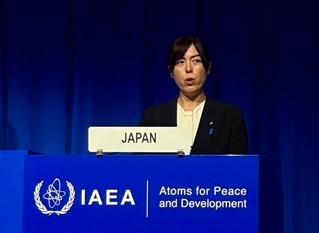
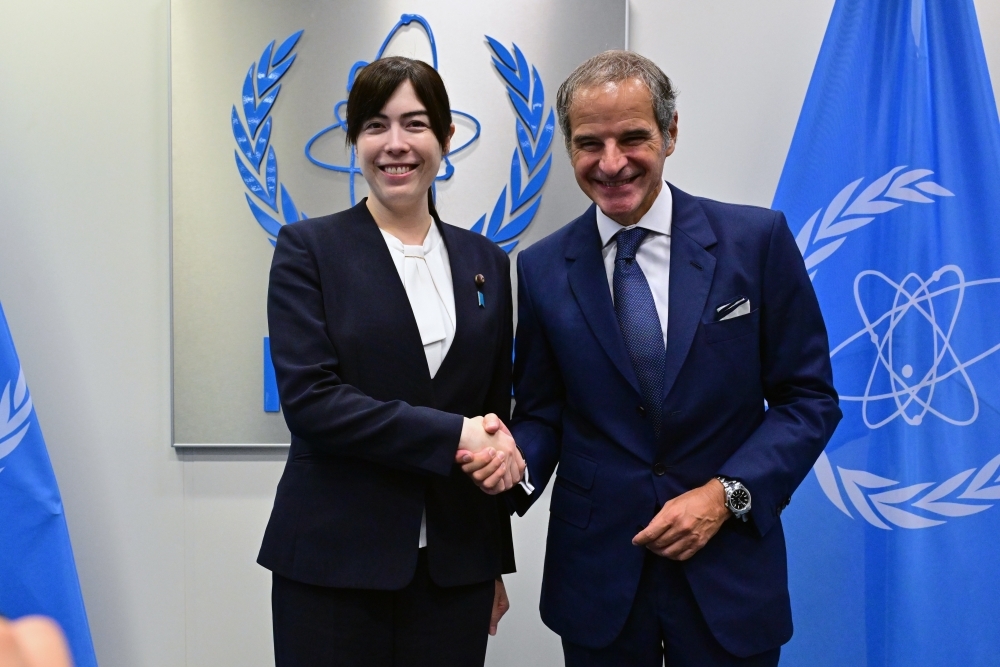
The 70th General Conference of the International Atomic Energy Agency (IAEA) was held in Vienna from September 14 to 18. The overview is as follows.
1. Statement by Minister of State Onoda
Ms. ONODA Kimi, Minister of State for Science and Technology Policy, attended the General Conference as the representative of the Government of Japan and delivered a national statement on September 14 (Japanese (PDF)  / English (PDF) ). In the national statement, Minister ONODA outlined Japan's commitment to promoting the peaceful uses of nuclear energy, ensuring the highest standards of nuclear safety, nuclear security, and safeguards, and addressing international challenges related to nuclear energy, through cooperation with the IAEA.
2. Major Agenda Items at the 70th General Conference
(1) Nuclear Issue of North Korea
A resolution “Implementation of the NPT safeguards agreement between the Agency and the Democratic People’s Republic of Korea” was adopted by a majority vote with the following main points:
- Strongly urging North Korea to take concrete steps toward the abandonment of all nuclear weapons and existing nuclear programs in a complete, verifiable, and irreversible manner, and to immediately cease all related activities.
- Underscoring the importance of all Member States fully fulfilling their obligations in accordance with relevant UN Security Council resolutions.
- Calling on North Korea to fully comply with its NPT obligations and to cooperate promptly with the implementation of IAEA safeguards.
Upon the adoption of this resolution, Japan, the United States, and the Republic of Korea issued a joint statement, affirming their unity in firm commitment to the complete denuclearization of the Korean Peninsula in line with UN Security Council resolutions. They also expressed that North Korea's nuclear and missile activities violate multiple the UN Security Council resolutions, and strongly urged North Korea to take concrete steps toward the complete abandonment of all nuclear weapons, existing nuclear programs, and ballistic missile programs. The three countries expressed serious concern over military cooperation between North Korea and Russia, and called upon all Member States to fully, comprehensively, and promptly implement the relevant the UN Security Council resolutions. Furthermore, they expressed gratitude and support for the IAEA Secretariat's continued efforts to strengthen its verification capabilities.
(2) Application of IAEA Safeguards in the Middle East
A resolution “Application of IAEA safeguards in the Middle East” was adopted by a majority vote with the following main point:
- Calling on all Member States in the Middle East region to accede to the NPT and to comply with their international obligations related to IAEA safeguards, and urging all relevant states to work toward the establishment of a nuclear-weapon-free zone in the region.
(3) Nuclear Safety, Nuclear Security, and Safeguards in Ukraine
A resolution “Nuclear safety, security and safeguards in Ukraine” was adopted by a majority vote with the following main points:
- Expressing concern that Russia has not heeded previous resolutions of the IAEA Board of Governors and General Conference to immediately cease all actions against and at nuclear facilities in Ukraine and to withdraw its military and other personnel from the Zaporizhzhia Nuclear Power Plant (ZNPP).
- In particular, calling for the urgent withdrawal of all unauthorized military and other personnel from the ZNPP and for the plant to be immediately returned to the Ukrainian authorities.
- Commending and supporting the IAEA's efforts to ensure nuclear safety in Ukraine, including the seven pillars and five principles outlined by the Director General.
(4) Resolutions on Technical Cooperation, Nuclear Safety, Nuclear Security, Nuclear Science, Technology and Applications, and Safeguards
As no consensus could be reached among Member States on any of the resolutions concerning
-Technical cooperation,
-Nuclear safety,
-Nuclear security,
-Nuclear science, technology and applications,
-Safeguards,
none of these resolutions were adopted. Instead, the validity of the previously adopted resolutions was reaffirmed (rolled over). The President of the General Conference issued a statement for these resolutions, indicating that discussion would begin at an early stage in order to achieve consensus at the next General Conference.
3. Bilateral Meetings with the IAEA and Representatives of Other Governments
Minister ONODA, as representative of Government of Japan, held bilateral meetings with Dr. Rafael Mariano Grossi, Director General of the IAEA, Mr. Barabaschi, Director General of ITER Organization, and Ms. Étiennble, Chairman of the French Alternative Energies and Atomic Energy Commission (CEA).
In a bilateral meeting with Director General Grossi, they exchanged views on the IAEA's continued involvement in the discharge of ALPS-treated water into the sea, as well as Japan's and the IAEA's efforts toward resolving the nuclear issues of North Korea and Iran.
In a bilateral meeting with ITER Director-General Barabaschi, Minister ONODA expressed her appreciation for the arrangement of site visit in ITER facility on September 12 and exchanged views on upcoming plans and initiatives for the ITER project.
In a bilateral meeting with CEA Chairman Étiennble, they exchanged views on bilateral nuclear cooperation between Japan and France, including fast reactor development and the nuclear fuel cycle.
4. Reception Hosted by the Japanese Government
Minister ONODA hosted a reception on behalf of the Government of Japan. At the reception, Minister ONODA and Mr. KAIFU Atsushi, Permanent Representative and Ambassador Extraordinary and Plenipotentiary of Japan to the International Organizations in Vienna, delivered remarks, and introduced the attractions of Japan including the food and tourism of the Tohoku region and Fukushima Prefecture — the safety of ALPS-treated water and removed soil, and Japan's efforts in the peaceful uses of nuclear energy, to attendees of representatives of various countries and international organizations. At the reception, food made with local agricultural products and Japanese sake from Fukushima Prefecture were also served.
5. Side Events
The Japanese Government took the opportunity of the IAEA General Conference to host a series of side events.
(1) Convention on Supplementary Compensation for Nuclear Damage (CSC) — Toward Building a Global Liability Regime
Co-hosted by Japan, the United States, and Canada, with the opening remarks delivered by Japan Atomic Energy Commission Chairperson UESAKA Mitsuru, this event highlighted the importance of the CSC in building a global nuclear liability regime, and introduced the amendment adopted in January 2026 to eliminate the obligation for all States with no nuclear reactors to contribute funds in cases where damage exceeds a certain amount following a nuclear incident. This amendment is expected to increase the number of Parties to the Convention, including States with no nuclear reactors, thereby further universalize the international nuclear liability regime. The side event contributed to better understanding among States, with a view to building momentum for the early entry into force of the CSC amendment and to expanding the number of CSC Contracting Parties.
(2) Human Resource Development in the Field of Nuclear Medicine
This side event was held with the aim of promoting the field of nuclear medicine to young healthcare professionals such as doctors and nurses, in order to address the shortage of human resources in the field, given the anticipated expansion of nuclear medicine treatments using radioisotopes such as Lutetium-177 and Actinium-225. Japan introduced its certification system of nuclear medicine specialist; the IAEA presented its educational programs; and Germany introduced initiatives including training for nuclear medicine specialists, other healthcare professionals, and medical personnel in nuclear disaster response. A panel discussion was then held on the importance of standardizing and harmonizing among human resource development programs.
(3) Decommissioning of TEPCO's Fukushima Daiichi Nuclear Power Station and Fukushima's Reconstruction
At this side event, it was highlighted that, fifteen years after the Great East Japan Earthquake, the decommissioning of TEPCO's Fukushima Daiichi Nuclear Power Station and the reconstruction of Fukushima are steadily progressing with the cooperation of local communities and the international community. Representatives from the Ministry of Economy, Trade and Industry (METI), Tokyo Electric Power Company (TEPCO), the Ministry of the Environment (MOE), and the Nuclear Regulation Authority (NRA) provided an overview of the progress of Fukushima's reconstruction, the current status of decommissioning at TEPCO's Fukushima Daiichi Nuclear Power Station, off-site environmental restoration efforts, the objectives and outcomes of accident investigation and analysis, and past and future radiation conditions on land and at sea. The IAEA shared its view that "the IAEA review is conducted with independence, impartiality, and transparency, against scientific and international safety standards, and through this review, the safety of the discharge has been confirmed," in connection with the discharge of ALPS-treated water into the sea. The IAEA also presented a report on the IAEA and expert on-site visit conducted in July of this year.
(4) Transfer of High-Assay Low-Enriched Uranium (HALEU) from Japan to the United States
This side event was co-hosted by the U.S. Department of Energy (DOE) and the National Nuclear Security Administration (NNSA) and Ministry of Education, Culture, Sports, Science and Technology (MEXT) and the Japan Atomic Energy Agency (JAEA). The event highlighted the successful transfer of HALEU from Japan to the United States earlier this year. It was noted that long-standing Japan-U.S. nuclear nonproliferation cooperation led to this achievement and this effort will support the future of nuclear energy in the United States. The importance of forthcoming efforts, including the conversion of the Kinki University reactor UTR-KINKI to low-enriched uranium fuel and the return of highly enriched uranium, were also discussed.
(5) Exhibition at the Japan Booth
At the Japan Booth, Japan presented the latest technological developments by the Japan Atomic Energy Agency (JAEA) and Japanese companies, and showcased content highlighting the progress of decommissioning at TEPCO's Fukushima Daiichi Nuclear Power Station. Japan also actively disseminated information to participants of the IAEA General Conference from around the world. In cooperation with the Reconstruction Agency, foods and beverages made from agricultural products in Fukushima were introduced to showcase the current status of Fukushima's reconstruction and the appeal of its tourism and food, promoting Fukushima’s progress toward reconstruction. For the food introduction, onigiri (rice balls) made with Fukushima-grown rice were served and enjoyed by many visitors, including Director General Grossi during his visit to the Japan Booth.
In addition to hosting the above events, JAEC Chairman UESAKA introduced good practices related to Japan's financial and international contributions to the "Rays of Hope" initiative at the IAEA-hosted Science Forum themed "Rays of Hope: Delivering on the Promise of Cancer Care." Regarding human resource contributions, he also highlighted Japan's support for human resource development aimed at fostering sustainable healthcare systems in countries around the world.