
Nuclear Disarmament and Non-Proliferation
Japan-Philippines Public-Private Forum on Export Control / Strategic Trade Management

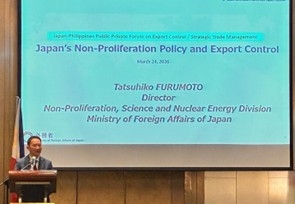
On March 24, 2026, the Japan-Philippines Public-Private Forum on Export Control / Strategic Trade Management was held in Manila, co-hosted by the Ministry of Foreign Affairs of Japan, the Department of Foreign Affairs of the Philippines, and the Department of Trade and Industry of the Philippines, with approximately 90 participants including business representatives and government officials from both countries.
1. Background and Objectives
Southeast Asian countries, including the Philippines, serve as major trading hubs for dual-use items with potential military applications, while also increasingly gaining presence as manufacturing bases for products utilizing sensitive technologies such as semiconductors. In a severe international security environment, the risk of illicit procurement via the southeast region is growing and the appropriate management of emerging technologies has become an urgent challenge.
In light of this background, this forum aimed to deepen understanding of export control with particular focus on emerging technologies, share best practices, and explore solutions to challenges through public-private dialogue, primarily targeting business representatives in the Philippines.
2. Overview
(1) Opening Remarks
Mr. YOKOTA Naobumi, Minister for Economic Affairs of the Embassy of Japan in the Philippines, stated that the holding of this forum is timely as the Philippines, serving as the 2026 ASEAN Chair, has placed Strategic Trade Management as one of its Priority Economic Deliverables. He expressed his expectation that cooperation between the two countries will be further deepened through active discussions at this forum and contribute to regional stability and prosperity, as this year marks the 70th anniversary of the normalization of diplomatic relations between Japan and the Philippines.
(2) Non-Proliferation Policies and Export Controls
Mr. FURUMOTO Tatsuhiko, Director for the Non-Proliferation, Science and Nuclear Energy Division of the Ministry of Foreign Affairs of Japan, explained Japan’s efforts and challenges in preventing the proliferation of weapons of mass destruction, the importance of public-private-academic collaboration in export control, and the need for cooperation with partner countries including the Philippines. The Department of Foreign Affairs of the Philippines presented its non-proliferation policy based on international frameworks such as treaties, and domestic measures for export control including the implementation of United Nations Security Council Resolution 1540. Furthermore, the Center for Information on Security Trade Control (CISTEC) of Japan explained its role as a bridge among industry, academia, and government regarding export control, including policy recommendations, corporate support, and international cooperation through seminars and dispatch of experts.
(3) Outreach on United Nations Security Council Resolution 1540
The United Nations Office for Disarmament Affairs (UNODA) explained the background and content of the United Nations Security Council Resolution 1540, which aims to prevent the proliferation of weapons of mass destruction to non-state actors, and the resolution’s position as complementing multilateral treaties related to non-proliferation. They also shared UNODA's support activities for promoting the implementation of the 1540 in Asian countries.
(4) Current Status and Challenges of Emerging Technology Control
The Ministry of Economy, Trade and Industry of Japan presented Japan's initiatives on emerging technology control, as well as recent policies to strengthen export controls on sensitive items and emerging technologies. The Department of Trade and Industry of the Philippines presented the Philippines' initiatives on emerging technology control, as well as the definition and characteristics of emerging technologies. Both emphasized that the involvement of industry and academia, inter-ministerial coordination, and international cooperation are crucial for effective control of emerging technologies. Furthermore, the Japan Institute of International Affairs (JIIA) explained the impact of emerging technologies on economic growth and security, and differences in approaches to emerging technology control between Japan and the Philippines, stressing that harmonizing different regulatory mechanisms among countries is essential for effective export control, including that of emerging technologies.
(5) Panel Discussion:Future Initiatives for Steady Implementation of Export Control and Appropriate Management of Technology through Public-Private Partnership — Corporate Needs, Challenges, and Solutions
A corporate participant (a Philippine subsidiary of a Japanese company) presented best practices and challenges in export control at their company. They explained that it is important to clarify the relevant regulations through proactive communication with the government or regulatory authorities, and have close coordination with the export control department of the parent company in Japan. They also shared the needs of companies to the government, including the formulation of clear practical guidelines, development of more comprehensive practical resources such as checklists and training materials, and early involvement of industry in policymaking. CISTEC also presented best practices for Internal Compliance Programs (ICP) developed by companies. Based on these presentations, discussions were held with export control officials from both the Japanese and Philippine governments, and active Q&A sessions were conducted with participants in the audience, confirming the importance of public-private collaboration and the need for continuous dialogue.
(6) Closing Remarks
The Department of Trade and Industry of the Philippines expressed gratitude for the meaningful discussions on three themes: the export control systems and initiatives of both Japan and the Philippines, United Nations Security Council Resolution 1540, and various initiatives regarding emerging technologies. They said that public-private collaboration is essential for effective export control, and that it is necessary to strengthen export control efforts by deepening coordination between the government and private companies in response to technological advances and changes in the security environment.