
Japan-India Relations
Japan-India Leaders’ Meeting and Luncheon
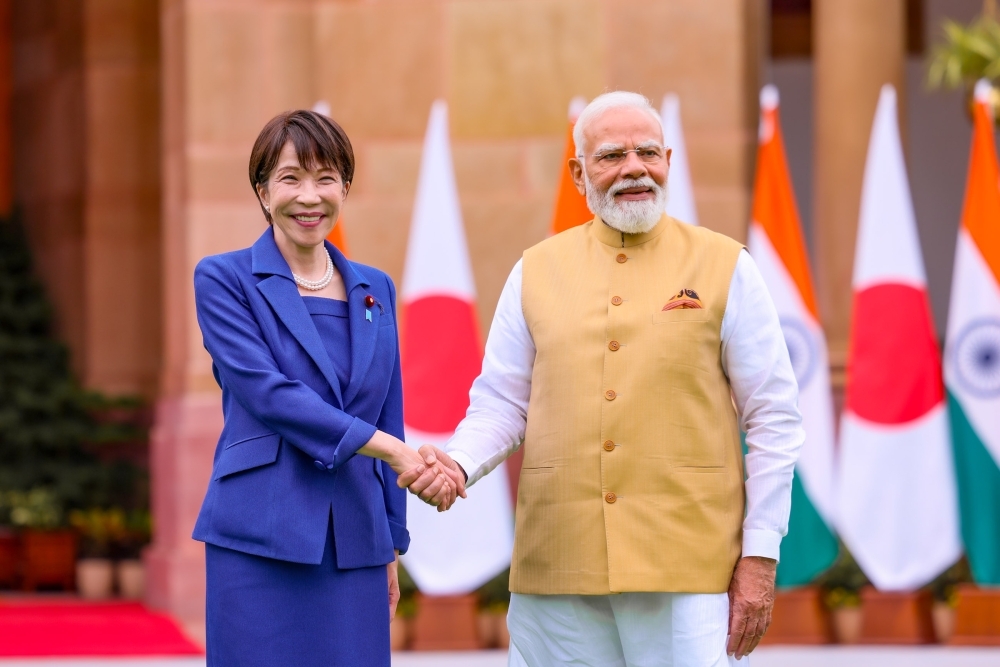 (Photo: Cabinet Public Affairs Office)
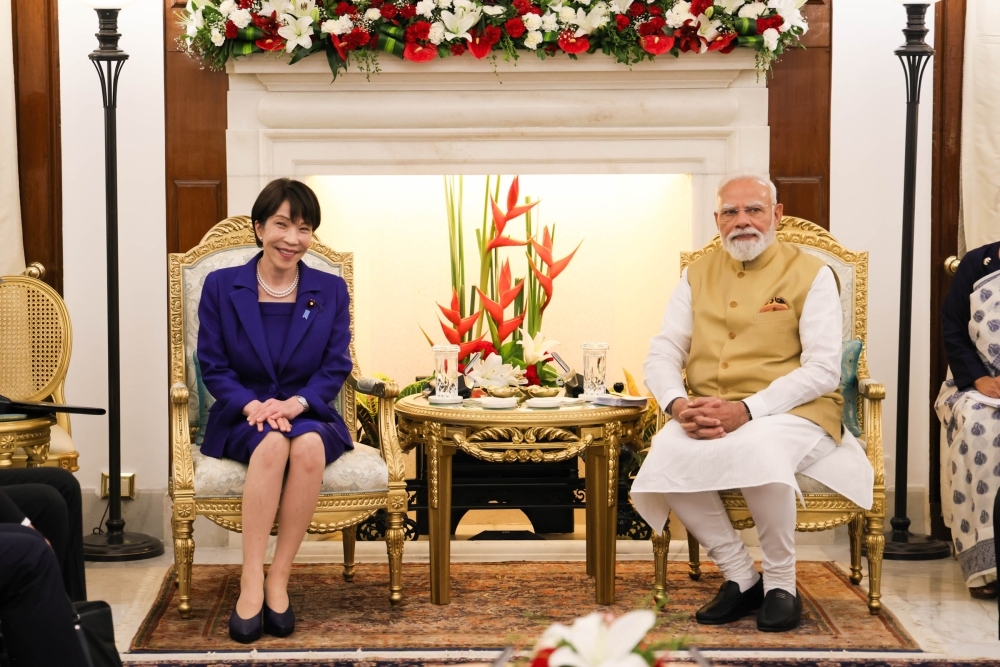 (Photo: Cabinet Public Affairs Office)
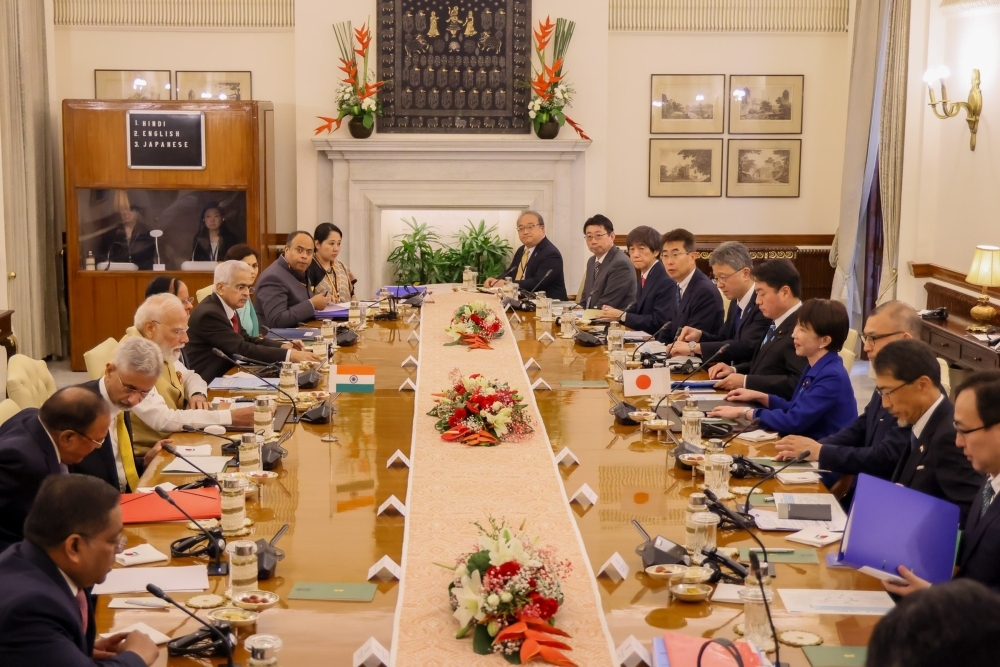 (Photo: Cabinet Public Affairs Office)
On July 2, commencing at 11:30 a.m. local time (03:00 p.m. on July 2, Japan time) for approximately 90 minutes, Ms. TAKAICHI Sanae, Prime Minister of Japan, held a leaders’ meeting with H.E. Mr. Narendra Modi, Prime Minister of India, during her visit to Delhi, India. (The small-group meeting commenced at 11:30 a.m. and lasted for approximately 60 minutes; the plenary meeting commenced at 12:35 p.m. and lasted for approximately 30 minutes).
After the meeting, the two leaders announced outcome documents such as the "Japan-India Annual Summit Joint Statement," the "Japan-India Joint Declaration on Economic Security Cooperation," and the "Japan-India Joint Statement on cooperation in the field of artificial intelligence (AI)," and held a joint press conference, and afterwards, participated in a luncheon.
1. Opening Remarks
- Prime Minister Modi welcomed Prime Minister TAKAICHI's visit to India and stated that he would like to further develop bilateral relations together with Prime Minister TAKAICHI under the "Special Strategic and Global Partnership."
- In response, Prime Minister TAKAICHI expressed her gratitude for India's welcome and stated that she would like to advance Japan-India relations to a new stage with Prime Minister Modi.
2. Regional Affairs
- The two leaders confirmed that the Updated "Free and Open Indo-Pacific (FOIP)," which Prime Minister TAKAICHI promotes, and "MAHASAGAR," which Prime Minister Modi promotes are aligned in their objective of fostering the Indo-Pacific as a prosperous sea enjoying freedom and prosperity and concurred to deepen their strategic cooperation toward achieving common goals.
- The two leaders exchanged views on the situation in the Indo-Pacific region, including various issues surrounding China, and responses to North Korea, such as nuclear and missile issues and the abduction issue. They also exchanged views on the situation in the Middle East and concurred to continue deepening our strategic cooperation to promote stability throughout the Middle East, including the assurance of free and safe navigation in the Strait of Hormuz in a lasting manner.
3. Bilateral Relations
- The two leaders concurred to further cooperate in the security field based on the "Joint Declaration on Security Cooperation between Japan and India" revised last year. They also stated that cooperation would be promoted, including deepening training in the Indian Ocean, promoting naval vassel maintenance cooperation and also defense equipment and technology cooperation based on “Make in India,” welcoming the progress on the transfer of the Unified Complex Radio Antenna “UNICORN.” To deepen such cooperation, the two leaders instructed relevant departments to hold discussions and the next Japan-India "2+2" within this year.
- The two leaders welcomed the issuance of “Japan-India Joint Declarationon on Economic Security Cooperation” to translate into concrete actions between the public and private sectors, with the understanding that various challenges surrounding economic security in recent years is a priority for strategic cooperation between the two countries. The two leaders also concurred to launch a bilateral dialogue under "POWERR Asia" towards India's petroleum and oil reserve in the field of energy security. Prime Minister TAKAICHI stated that Japan would support India's participation in the International Energy Agency (IEA) while placing importance on India's role in stabilizing the international energy market going forward. Prime Minister TAKAICHI also mentioned India's goal of developing 1,000 biogas plants and the two leaders concurred to launch a new initiative between the two countries, the "Japan-India CBG (Cooperative Biogas for Growth Initiative) Initiative."
- Regarding the economic sector, the two leaders welcomed the announcement of a joint statement on cooperation in the field of AI, including joint research and development of large language models (LLMs) and responses to frontier AI, and concurred on promoting innovation collaboration, and expand the scope of cooperation through Japanese companies' expansion to India, including in such advanced technology fields, and the promotion of industry-government-academia collaboration. Regarding the Mumbai-Ahmedabad High-Speed Rail, a flagship project between Japan and India, they concurred on continuing cooperation for the introduction of Japan's state-of-the-art E10 series Shinkansen. Furthermore, they welcomed the announcement of a Memorandum of Coopeartion on the Next Generation Mobility Partnership.
- The two leaders welcomed the deepening of the bilateral economic relationship, noting that investment commitments totaling 2 trillion yen have already been made since setting the 10 trillion yen private investment target for India last year, and that over 150 Japanese companies participated in Prime Minister TAKAICHI’s visit to India, and that approximately 120 cooperation documents were announced at this time. Prime Minister TAKAICHI stated that improving the business environment is crucial for further private investment and trade promotion, and requested India's efforts in this regard led by Prime Minister Modi. The two leaders confirmed that they would explore ways the Japan-India Comprehensive Economic Partnership Agreement (CEPA) would remain consistent with Japan-India economic relations.
- The two leaders concurred to promote concrete initiatives in people-to-people exchanges and inter-local government cooperation which serves as the faoundation of aforementioned efforts, including the "LOTUS Program" which promotes top-level Japan-India joint research. They also concurred to deepen exchanges between the two countries, noting that next year (2027) will be a milestone year marking the 75th anniversary of the establishment of diplomatic relations between Japan and India.
(Reference) Attachments
- 16th Japan-India Annual Summit Joint Statement (Japanese (PDF)
 / English (PDF))
 - Japan-India Joint Declaration on Economic Security Cooperation (Japanese (PDF) / English (PDF))
- Japan-India Joint Statement on cooperation in the field of artificial intelligence (AI) (Japanese (PDF) / English (PDF))
- Joint Statement on Energy Resilience (Japanese (PDF) / English (PDF))
- List of memoranda and other documents exchanged between Japan and India on this occasion (Japanese (PDF))
- List of memoranda between Japanese and Indian companies and other organizations on this occasion (Japanese (PDF))