
Press Releases
The 2nd OECD-Southeast Asia Policy Roundtable on Economic Security (Results)
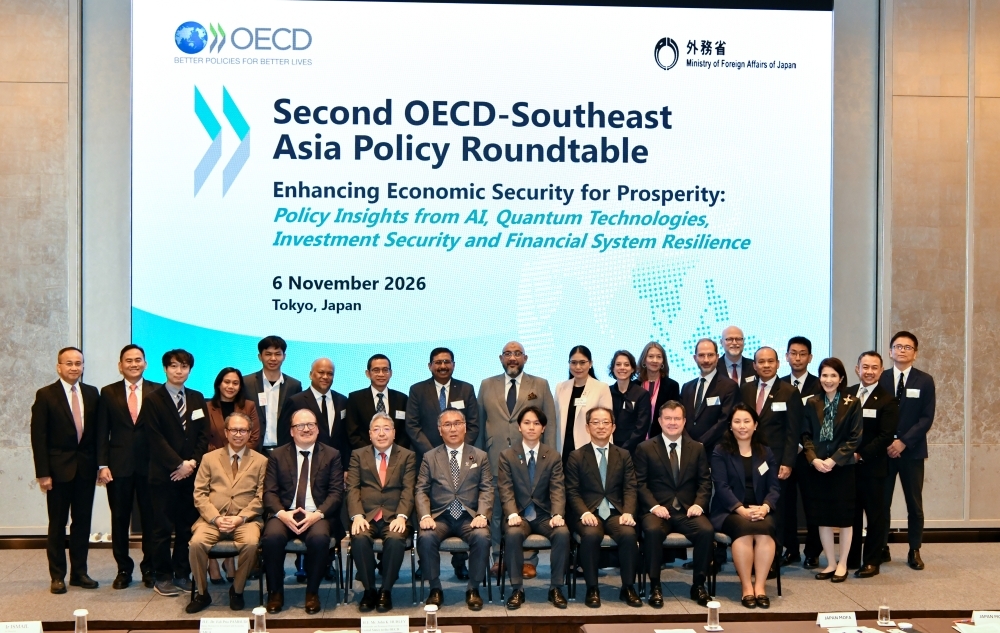 (Photo: OECD)
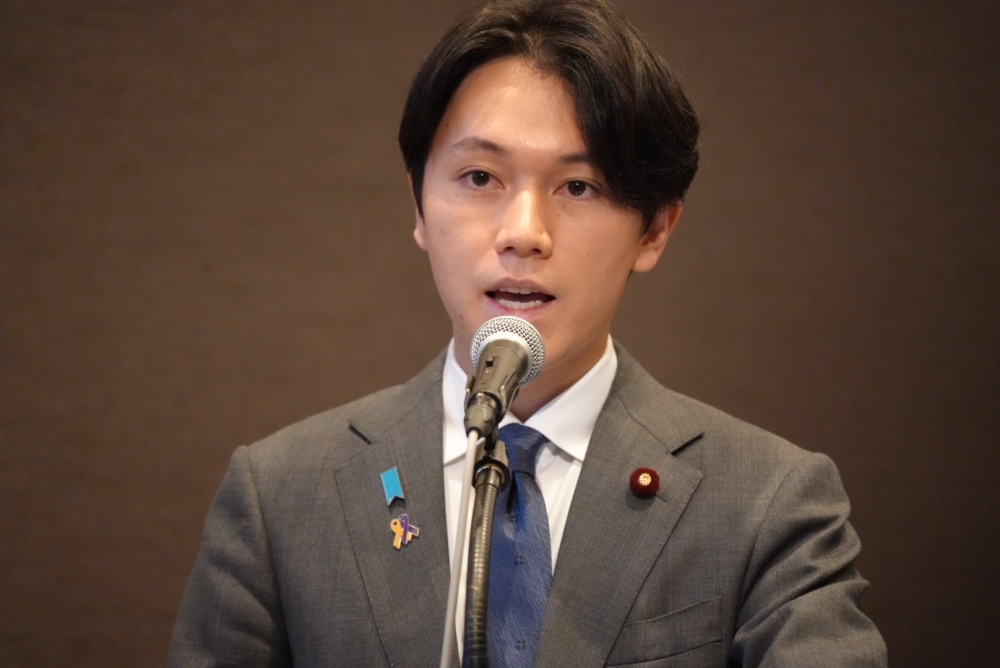
On November 6, the "Second OECD-Southeast Asia Policy Roundtable on Economic Security" was held in Tokyo, co-hosted by the Ministry of Foreign Affairs of Japan and the OECD Tokyo Office. Mr. OZORA Koki, Parliamentary Vice-Minister for Foreign Affairs, attended the Roundtable and delivered the opening remarks.
1. Overview
This Policy Roundtable was held as a core initiative under the "Japan-OECD Cooperation Plan on Economic Security", based on the outcomes of the first "OECD-Southeast Asia Policy Dialogue" , which took place in Tokyo in February this year (focused on shipbuilding, steel, and AI). The Cooperation Plan was issued between the Government of Japan and the OECD in May this year and was welcomed by Prime Minister TAKAICHI Sanae.
At this dialogue, welcoming high-level government officials and practitioners from Southeast Asian countries—the growth center of the global economy—to Tokyo, participants engaged in advanced and concrete discussions on AI, quantum technology, investment including responsible business conduct (RBC)and resilience in financial systems. Based on the OECD's objective, evidence- and data-driven analyses as well as its rules and standards, the discussions focused on how to secure economic security, strengthen economic resilience, and address potential vulnerabilities arising from strategic dependencies, while maintaining an open and predictable environment amid geopolitical tensions and risks of supply chain disruptions.
From the OECD, Mr. MASAKI Yasushi, Deputy Secretary-General, delivered a keynote speech. In addition, Mr. Andreas Schaal, Director of the Directorate for Global Relations and Cooperation, Ms. Audrey Plonk, Deputy Director of the Directorate for Science, Technology and Innovation, and Mr. Antonio Gomes, Deputy Director of the Directorate for Financial and Enterprise Affairs, participated and led the discussions.
From Japan, in addition to the opening remarks by Parliamentary Vice-Minister Ozora, representatives from relevant departments of the Cabinet Office, the Ministry of Foreign Affairs, the Ministry of Finance, and the Financial Services Agency attended and contributed to the discussions. In the closing session, Mr. ANDO Toshihide, Ambassador Extraordinary and Plenipotentiary, Permanent Representative of Japan to the OECD, provided a summary and closing remarks. Along with the in-person participation of high-level government officials and practitioners from Southeast Asian countries, H.E. Mr. John K. Hurley, Ambassador and Permanent Representative of the U.S. to the OECD, and Ms. Tsering Dhongthog, Deputy Assistant Secretary for Trade Policy and Negotiations, visited Japan from the United States and contributed to the discussions. There was also active participation from embassies of other OECD member countries and Southeast Asian countries in Tokyo, and Member of the House of Representatives Tadahiko Ito (Secretary-General of the Liberal Democratic Party League for the OECD) also attended.
On each theme, participants shared their understanding based on objective evidence, and confirmed to reflect the actual situations and policy insights of Southeast Asia in future OECD discussions, and to further strengthen cooperative relations. They also confirmed that this dialogue will continue to be held next year, aiming to further deepen discussions on pressing policy challenges and establish the dialogue as a major forum for economic security.
2. Opening Remarks by Parliamentary Vice-Minister for Foreign Affairs OZORA
Parliamentary Vice-Minister OZORA emphasized that amidst rising geopolitical tensions and apparent non-market policies and practices, and supply chain vulnerabilities, ensuring economic security is an urgent challenge in maintaining a rules-based, free and fair international economic order. He stressed the importance of cooperation between the OECD and Southeast Asian countries to address these challenges.
He further stated that Japan would contribute to ensuring regional economic security by strengthening cooperation with the OECD and Southeast Asian countries in preparation for upcoming international conferences on investment, hosting online workshops on quantum technology, and contributing to the third in-person meeting to be held in Indonesia next February under the “OECD-Southeast Asia AI Dialogue”. He also shared serious concerns regarding North Korea’s illicit revenue generation through malicious cyber-related activities—including the theft of cryptocurrencies and foreign currency earnings generated by IT workers—and expressed hope for active discussions aimed at strengthening the cyber resilience of the financial system.
Furthermore, pointing out the importance of the role of the OECD Tokyo Office as a hub for outreach to Southeast Asia, he expressed his hopes for the prosperity of the entire region through this dialogue.
3. Summary of Main Outcomes
The dialogue shared assessments of the current situation and provided guidelines for future efforts.
- Visualization of structural dependencies through new data analysis indicators (ICIO/TiVA)
Deputy Secretary-General Masaki presented a new analytical method using the OECD's latest Inter-Country Input-Output (ICIO)tables and Trade in Value Added (TiVA) database and to visualize the flow of value added and structural dependencies spreading through third countries. Based on objective and scientific data, participants deepened their shared understanding of potential vulnerabilities in global value chains that could not be fully captured by conventional bilateral trade statistics. - Importance of the "More, Better, and Safe (MBS)" investment approach, Responsible Business Conduct (RBC), and cooperation for resilient critical minerals supply chains.
Based on the " OECD Review of Investment Policies in ASEAN", participants confirmed the importance of and ways to advance the "MBS approach"— which aims to mobilise high-quality foreign direct investment (FDI) managing security-related risks while maintaining openness. They also discussed the role of promoting Responsible Business Conduct (RBC) standards in critical mineral supply chains and the value of the technical workshops in Indonesia and Thailand co-hosted by the UK and the OECD in May this year, confirming the importance of continuing practical peer learning on investment screening in Southeast Asian countries. Furthermore, they confirmed close cooperation among the OECD, OECD member countries including Japan, and Southeast Asian countries toward the "OECD High-Level Investment Meeting: 50 Years of International Co-operation on Investment at the OECD" in December this year, and the "Conference on Investment and National Security" in April 2027. - Online workshop for building a quantum ecosystem
In light of the "OECD Recommendation on Quantum Technologies" adopted this year, participants discussed approaches to support responsible technology development and application, while maintaining openness and international cooperation that support scientific research and innovation. Furthermore, they confirmed to newly hold an "OECD Online Workshop for Southeast Asian Countries" in March 2027 involving policymakers, researchers, and industry representatives from Southeast Asian countries to identify common priority issues and challenges between the OECD and Southeast Asia regarding technology access, supply chains, and human resource development in the quantum field. - AI policy and further cooperation under the " OECD-Southeast Asia AI Dialogue "
Participants discussed approaches to trustworthy AI systems, and the conditions for establishing the necessary environment to expand access to AI infrastructure and capabilities, enhance resilience, and support the development and adoption of AI throughout the region. They also confirmed the importance of utilizing global frameworks, including the OECD AI Policy Toolkit and the Hiroshima AI Process (HAIP) reporting framework. Furthermore, they confirmed to hold the third in-person meeting in February 2027 in Indonesia under the " OECD-Southeast Asia AI Dialogue " to further discuss themes such as AI safety, including incident reporting, and the role of AI in the manufacturing sector. - Strengthening resilience against cyber risks in the financial system and protecting Small and Medium-sized Enterprises (SMEs)
Participants deepened discussions on systemic risks and challenges posed to financial infrastructure and interconnected supply chains by malicious cyber activities, including cryptocurrency theft and activities by IT workers from North Korea. They also discussed the spillover risks to the overall financial system arising from the vulnerabilities of SMEs in Southeast Asian countries embedded in global value chains. Furthermore, recognizing that increasingly sophisticated, advanced AI models could increase cyber risks for financial institutions, they discussed the importance of strengthening cyber resilience through cooperation among financial institutions, technology providers, and supervisory authorities.
