
Press Conferences
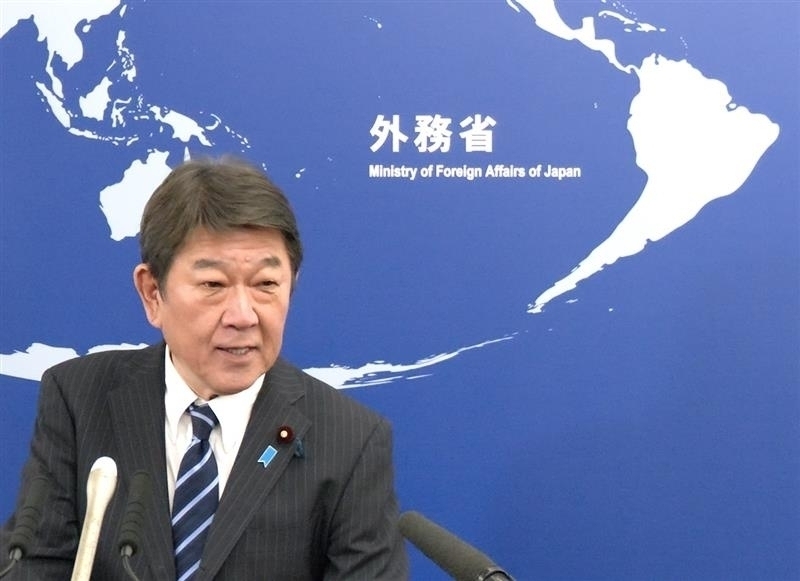
Press Conference by Foreign Minister MOTEGI Toshimitsu
Friday, November 6, 2026, 5:55 p.m. Ministry of Foreign Affairs
Japanese
Opening Remarks
(1) Japan-U.S. Consultations on Measures to Prevent Incidents
Foreign Minister MOTEGI Toshimitsu: I would like to make two announcements at the outset.
The first concerns measures to prevent incidents involving U.S. military personnel. Following the robbery-murder incident that occurred in Okinawa Prefecture on October 3, Japan and the U.S. have been holding consultations on effective measures to prevent a recurrence. While the consultations are still ongoing, I would like to explain what Japan and the U.S. have agreed upon at this stage.
The first point concerns the enhancement of education. The education programs for U.S. military personnel in Okinawa will be enhanced, with the involvement of the Government of Japan. This was also requested by Governor KOJA of Okinawa Prefecture.
Specifically, the “Okinawa Orientation Overview,” which is used in briefings for U.S. military personnel newly assigned to Okinawa, will be updated to incorporate the views of the Okinawa Prefectural Government, and will be utilized across all U.S. forces in Okinawa.
Furthermore, in addition to briefings by the Prefectural Police, the Ministry of Foreign Affairs’ Ambassador in charge of Okinawan Affairs will newly conduct briefings for the U.S. military personnel in Okinawa at an early date, to thoroughly raise their awareness of the importance of understanding by the local community regarding the stationing of U.S. Forces Japan, as well as Japan’s legal system.
In addition, starting next fiscal year, the “Okinawa Orientation Program” will be newly launched, to help U.S. military personnel in Okinawa deepen their understanding of Okinawa’s culture, history and relations with the local community, to support them in becoming “good neighbors.”
The second point concerns patrols. We have decided to strengthen Japan-U.S. joint patrols. We will expand the areas and increase the frequency of patrols, and intend to work out the details between Japan and the U.S. in close coordination with local governments and other relevant parties.
The third point concerns the Liberty Policy. The U.S. side will continue to review the liberty policy even after the “period of reflection” ends on Sunday, November 8.
In any case, what is important is how we take effective measures to prevent incidents from occurring, and we intend to continue consultations between Japan and the U.S.
(2) Foreign Minister MOTEGI’s Attendance at the G7 Foreign Ministers’ Meeting (France)
Foreign Minister MOTEGI: My second announcement concerns my overseas visit. From Sunday, November 8 to Wednesday, November 11, I will visit France, to attend the G7 Foreign Ministers’ Meeting. Although the venue was originally Marseille, it has been changed to Paris, so I am going there.
At this meeting, I plan to hold discussions with the foreign ministers of the G7 countries, focusing mainly on four themes: first, how to secure and restore stability in the Middle East; second, the future support for Ukraine; third, regional affairs, including in the Indo-Pacific; and fourth, international cooperation in response to cyberattacks, as well as addressing various AI-related challenges. In addition, while final arrangements are currently being made, I also intend to hold bilateral meetings, and I would like to take this opportunity to further deepen cooperation with each country.
This concludes my opening remarks.
Japan-China Relations
Sankei Shimbun, NAGAHARA: One year has passed since Prime Minister TAKAICHI stated, with regard to a Taiwan contingency, that it could constitute a survival-threatening situation in which the right of collective self-defense may be exercised. China has used this statement to intensify its criticism of Japan for “new militarism.” I would like to ask once again about the Government of Japan’s view on this criticism, and how it has addressed China’s propaganda warfare against Japan in the international community. In addition, given that an improvement in relations with China does not appear likely, I would like to ask your thoughts on how Japan intends to maintain supply chains for critical minerals and other resources?
Foreign Minister MOTEGI: While it is true that Japan-China relations are currently in a difficult situation, I believe it is an indisputable fact that Japan and China bear a significant responsibility for the peace and stability in the region.
Precisely because there are issues and concerns, we believe it is important to maintain communication between our two nations at various levels.
Under this policy, Japan intends to advance dialogue to protect its national interests and build a constructive and stable bilateral relationship.
On that basis, as you pointed out, we have firmly countered China’s factually incorrect claims regarding Japan’s policies and positions, and we intend to continue explaining our positions and views to the international community in an appropriate and timely manner.
Furthermore, we have discussed supply chains, including those for critical minerals, at various international conferences as well as in bilateral meetings, and are currently working steadily to enhance their resilience, leveraging frameworks with like-minded countries.
In cooperation with like-minded countries and through an all-Japan effort, we intend to accelerate efforts to secure alternative supply sources, including cooperation on mine development and refining facilities. We are currently advancing preparations to this end through multiple channels, and aim to build resilient supply chains as quickly as possible through an all-Japan effort that involves the private sector, as well as through cooperation with like-minded countries.
Okinawa Policy Council and the Robbery-Murder Incident Involving a U.S. Military Service Member
Okinawa Times, MATSUDA: This morning, the Okinawa Policy Council, which discusses the promotion and development of Okinawa and the reduction of the burden of hosting U.S. bases, was held for the first time in 13 years. As you were also in attendance, could you please share the remarks you made during the meeting, as well as your views on the measures to reduce the base-hosting burden requested by Governor KOJA Genta? Furthermore, regarding the 30-day nighttime curfew implemented by the U.S. forces in Okinawa, Lt. Gen. Benjamin Watson, the top U.S. commander in the region, announced a one-month extension of the measure for service members below a certain rank. All military personnel will also be prohibited from purchasing or consuming alcohol outside their primary residence at night. I would like to ask for your views on these measures, including the extension. Additionally, could you please tell us whether this decision was announced as a result of the Japan-U.S. consultations that have been ongoing at the senior working level?
Foreign Minister MOTEGI: Today, the Okinawa Policy Council was held, and Governor KOJA presented ten requests on mitigating the impact of U.S. military bases. In response, I stated that I take very seriously the heavy burden borne by the people of Okinawa, and that MOFA will also make every effort to mitigate the impact on the local community.
Taking into account the requests we received today, we will continue to work toward reducing the burden of U.S. military bases in Okinawa.
As for the rest of your question, it is as I stated earlier in my opening remarks.