
Press Conferences
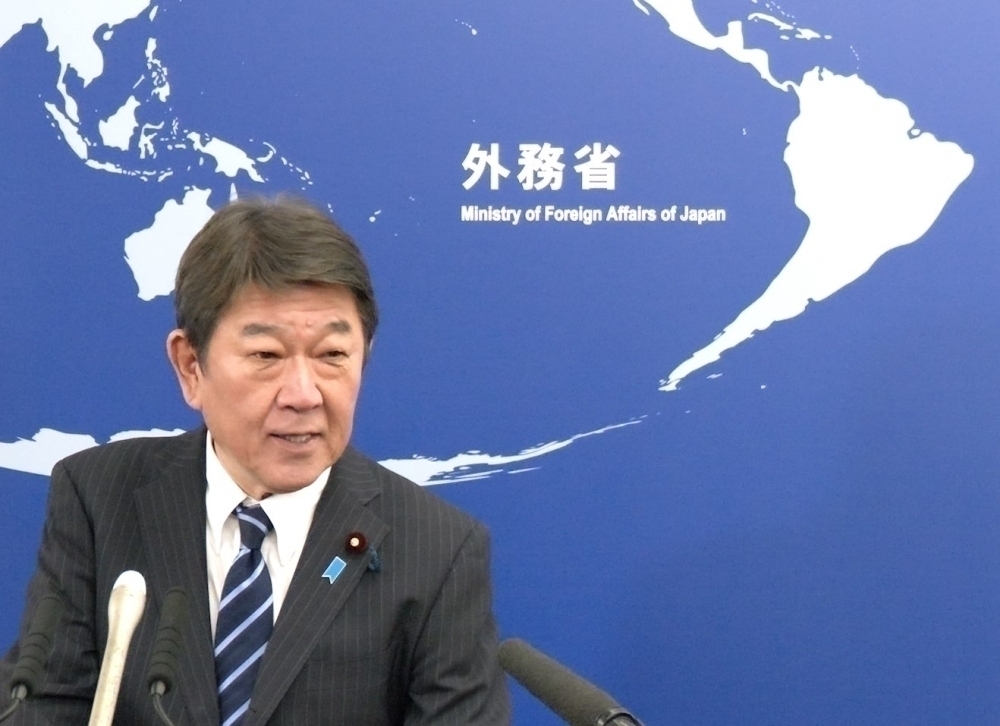
Press Conference by Foreign Minister MOTEGI Toshimitsu
Friday, September 18, 2026, 1:51 p.m. Ministry of Foreign Affairs
Japanese
Opening Remarks
(1) Thoughts on Reappointment as Foreign Minister
Foreign Minister MOTEGI Toshimitsu: I have been reappointed as Minister for Foreign Affairs. I look forward to continuing to work with you.
It has been 11 months since I assumed office as Foreign Minister last October. During this period, I made 14 overseas visits to a total of 28 countries and regions, and held approximately 200 meetings with foreign ministers of various countries.
The world today is undergoing the most significant structural changes since the end of World War II—driven by shifts in the balance of power, the intensification of conflicts and confrontations, and rapid technological innovation, notably artificial intelligence (AI). The security environment surrounding Japan is also becoming increasingly severe. In order to ensure the security and prosperity of Japan, I intend to implement our national security policy in an even more strategic and systematic manner.
At the same time, amid such severe international circumstances, through my diplomatic activities to date, such as overseas visits and meetings with foreign ministers, I have come to realize once again that it is precisely because of these difficult circumstances that expectations toward Japan are growing.
In order to live up to such expectations, Japan will further press forward with efforts to maintain and strengthen a free and open international order based on the rule of law and fulfill a more proactive role in the peaceful settlement of disputes, including peace mediation.
I will continue to vigorously promote Japan’s foreign policy, including an updated Free and Open Indo-Pacific (FOIP), further strengthen the Japan-U.S. Alliance, and expand the areas of cooperation between Japan and the U.S.
In addition, I will work to strengthen cooperation with like-minded countries and partners in areas such as enhancing supply chain resilience, while also working to strengthen relations with the countries of the Global South, through cooperation and coordination with Asian countries based on POWERR Asia, as well as through the strategic use of Official Development Assistance (ODA).
Through the efforts I mentioned, I am determined to take the lead in conducting “diplomacy that combines inclusiveness and strength.”
(2) Attendance at the 81st Session of the United Nations (UN) General Assembly
Foreign Minister MOTEGI: I have one more announcement about my overseas visit.
I will visit New York from the day after tomorrow, Sunday, September 20, to Thursday, September 24, to attend the UN General Assembly session.
This year marks the 70th anniversary of Japan’s admission to the UN. In this milestone year, I will reiterate to the world Japan’s commitment to multilateralism and strongly emphasize Japan’s intention to fully play its role in the UN, a one-of-a-kind, universal, and diverse forum.
In addition, I hope to make the most of this opportunity by having bilateral foreign ministers’ meetings and various multilateral meetings, to articulate Japan’s positions and initiatives regarding issues facing the international community, including regional and international affairs and global challenges, and to further strengthen coordination with the international community.
This concludes my opening remarks.
Japan’s Positions at the UN General Assembly Session
Kyodo News, ONDA: I would like to ask about the UN. In relation to your earlier remarks, UN Secretary-General Guterres, during his press conference at this year’s UN General Assembly session, called for upholding the UN Charter, defending international law, and protecting human rights, and stated that at this crucial moment in the Middle East, de-escalation is the top priority. Amid an intensifying international situation, what issues are important for Japan and what kind of positions will Japan express?
Foreign Minister MOTEGI: As I stated in my opening remarks, this year marks the 70th anniversary of Japan’s admission to the UN. In this milestone year, I will reiterate to the world Japan’s commitment to multilateralism and strongly emphasize Japan’s intention to fully play its role at the UN, a one-of-a-kind, universal, and diverse forum.
In addition, I hope to make the most of this opportunity by having bilateral foreign ministers’ meetings and various multilateral meetings, to articulate Japan’s positions and initiatives regarding issues facing the international community, including the situations in the Middle East and the Indo-Pacific, other regional and international affairs, and global challenges, and to further strengthen coordination with the international community.
UN General Assembly-related Meetings
Asahi Shimbun, MIYAWAKI: I believe you will attend the G4 Foreign Ministers’ Meeting on the margins of next week’s UN General Assembly session. At a time when the UN is seen as dysfunctional due to the veto power of the permanent members of the Security Council and other factors what is the significance of Japan seeking permanent membership, and how does Japan intend to engage with the other countries through the Foreign Ministers’ Meeting? Relatedly, I understand that you will also attend a meeting on maritime security. As the situation surrounding the Strait of Hormuz intensifies, how does Japan intend to lead the discussions?
Foreign Minister MOTEGI: On the occasion of the UN General Assembly session, I am scheduled to hold a G4 Foreign Ministers’ Meeting with Germany, India, and Brazil.
Japan has consistently maintained that, in order for the UN to address the challenges facing the international community more effectively, it is necessary to enhance the representativeness and legitimacy of the Security Council. More than 80 years after the founding of the UN, its membership has expanded significantly, and the range of the issues to be addressed has also broadened. For this reason, both the permanent and non-permanent membership need to be expanded, and this view is shared by a majority of UN Member States, including the G4 members including Japan, African countries, and some permanent members of the Security Council. Going forward, I believe one of the major challenges will be to develop a so-called consolidated model, based on the proposals submitted by groups representing different positions. At the G4 Foreign Ministers’ Meeting, I would like to reaffirm the G4 will lead discussions on UN reform and achieve concrete results, while working together with many countries.
Turning to the maritime domain, on September 23, Japan will co-host with the Netherlands and other countries a foreign ministers’ meeting on “Reinforcing Maritime Cooperation to Achieve a Secure and Stable Maritime Domain.” In light of the current international situation, we believe that it is becoming increasingly important to maintain and strengthen a free and open maritime order based on the rule of law. At this meeting, Japan intends, as it has always done, to take a leading role in the international discussions particularly with a view to ensuring the security of the Strait of Hormuz and the Bab el-Mandeb Strait. With regard to the Strait of Hormuz, we believe that it is important to restore the Strait as it was before February 28, in which vessels can navigate freely and safely without any additional costs, and I would like to underscore this point at the meeting.
Japan-Russia Relations (Diplomacy toward Russia Going Forward)
Hokkaido Shimbun, MURAKAMI: I would like to ask again about Japan’s diplomacy toward Russia. Japan-Russia relations continue to face a difficult situation, with President Putin’s visit to Etorofu Island in the Northern Territories and the installation of a monument commemorating the victory over Japan in Khabarovsk. Now that you have been reappointed as Foreign Minister, could you please tell us once again how you plan to conduct diplomacy toward Russia, and what the priority issues are? Thank you.
Foreign Minister MOTEGI: Before going into specific issues, I would first like to reiterate Japan’s basic position that Russia’s aggression against Ukraine is an outrageous act that shakes the very foundation of the international order and undermines peace and stability of the entire international community. From this perspective, Japan has provided support for Ukraine and imposed sanctions against Russia in coordination with the G7 and the international community. This policy remains unchanged.
As you pointed out, Japan-Russia relations face a difficult situation. At the same time, Russia is a neighboring country of Japan, and we believe it is important to appropriately manage our bilateral relations. We will continue to take timely and appropriate actions, in the context of overall diplomacy, from the perspective of what is in Japan’s national interests. In particular, as visits to graves in the Northern Territories, which is a humanitarian issue, remain suspended, Japan will continue to persistently call on Russia to resume the visits.
U.S. Sanctions against President AKANE of the International Criminal Court (ICC)
Nikkei Shimbun, NAKAOKA: Prime Minister TAKAICHI issued instructions to the Cabinet ministers following the Cabinet reshuffle. The instructions state, “To maintain and strengthen an international order based on the rule of law in light of Japan’s contributions in providing judges to international judicial organs, such as the ICC.” Conversely, the U.S. has taken actions that appear to run counter to the rule of law, implementing sanction measures against a Japanese President and other officials of the ICC, an organ for which Japan and European countries have expressed support. I would like to ask, following the Prime Minister’s instructions, how you intend to respond in order to maintain and strengthen an international order based on the rule of law.
Foreign Minister MOTEGI: Japan has consistently attached great importance to the rule of law in the international community. From this perspective, we have supported efforts to strengthen the functions of, and reform, international judicial organs that play an important role in upholding the rule of law, including the International Court of Justice (ICJ), the ICC, and the International Tribunal for the Law of the Sea (ITLOS). This policy remains unchanged.
Japan will continue to work closely with relevant countries in steadily advancing efforts to maintain and strengthen a free and open international order based on the rule of law.
Japan-U.S. Status of Forces Agreement (SOFA)
Ryukyu Shimpo, TERUYA: I would like to ask about the Japan-U.S. SOFA. In Okinawa, incidents and accidents involving members of the U.S. armed forces and the civilian component continue to occur, and there are calls across the political spectrum for the revision of SOFA. As Foreign Minister, do you have any intention to pursue the revision of SOFA? Or do you believe that the current agreement is sufficient as it is? Please share your thoughts on this matter.
Foreign Minister MOTEGI: Regarding the Japan-U.S. SOFA, the Government has addressed specific issues one by one through the most appropriate measures that enable effective and quick responses depending on the nature of each matter or case. For example, the Government concluded two supplementary agreements, one in 2015 on environmental stewardship and one in 2017 on the civilian component. The Government intends to continue examining how the Japan-U.S. SOFA should be structured by building on these efforts.
Public-Private Joint Practical Training for Counter-Terrorism and Anti-Kidnapping Measures (Criticism on Social Media)
Jiji Press, KINOSHITA: I would like to ask about the Public-Private Joint Practical Training for Counter-Terrorism and Anti-Kidnapping Measures held on September 10. A photograph of the drill posted by the Ministry of Foreign Affairs (MOFA) on X drew criticism on social media, with some users saying that the costume worn by the personnel playing the perpetrator evokes the Middle East or the Islamic world, thereby linking terrorism with specific ethnic groups or religions. MOFA subsequently removed the photographs, explaining that the depiction “was not intended to suggest or be associated with any particular ethnicity or religion.” I would like to ask your views on the criticism, as well as the reasons behind removing the photographs. Please also share your thoughts on whether this matter was handled appropriately by MOFA as the ministry responsible for diplomacy.
Foreign Minister MOTEGI: I believe that conducting various counterterrorism drills is very important from the perspective of protecting Japanese nationals.
That being said, the role-players portraying perpetrators in the recent Public-Private Joint Practical Training for Counter-Terrorism and Anti-Kidnapping Measures included both Japanese and foreign nationals, and the depiction, including costume, was not based on any particular ethnicity, region, or religion. However, we have heard the various opinions seriously, and have taken steps, including removing the relevant photographs and explaining the Ministry’s position on MOFA’s website. We believe that the protection of Japanese nationals remains one of the most important responsibilities of MOFA. We intend to take a range of measures for that purpose and will make every effort to communicate about them in a timely and appropriate manner and provide careful explanations.
Foreign Policy Going Forward
Pan Orient News, Azhari: Congratulations on your reappointment. My question is: looking ahead to your third term, for which you outlined the main course of action very well, I am wondering what diplomatic crisis, if any, you identify as the single most urgent and immediate challenge for Japan to deal with, and how will you navigate the policies to ensure success?
Foreign Minister MOTEGI: As I stated in my opening remarks, the world is undergoing the most significant structural changes since the end of World War II, including shifts in the balance of power, the intensification of conflicts and confrontations, and rapid technological innovation, notably AI. The security environment surrounding Japan is likewise becoming increasingly severe.
It is difficult to single out one issue from these challenges, but first and foremost, I believe it is important to implement the National Security Strategy in an even more strategic and systematic manner in order to ensure Japan’s security and prosperity. Japan intends to steadily advance efforts to maintain and strengthen a free and open international order based on the rule of law.
Furthermore, Japan will promote its Updated FOIP and will commit to further strengthening the Japan-U.S. Alliance, deepening cooperation with like-minded countries, and enhancing relations with countries of the Global South.
I will take the lead in vigorously carrying out Japan’s wide-ranging foreign policy.
Japan-India Relations
ANI, ITAGAKI: Following the Cabinet reshuffle, you have probably received numerous messages expressing high expectations for the further development of Japan’s diplomatic relations and for your leadership. As for relations with India, next year will mark one of the major milestones — the 75th anniversary of the establishment of diplomatic relations. Could you tell us more about the events planned for the anniversary or share any other thoughts on this matter?
Foreign Minister MOTEGI: Japan and India are partners of strategic convergence and trust under the “Special Strategic and Global Partnership.” There have been active high-level exchanges of visits between our two countries. This year alone, I myself have visited India in January and May.
Looking ahead to next year’s 75th anniversary of the establishment of diplomatic relations between Japan and India, 2027 has been designated as the “Japan-India Year of Shared Horizons.” As was confirmed during Prime Minister TAKAICHI’s visit to India in July, we intend to further deepen people-to-people ties in areas such as culture and the arts, sports, science, and local communities, through various events planned by both countries.
Furthermore, Japan and India intend to continue building a mutually complementary relationship that leverages each other’s strengths, primarily in the areas of security, including economic security, as well as the economy, investment, innovation, and people-to-people exchanges.