
Press Conferences
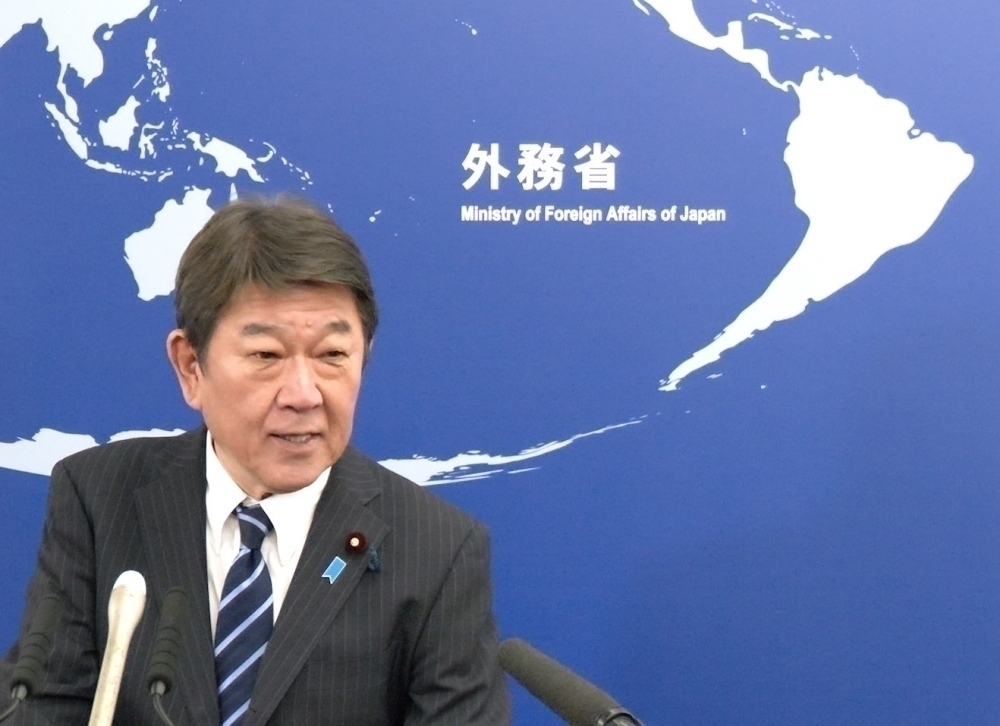
Press Conference by Foreign Minister MOTEGI Toshimitsu
Friday, August 28, 2026, 1:51 p.m. Ministry of Foreign Affairs
Japanese
Opening Remarks
(1) Flash Flood in Nepal and China
Foreign Minister MOTEGI Toshimitsu: I would like to make two announcements at the outset.
The first concerns the flash flood in Nepal and China.
On Wednesday, August 26, large-scale flooding and mudslides occurred in Raswa District in central Nepal and Shigatse City in the Tibet Autonomous Region of China. I once again offer my deepest condolences to those who lost their lives and extend my heartfelt sympathy to all those affected.
On the Nepal side, we have yet to establish contact with five Japanese nationals who are believed to have been participating in a tour. We are currently making every effort across the Ministry to confirm their safety. On the China side, no injuries or casualties of Japanese nationals have been reported at this stage.
Following this flash flood, the Ministry of Foreign Affairs (MOFA) immediately set up an on-site response headquarters in Nepal headed by Mr. MAEDA, Ambassador of Japan to Nepal, and a response office at MOFA in Tokyo headed by Director-General MIBAE of the Consular Affairs Bureau, and have started taking action. I have also instructed the dispatch of Emergency Response Team (ERT) personnel, and two such personnel will begin arriving in Nepal from today.
In light of the extensive damage caused by this disaster, and in response to requests from Nepal, Japan has decided to provide emergency relief supplies as part of our commitment to extend the utmost support. While reports of damage continue to emerge from the affected areas, Japan intends to provide all possible assistance based on the needs in Nepal.
(2) The Visit of Foreign Minister MOTEGI to Turkmenistan, Slovakia, Austria and Mongolia
Foreign Minister MOTEGI: The second announcement is about my overseas visit.
I will visit four countries—Turkmenistan, Slovakia, Austria, and Mongolia—from tomorrow, August 29, to Friday, September 4.
During this visit, in addition to holding meetings with foreign ministers and other key government officials of each country, I will convene the “V4 Plus Japan” foreign ministers’ meeting in Slovakia for the first time in five years, together with the foreign ministers of Slovakia, the Czech Republic, Hungary, and Poland—the countries collectively known as the “Visegrad Group” or “V4”. As the international situation grows increasingly challenging, I intend to confirm strategic collaboration with these countries—incorporating the concept of an updated “Free and Open Indo-Pacific (FOIP)” — to maintain and strengthen a free and open international order based on the rule of law.
Furthermore, I look forward to deepening discussions toward strengthening cooperation with each country in such fields as energy, infrastructure, and science and technology, in light of Japan’s strengths and the needs of each country.
That concludes my opening remarks.
Flash Flood in Nepal and China
Kyodo News, ONDA: I would like to ask about the flash flood in Nepal, which you mentioned in your opening remarks. The damage is widespread and severe; in addition to the current deployment of ERT personnel, could you tell us how the Government intends to proceed with rescue and support efforts —including the dispatch of a Japan Disaster Relief Medical Team?
Foreign Minister MOTEGI: As I stated at the beginning, our current course of action is to devote our full efforts to confirming the safety of the five Japanese nationals with whom we have been unable to establish contact and to ensure their protection.
In addition, upon the request of Nepal, Japan has decided to provide emergency relief goods in order to offer the utmost support. We intend to consider further assistance and response based on any future developments and the needs of Nepal.
Situation in Iran
Sankei Shimbun, NAGAHARA: Today marks six months since the U.S. launched attacks on Iran. You have continued to make diplomatic efforts, recently visiting Saudi Arabia and Oman and holding nearly 80 telephone calls regarding the situation in Iran. A final agreement aimed at the cessation of hostilities between the U.S. and Iran has yet to be reached. How do you assess the current situation in the Middle East, and what kind of diplomatic efforts does Japan intend to continue going forward?
Foreign Minister MOTEGI: Six months have passed, and regarding the situation in Iran, Japan has pursued a range of diplomatic efforts from the outset to achieve an early de-escalation. Since the situation deteriorated at the end of February this year, I myself have engaged in more than 80 exchanges, including telephone calls, with various countries.
Peace and stability in the Middle East are extremely important for the energy security of not only Japan but also of the broader world. Japan considers it is important that free and safe navigation through the Strait of Hormuz and the Bab el-Mandeb Strait be restored as soon as possible, that talks between the U. S. and Iran resume, and that a final agreement, including on the nuclear issue, be reached at an early date.
With this in mind, I visited Saudi Arabia and Oman last week, and also held a meeting with the Foreign Minister of Kuwait, who was visiting Japan, the day before yesterday. We had an in-depth discussion aimed at breaking the current impasse.
Japan intends to continue to work closely with the international community and persistently engage in necessary diplomatic efforts, while fully leveraging our relationships of trust and channels of dialogue with the countries concerned.
U.S. Sanctions against President AKANE of the International Criminal Court (ICC)
Yomiuri Shimbun, FUKUDA: I would like to ask about the ICC. Given Japan’s position of upholding the rule of law, some have argued that the Government should explicitly call for the withdrawal of the U.S. sanctions against President AKANE. Please explain how the Government would respond to these views.
Foreign Minister MOTEGI: As I also responded the other day, Japan has consistently supported the ICC, a permanent international criminal court, in its efforts to prosecute and punish the most serious crimes of concern to the international community and to uphold the rule of law. Japan views that the recent measures are incompatible with its position.
We have repeatedly urged the U.S. at various levels not to designate President AKANE and other officials for sanctions. I would like to refrain from disclosing the details of the discussions in consideration of their future implications. Nevertheless, it is an indisputable fact that we have made such efforts on numerous occasions.
The U.S.’s stance toward the ICC, as we perceive it, is a very severe one. The U.S. has also suggested the possibility of further measures. Despite this challenging situation, Japan will continue to engage with the U.S. at various levels and will remain committed to strengthening the rule of law in the international community while maintaining close communication with related countries.
There may be various ways of expressing our position, but what is unquestionable is that Japan has been engaging the U.S. by clearly stating what needs to be said.
The Comprehensive Nuclear-Test-Ban Treaty (CTBT)
Chugoku Shimbun, SHIMOTAKA: I would like to ask about the CTBT. Next month will mark 30 years since the CTBT was adopted by the United Nations, yet it has still not entered into force. The Government of Japan has consistently attached importance to the CTBT. In recent years, however, Russia revoked its ratification of the CTBT, and there are reports that President Trump has directed that nuclear testing be conducted, although the details are unclear. First, please share the Government’s assessment of the current situation regarding the CTBT’s entry into force. Additionally, please explain the Government’s basic approach toward the CTBT’s entry into force, including whether it will continue initiatives such as “Friends of the CTBT” meeting, which was elevated to the leaders’ level in 2022.
Foreign Minister MOTEGI: As the international security landscape grows more complex, we recognize that the environment surrounding nuclear disarmament is also becoming more challenging.
Even under these circumstances, the CTBT remains an extremely important treaty for pursuing realistic and practical nuclear disarmament efforts within the NPT framework, and Japan, as one of the core members of the “Friends of the CTBT,” has continued to persistently urge states that have yet to sign and ratify the Treaty to do so.
Japan has also held 11 ministerial meetings of the “Friends of the CTBT” with a view to building political momentum toward the CTBT’s early entry into force. We are currently making arrangements to convene the Twelfth Ministerial Meeting on the margins of the United Nations General Assembly in late September of this year. On the occasion of the 30th anniversary of the CTBT’s opening for signature, Japan intends to make continued efforts to promote the CTBT’s early entry into force.
Travel Advisory for Saudi Arabia and Oman
Pan Orient News, Azhari: Your videos in Oman and Saudi Arabia gained big attention, especially in the Arab world. The images presented show a pleasant backdrop and a normal standard of living and movement. However, Japan has issued a travel advisory at Level 2 for these countries, which advises “travel there only if necessary”. So, my question is: do you believe this designation of Level 2 is fair and that it reflects the peaceful ambience witnessed there?
Foreign Minister MOTEGI: Regarding Travel Advisory levels, it is sometimes difficult to determine solely by watching videos. From the standpoint of ensuring the safety of Japanese nationals, we determine Travel Advisory levels based on a comprehensive assessment of factors such as the local political and social conditions, including the security situation.
For Saudi Arabia and Oman, we will continue to closely monitor the regional situation and make appropriate decisions accordingly.
Case of the Detention of Japanese Nationals in China
Yomiuri Shimbun, FUKUDA: I would like to ask about the detention of Japanese nationals in China. In May, there was a case in Dalian in which two Japanese nationals were detained by Chinese authorities on suspicion of taking products related to rare earths out of the country. Some media outlets have reported that several other Japanese nationals have been detained in separate cases of a similar nature. Is the Government of Japan aware of these cases? Please share the facts with us.
Foreign Minister MOTEGI: With regard to the Dalian case, it is as you stated.
That being said, generally speaking, with regard to whether Japanese nationals have been detained by local authorities in foreign countries, the Government exercises caution in determining whether and how to disclose such cases, taking into account possible adverse effects on the individuals concerned, among other factors. Accordingly, I would like to refrain from responding in detail.
Japan has repeatedly requested the Chinese side to provide consular access, an explanation of the facts, and due consideration for the health of the detained Japanese nationals. We will continue to urge the Chinese side to take appropriate actions.