
Press Conferences
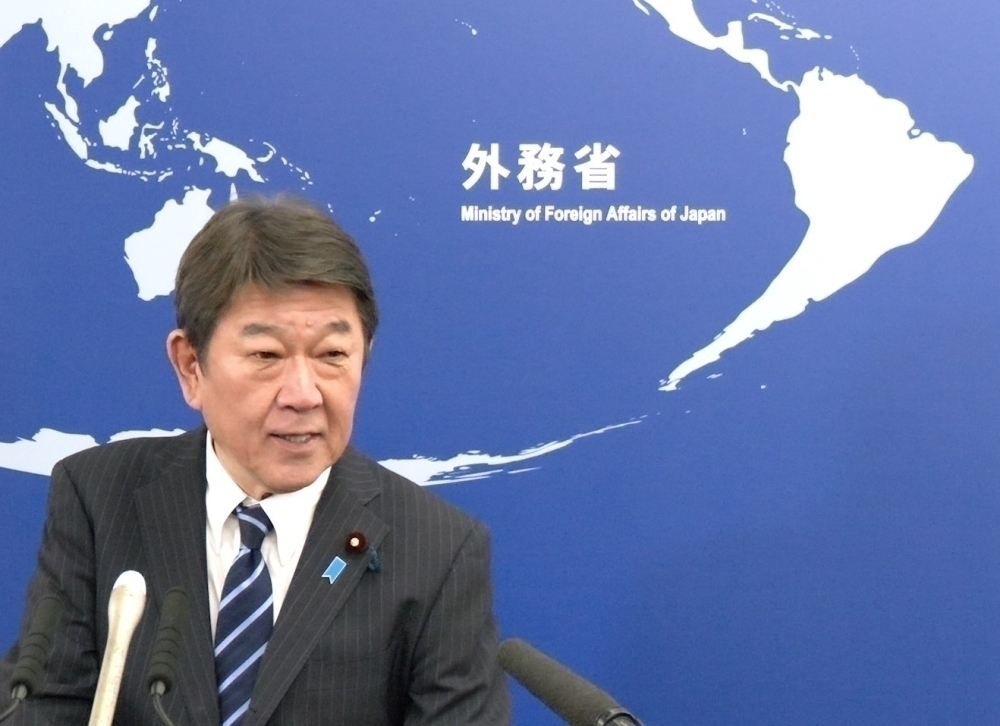
Press Conference by Foreign Minister MOTEGI Toshimitsu
Tuesday, August 25, 2026, 2:41 p.m. Ministry of Foreign Affairs
Japanese
Opening Remarks
Foreign Minister MOTEGI Toshimitsu: It has been a while since my last press conference due to the summer break and my overseas visits. I appreciate your attendance. I have no particular announcements to make, and I am happy to take your questions.
Situation in Iran (Economic Sanctions by the U.S.)
Kyodo News, ONDA: I have a question related to the situation in the Middle East. U.S. Treasury Secretary Bessent announced details regarding economic sanctions against Iran at a press conference. The Trump administration is shifting its policy from military pressure back to economic pressure. I would like to ask your reaction to the latest sanctions, and your assessment of how they will affect the overall situation in the Middle East.
Foreign Minister MOTEGI: I believe in the early hours of today, Japan time, U.S. Treasury Secretary Bessent announced new sanction measures against Iran.
I do not expect any issues of particular concern specifically to Japan to arise. I visited the Middle East last week and we believe that it is important that the Strait of Hormuz reopens as soon as possible and that the talks between the U.S. and Iran resume and a final agreement is reached, including on the nuclear issue, at an early date.
From this perspective, Japan is currently examining the details of the new U.S. measures, specifically how they may impact future U.S.-Iran talks as well as the international community, including Japan.
In any case, Iran’s development of nuclear weapons must never be allowed. Japan will continue to work closely with the U.S. and other members of the international community toward peace and stability in the Middle East.
U.S. Sanctions against President AKANE of the International Criminal Court (ICC)
Yomiuri Shimbun, FUKUDA: I would like to ask about the U.S. sanctions against President AKANE of the ICC. On August 24, the Nonpartisan Parliamentary Association for Reconsidering Human Rights Diplomacy adopted a statement condemning the sanctions and criticized the Government of Japan’s response as being “far weaker than those shown by other countries.” First, what is your reaction to the Association’s statement? Second, the Government has stated that it will maintain close communication with President AKANE and provide whatever support is necessary. Specifically, I would like to ask what kind of support the Government has in mind. These are my two questions.
Foreign Minister MOTEGI: I believe that countries have responded to this matter in various ways, and that there are also many countries which have not issued statements or comments. Japan has consistently supported the ICC, which is a permanent international criminal court, in its efforts to prosecute and punish the most serious crimes of concern to the international community and to uphold the rule of law. Japan considers that the sanction measures to be incompatible with its position.
Japan has made efforts, numerous times, at various levels, to urge the U.S. not to designate President AKANE and other officials for sanctions. In particular, the Government has maintained close communication with President AKANE, whom Japan nominated, and it shares the serious sense of crisis and concern that she is facing. The Government will remain committed to providing the necessary support.
As for what support may be necessary, Director-General NAKAMURA of the International Legal Affairs Bureau recently visited the Netherlands and consulted directly with President AKANE. We believe that the necessary support will become clearer as the situation develops, and we will remain committed to firmly supporting her.
At the same time, in order for the ICC to gain the trust of the international community as a universal court, it is important for the ICC Prosecutor to carry out duties properly and for the ICC and its States Parties to address the challenges facing the ICC in a thorough manner, so that the Court is administered appropriately. Japan, for its part, will continue to fulfill its role as a State Party by participating in relevant discussions.
Japan has consistently upheld the rule of law in the international community, and this position remains unchanged. We recognize that the U.S. takes a very severe stance toward the ICC and has suggested the possibility of further measures. Amid this challenging situation, Japan will continue to consider what response will be effective, while maintaining communication with related countries, and will remain committed to strengthening the rule of law in the international community.
Freelance, SHIBA: My question relates to the ICC. While I understand that your stance as just stated, does Japan not intend to explicitly call on the U.S. to withdraw the sanctions? Additionally, will Japan, for example, take a leading role in joining a joint statement by ICC States Parties, or introduce blocking regulations to protect Japanese citizens and corporations from the extraterritorial application of U.S. sanctions? I would appreciate it if you could clarify how Japan intends to implement such specific measures.
Foreign Minister MOTEGI: As I mentioned earlier, Japan has been engaged in various exchanges with the U.S. I would like to refrain from disclosing the details as these are diplomatic exchanges. With regard to our response going forward, Japan intends to thoroughly consider what response will be most effective, in coordination with relevant countries, and will continue to work toward strengthening the rule of law in the international community.
Joint Exercise by the Chinese and Indonesian Navies
Tribune News, Susilo: On August 8, the Indonesian Navy participated in a bilateral exercise with the Maritime Self-Defense Force in Sagami Bay. Four days later, the Indonesian military conducted a bilateral exercise with the Chinese military in waters near Taiwan, and the Taiwan lodged a protest on August 12. Moreover, on August 22, a “2+2” ministerial meeting between the foreign and defense ministers of Indonesia and China was held. I am not asking about the military or technical details of the joint exercise between the two militaries. My question is how the Government of Japan, particularly the Ministry of Foreign Affairs, views and assesses, from a foreign policy perspective, the series of actions taken by Indonesia that led to Taiwan’s strong protest against China and developed into an international issue?
Foreign Minister MOTEGI: Weare aware that China’s Ministry of National Defense announced that Chinese and Indonesian naval vessels completed a naval navigation exercise in waters east of Taiwan on August 12, as you mentioned.
With regard to this matter, Japan conveyed its position and expressed its concern to China. Japan is also engaged in various communications with the Indonesian side. However, as these are diplomatic exchanges, I would like to refrain from disclosing the details of those communications.
As was concurred at the Japan- Indonesia summit meeting in March of this year, Japan intends to advance cooperation with Indonesia across a range of areas with a view to further strengthening the Comprehensive Strategic Partnership, and there is no change in this stance.
U.S. Sanctions against President AKANE of the International Criminal Court (ICC)
Freelance, SHIBA: This is my second question. You mentioned earlier the challenges facing the ICC and its appropriate administration. What did you mean by that? I believe the prevailing view is that the U.S. is imposing sanctions on the ICC ultimately to protect Israel. Do you share this view?
Foreign Minister MOTEGI: I do not necessarily share that view.