
Press Conferences
Press Conference by Foreign Minister MOTEGI Toshimitsu
Friday, November 14, 2025, 4:59 p.m. Ministry of Foreign Affairs
Japanese
Opening Remarks
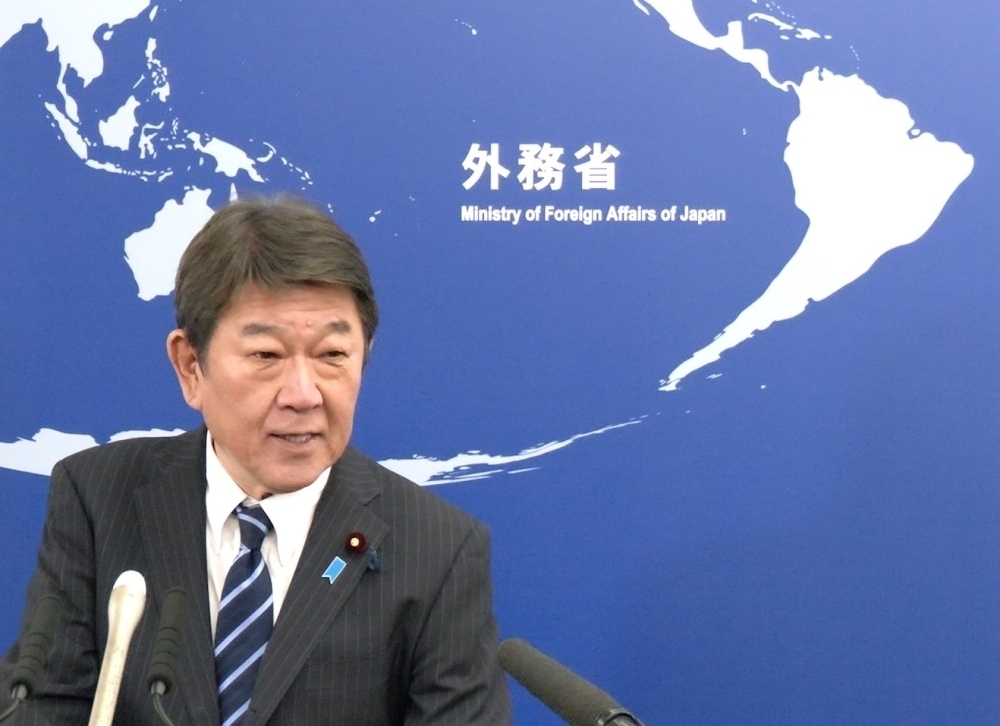
Foreign Minister MOTEGI Toshimitsu: Here we are again, back in the original press conference room. The world map backdrop is yet to return.
Last night, I came back from the G7 Foreign Ministers’ Meeting in Canada. The details of the meeting and its outcomes, including those of bilateral meetings, are as I explained in my press conference in Canada.
(1) Japan-Indonesia Foreign and Defense Ministerial Meeting (“2+2”)
That being said, I have two announcements at the outset on a different note.
The first is about the “2+2” meeting with Indonesia. Next Monday, November 17, the third Japan-Indonesia Foreign and Defense Ministerial Meeting, or the so-called “2+2,” will be held in Tokyo. From the Japanese side, Minister of Defense KOIZUMI and I will be attending, and from the Indonesian side, Minister for Foreign Affairs Sugiono and Minister of Defense Sjafrie, will be attending. I also attended the second “2+2” meeting in my capacity as Foreign Minister.
Following the upcoming “2+2” meeting, I will host a working dinner with Foreign Minister Sugiono.
Through these dialogues, we intend to thoroughly align our recognition of the increasingly severe security environment. In addition, we aim to have discussions on further strengthening our collaboration toward the realization of a “Free and Open Indo-Pacific” (FOIP), while acknowledging progress in security and defense cooperation between Japan and Indonesia.
(2) Appointment of Ambassador in charge of Gaza Rebuilding Assistance OKUBO
Foreign Minister MOTEGI: The second is regarding Gaza, specifically, about the appointment of Mr. OKUBO Takeshi, a former diplomat, as Ambassador in charge of Gaza Rebuilding Assistance.
As I presented at this week’s G7 Foreign Ministers’ Meeting, Japan’s basic stance is to continue playing a proactive role toward the recovery and reconstruction of Gaza. As part of these efforts, we have appointed Mr. OKUBO, a former diplomat who has experience being posted to the region, as Ambassador in charge of Gaza Rebuilding Assistance.
Mr. OKUBO has extensive experience working in both Israel and Palestine, and his last post was Ambassador Extraordinary and Plenipotentiary of Japan to Lebanon. Japan expects that, drawing on his insight and network, Mr. OKUBO will work and actively contribute toward the rebuilding of Gaza and the establishment of governance mechanisms.
That concludes my opening remarks.
Survival-Threatening Situation
Yomiuri Shimbun, UEMURA: Regarding Prime Minister TAKAICHI’s response in the Diet on a survival-threatening situation surrounding the Taiwan Strait, China’s Spokesperson Lin Jian, at his press conference on November 13, condemned Japan with strong words, making claims about China’s sovereignty and citing memories of past history. Additionally, the Ministry of Foreign Affairs of China summoned Ambassador KANASUGI Kenji, in Beijing, and made a protest, and demanded the retraction of the Prime Minister’s statement. According to my understanding, the Prime Minister was stating that the destabilization of the Taiwan Strait would adversely affect Japan’s security, and it represents neither a policy change nor an infringement on China’s sovereignty. What are your views on the differences in the arguments and perceptions between Japan and China as well as China’s strong reaction? Please also share with us your thoughts on China summoning Ambassador KANASUGI and making a protest, as I just mentioned. Thank you.
Foreign Minister MOTEGI: I am aware of the remarks made at the press conference of the Ministry of Foreign Affairs of China. Yesterday, the Chinese side lodged a protest to Ambassador KANASUGI of Japan regarding Prime Minister TAKAICHI’s response in the Diet, and Ambassador KANASUGI clearly countered the protest, once again explaining to the Chinese side the context in which Prime Minister TAKAICHI made her statement and the position of the Government of Japan, as I also stated at my press conference yesterday.
The Ambassador of Japan then made a strong protest, stating that the post by China’s Consul General in Osaka was highly inappropriate as remarks from the head of a diplomatic mission, and once again strongly demanded that the Chinese side take appropriate actions.
Japan will continue to strongly urge the Chinese side to take appropriate actions, so that the situation does not significantly affect the broad direction of Japan-China relations, which was confirmed at the Japan-China Summit meeting and Japan-China Foreign Ministers’ telephone meeting at the end of last month.
In any case, peace and stability across the Taiwan Strait is extremely important not only for Japan’s security but also for the stability of international community, and as we have repeatedly stated, it is the consistent position of Japan to expect that the issue surrounding Taiwan will be resolved peacefully by dialogue.
Furthermore, the Government’s position on Taiwan remains as articulated in the 1972 Japan-China Joint Communique, and there is no change in this position.
Persona Non Grata (An Undesirable Person)
Sankei Shimbun, NAGAHARA: I would like to ask about the social media post made by China’s Consul General in Osaka, which you mentioned earlier. Both the ruling and opposition parties are increasingly calling for the Consul General to be designated as persona non grata. I would like to know about any cases in which the Government of Japan designated foreign officials as persona non grata in the past, and conversely, any cases in which Japanese officials were designated as persona non grata by other countries. I would like to ask once again whether you think the posts made by the Consul General in Osaka constitute grounds for declaring him persona non grata as compared with the previous cases.
Foreign Minister MOTEGI: There were two questions. Let me answer the second one first. This partly overlaps with my earlier response to Yomiuri’s question, but Japan and China have confirmed a broad direction to comprehensively promote a “Mutually Beneficial Relationship Based on Common Strategic Interests” and building “constructive and stable Japan-China relations.” This was also reaffirmed at the recent Japan-China Summit meeting and my telephone meeting with Foreign Minister Wang Yi prior to that.
Under this broad direction, Japan and China would reduce issues and concerns and increase mutual understanding and cooperation through mutual efforts while further enhancing communication across a wide range of fields at all levels.
It was against this backdrop that the Consul General made the post you mentioned. As I have been stating, I consider it highly inappropriate as remarks from the head of a diplomatic mission.
The Ministry of Foreign Affairs and the Embassy of Japan in China have made démarches to the Chinese side that such posts are highly inappropriate, lodged a strong protest, and demanded the prompt deletion of the relevant posts, while strongly demanding appropriate measures. I understand that some of the relevant posts have since become inaccessible.
Not only this recent remark but also several inappropriate remarks by China’s Consul General in Osaka, including those made during last year’s elections, are regrettable. To ensure that this does not affect the broad direction of Japan-China relations, Japan is continuing and will continue to strongly demand that the Chinese side take appropriate measures.
As for past cases of persona non grata, Japan has made such declarations four times, while Japanese officials have been declared persona non grata two times.
Specifically, Japan has declared four foreign embassy officials in Japan persona non grata: a First Secretary of the Embassy of the Republic of Korea (ROK) in Japan in 1973, an Attaché of the Embassy of Cote d’Ivoire in Japan in 2006, an Ambassador of Syria to Japan in 2012, and a Consul General of Russia in Sapporo in 2022.
Conversely, since the end of World War II, I understand that two Japanese officials at diplomatic missions have been declared persona non grata: a Japanese Ambassador to Syria in 2012 and a member of the Consulate-General of Japan in Vladivostok in 2022.
Application of Espionage Charges in China
Kyodo News, ONDA: Related to China, I would like to ask about the application of espionage charges in China. On November 13, the High People’s Court of Beijing Municipality dismissed an appeal by Dong Yuyu, a former senior member of a major newspaper affiliated with the Communist Party of China, who had been charged with espionage for allegedly providing information to a Japanese diplomat. The court upheld the first-instance judgment of seven years’ imprisonment, thereby making the judgment final. The first-instance judgment issued in November last year listed the names of several Japanese diplomats and others who were acquaintances of Dong and identified them as agents of an espionage organization. The judgment deems the Embassy of Japan in China to be an espionage organization. Could you please share your thoughts, as well as your opinion on the obscure use of espionage charges in China?
Foreign Minister MOTEGI: We are currently confirming the facts of this case, including the court’s judgment.
That being said, I will refrain from responding about specific individual matters concerning the diplomatic activities of the Government of Japan, including the matter you raised, as doing so could interfere with future diplomatic activities. In no way am I stating that Japanese diplomats are engaged in any wrongful acts. There is no doubt that our diplomats at Japanese diplomatic missions are conducting legitimate diplomatic activities.
Regarding China’s so-called Anti-Espionage Law, there are, for instance, ambiguous sections such as “other espionage activity” in its last part. Japan has urged the Chinese side to ensure transparency in law enforcement and judicial processes.
Since transparency remains insufficient, we will continue making relevant efforts and diplomatic démarches.
Survival-Threatening Situation
Hong Kong Phoenix TV, Li: I have a follow-up question on China’s protest against Japan. When China made a protest, it demanded that Japan retract Prime Minister TAKAICHI’s statement. Is my understanding correct that the Japanese side refused to retract the statement as requested? You also mentioned in your earlier explanation that the Japanese side clearly countered the protest. Could you please specify which Chinese claims Japan countered and how?
Foreign Minister MOTEGI: As they are diplomatic communications, I will refrain from going into details. Regarding the context in which Prime Minister TAKAICHI made her statement, specifically, what constitutes a survival-threatening situation and under what circumstances such a situation would be recognized and invoked, these points have already been thoroughly explained, both during the deliberations for enacting Japan’s Legislation for Peace and Security and after its enactment. We explained Japan’s stance on survival-threatening situations remains unchanged and countered wrong claims made by China.
Phoenix TV, Reporter: What about whether or not Japan refused to retract the statement?
Foreign Minister MOTEGI: As I stated, the explanation provided by Japan, including that by Prime Minister TAKAICHI, regarding the Legislation for Peace and Security and survival-threatening situations is clear and fully consistent with international law. The legislation was thoroughly deliberated in the Diet before it was enacted. Therefore, there is no need for a retraction as a matter of course.
60th Anniversary of Japan Overseas Cooperation Volunteers (JOCV) and Development Cooperation
Jiji Press, CHIBA: I would like to change the topic to the JOCV program. This year marks 60 years since its establishment, and an anniversary ceremony was held yesterday. Please share your thoughts on this 60th anniversary. Also, as demonstrated by the recent issue surrounding JICA Africa Hometown, it has become increasingly difficult to obtain public understanding of people-to-people exchanges and development cooperation. What is your view on the significance and necessity of Japan’s overseas development cooperation?
Foreign Minister MOTEGI: Yesterday, a grand anniversary ceremony was held to commemorate the 60th anniversary of the JOCV with the presence of Their Majesties the Emperor and Empress.
Over these 60 years, the JOCVs have carried out various activities, including industrial, agricultural, and cultural exchange activities, in some of the most remote areas and regions with particularly challenging living conditions. I believe the JOCVs, as key players of quintessentially Japanese visible development cooperation, have contributed to building trust and bond with countries in the international community.
During my overseas visits as Foreign Minister and on other occasions, I had many opportunities to interact with young JOCVs in the field. They are working hard and providing support in extremely harsh conditions with a strong sense of fulfillment. I remember well how joyfully they spoke about their activities. The trust gained from countries through this kind of quintessentially Japanese development cooperation is an invaluable asset for Japan. After completing their work as JOCVs, former volunteers have continued to play active roles in Japan and abroad in various fields by drawing on their experience with high recognition.
In my constituency, there is a woman who served as a JOCV in Bolivia and is now a city council member. Given that it is Bolivia, the altitude is quite high. She works hard as a city council member and is highly regarded by her colleagues. Some former JOCVs who have experience working in various regions, such as Latin America and the Caribbean, and Africa, remain overseas, while others return to Japan after completing their programs. I trust they are highly valued by the public. At the very least, I believe that they are highly esteemed by the people who know about their activities in the regions.
Regarding the development cooperation and its necessity, Japan can contribute to the peace and prosperity of the international community through overseas cooperation, for example, by helping ensure stable access to resources. Furthermore, by enhancing trust in Japan, I believe that Japan’s development cooperation will also lead to our national interests, including Japan’s peace, stability, and further development.
I believe that official development assistance (ODA) can be used strategically and effectively to address critical issues, such as economic security, evolve FOIP in line with the changes of the times, and help promote tailor-made cooperation with the Global South.