
Press Conferences
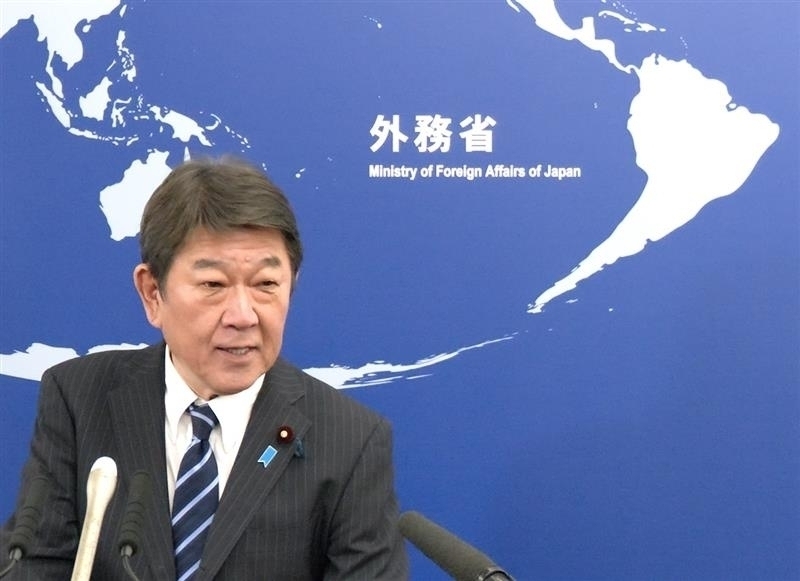
Press Conference by Foreign Minister MOTEGI Toshimitsu
Friday, July 17, 2026, 5:03 p.m. Ministry of Foreign Affairs
Japanese
Japan-China Relations and ASEAN-related Foreign Ministers’ Meetings
Sankei Shimbun, NAGAHARA: There will be the ASEAN-related Foreign Ministers’ meetings next week, and I believe you are considering attending. In the South China Sea near the Philippines, the host country, China’s hegemonic acts have caused concern. Japan, for its part, has opposed unilateral attempts to change the status quo by force. Should you attend, would you raise these concerns about China at the meetings? I believe Foreign Minister Wang Yi will be attending the meetings as well Could you please tell us if you intend to take this opportunity to counter China’s critiques of Japan, such as the “new-militarism” criticism?
Foreign Minister MOTEGI Toshimitsu: If circumstances permit, I will attend the ASEAN-related Foreign Ministers’ meetings, which will be held in Manila, the Philippines, next week. The arrangements for my attendance are currently being coordinated.
At the ASEAN-related Foreign Ministers’ meetings, I would like to further deepen discussions with participating countries on regional and international issues, such as the situations in the East and South China Seas, North Korea, Myanmar, the Middle East, and Ukraine. I also intend to further deepen Japan’s cooperative relations with ASEAN, a region central to the realization of a “Free and Open Indo-Pacific (FOIP).”
As for specific statements to be made during the meetings, I will need to respond flexibly depending on the overall atmosphere and on what each country says. In any case, I intend to clearly convey Japan’s position of contributing to the peace and prosperity of the region while working closely with Asian countries and other like-minded countries. Given that various new economic security issues are also emerging, such as the energy situation and the issue of critical minerals, I will articulate Japan’s stance as well as how Japan will cooperate with and support ASEAN in this area.
ASEAN-Japan Foreign Ministers’ Meeting
Asahi Shimbun, MIYAWAKI: I apologize for overlapping somewhat with your earlier response, but I would like to ask about Japan-ASEAN relations. If you attend the ASEAN-related Foreign Ministers’ meetings, how do you intend to advance Japan-ASEAN cooperation, including energy security cooperation, such as the “Partnership On Wide Energy and Resources Resilience (POWERR) Asia,” and maritime security cooperation with China’s actions in mind?
Foreign Minister MOTEGI: As I mentioned earlier, ASEAN is central to the realization of FOIP. Furthermore, as the ASEAN Outlook on the Indo-Pacific (AOIP) shares common fundamental principles and direction with FOIP, I intend to continue promoting cooperation between Japan and ASEAN in line with FOIP and AOIP.
Under the updated FOIP, Japan will provide necessary support and cooperation to enable countries in the region to strengthen “autonomy” and “resilience.”
Specifically, I believe there are three broad areas. The first area is the capability of each country to protect its own territory and waters. The second area is, as you mentioned, economic security, including energy security. The third area is technological development and disaster response. Japan considers these three areas to be important, and I intend to emphasize this point at the ASEAN-Japan Foreign Ministers’ Meeting.
Situation in Iran
Kyodo News, ONDA: I have a question related to the U.S. and Iran. U.S. Central Command announced that it fired missiles at an oil tanker that had violated naval blockade measures against vessels transiting to or from Iranian ports and disabled the tanker. This marked the first attack on a commercial vessel since the naval blockade was resumed on July 14. The U.S. has escalated pressure on Iran in response to its announcement of a strait blockade. As attacks against Iran continue and tensions between the U.S. and Iran escalate, I would like to ask for your assessment of the current situation and what diplomatic efforts Japan will undertake to de-escalate the situation.
Foreign Minister MOTEGI: Approximately one month has passed since the signing of the Memorandum of Understanding (MoU) on June 18, but military tensions between the U.S. and Iran remain high and the exchange of attacks has resumed. Japan is gravely concerned about this situation.
I believe many countries share our concerns. The issues surrounding Iran include the Strait of Hormuz situation, how to settle the nuclear issue, and how to ensure peace across the region including Lebanon.
On the other hand, from Iran’s perspective, there is the issue of unfreezing its assets and the issue of lifting the primary and secondary sanctions imposed by the U.S. and others. These challenging issues are, so to speak, interrelated like simultaneous equations. For example, if there is progress on the nuclear issue, some assets may be unfrozen, some sanctions may be lifted, or a pay-as-you-go approach may be taken. These issues are intertwined in a range of ways and have to be resolved one by one. This is very challenging, but progress must be made.
What is most important now is to de-escalate military tensions and restore peace and stability in the region, including the Strait of Hormuz, as soon as possible. Once this is achieved, it is necessary to resolve the issues I have just mentioned one by one, in line with the MoU.
With a view to de-escalating the situation and restoring peace and stability in the Middle East, Japan has maintained close communication with Iran and the U.S., as well as with mediating countries and the Gulf states. On these issues alone, I have held perhaps close to 60 meetings and telephone calls since February 28.
Japan will continue to maintain dialogue with relevant countries and coordinate with the international community in making every effort to foster the conditions necessary for the U.S.-Iran talks.