
Press Conferences
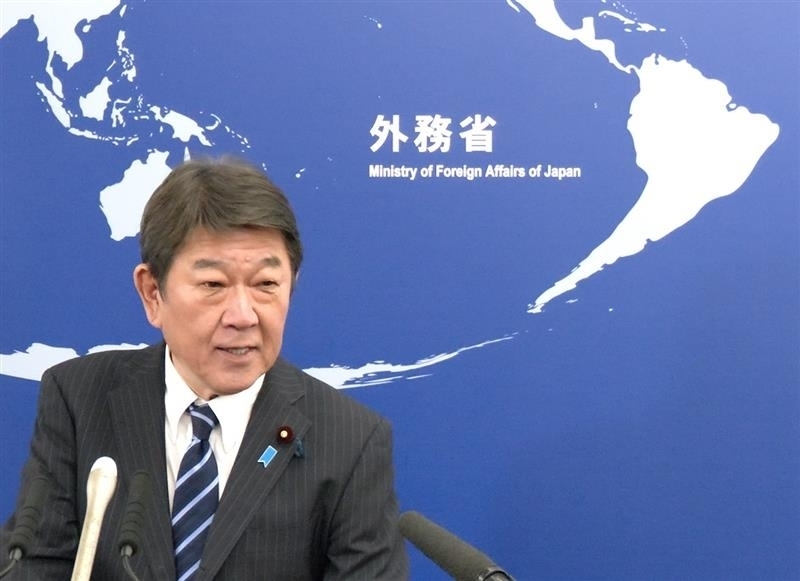
Press Conference by Foreign Minister MOTEGI Toshimitsu
Friday, July 3, 2026, 4:17 p.m. Ministry of Foreign Affairs
Japanese
Security Cooperation with Bangladesh
Nikkei Shimbun, NAKAOKA: On July 2, local time, a handover ceremony was held for the five patrol boats provided from Japan to Bangladesh under the Official Security Assistance (OSA) framework. Although the decision to provide these vessels to Bangladesh was made in FY2023, Bangladesh and China in June issued a communiqué stating that they “oppose any attempts for fascistic and militaristic revival.” It appears that this was directed at Japan. Could you please tell us the Government of Japan’s view on security cooperation with such countries and the direction of future OSA projects?
Foreign Minister MOTEGI Toshimitsu: Yesterday, a ceremony for the handover of patrol boats under an OSA FY2023 project was held at the BNS Nirvik located in Chattogram, Bangladesh. Parliamentary Vice-Minister for Foreign Affairs SHIMADA attended representing the Ministry of Foreign Affairs (MOFA).
In its remarks at the ceremony, the Bangladeshi side expressed gratitude for the provision of equipment and stated to the effect that Bangladesh “highly appreciates Japan’s constructive role in promoting peace, stability, resilience, and capacity building in the region.”
Regarding the Joint Communiqué you noted, as it concerns matters between third countries, we are not in a position to comment, including whether the wording was intended to refer to Japan. That being said, Japan has consistently followed the path of a peace-loving nation since the end of World War II. Many countries around the world have highly valued this, and we believe it is also evident from yesterday’s statement by the Bangladeshi side.
China’s Critique of the Updated “Free and Open Indo-Pacific (FOIP)”
Kyodo News, ONDA: I have a question related to Prime Minister TAKAICHI’s visit to India. At yesterday’s regular press conference of the Chinese Ministry of Foreign Affairs, the Spokesperson stated that the updated FOIP is a concept that sows division and rivalry and exists in name only. Could you please tell us what the Government of Japan makes of this?
Foreign Minister MOTEGI: The FOIP, as we have consistently explained since its launch in 2016 and as reaffirmed in the updated FOIP announced in May of this year, is an inclusive and open vision. The FOIP is clearly not intended to create further division and rivalry. We believe that the vision has generated warm support and understanding from countries in the region.
Based on this vision, we intend to advance concrete cooperation that delivers benefits to Japan, partner countries, and the Indo-Pacific region as a whole, working together with many countries and regions under the updated FOIP.
Japan-China Relations
Yomiuri Shimbun, FUKUDA: I would like to ask about Japan-China relations. China has tightened export controls on dual-use items, including rare earths. At the same time, developments such as the detention of Japanese nationals in Liaoning Province and jurisdiction claims made by the China Coast Guard (CCG) within Japan’s Exclusive Economic Zone (EEZ) off Yonaguni Island are ongoing. In light of these developments, I would like to ask what kind of relations the Government of Japan seeks to build with China going forward.
Foreign Minister MOTEGI: First of all, the Chinese export controls targeted only at Japan are absolutely unacceptable and deeply regrettable. We have strongly protested with the Chinese side and demanded the withdrawal of these measures.
With regard to the case of the detention of Japanese nationals in Dalian, we intend to continue taking appropriate responses from the standpoint of protecting Japanese nationals, while maintaining close communication with the Japanese individuals concerned and relevant parties.
With respect to the activities of CCG and other vessels in Japan’s EEZ south of Yonaguni Island and China’s related announcements, these are unacceptable and Japan has made repeated demarches to the Chinese side through diplomatic channels.
As I have stated previously, we believe that precisely because there are concerns and issues, it is all the more important for Japan and China to communicate with each other. Japan remains open to a range of dialogues with China. Japan intends to maintain communication with China and to continue responding calmly and appropriately in consideration of national interests.
Travel Advisory for the Middle East Region
Jiji Press, KINOSHITA: I would like to ask about the Travel Advisory for the Middle East region. On June 25, following developments such as the signing of a Memorandum of Understanding (MoU) regarding the cessation of hostilities between the U.S. and Iran, MOFA lowered the Travel Advisory from Level 3 to Level 2 for seven Middle Eastern countries, including Saudi Arabia and Qatar. However, even after the signing of the MoU, the Travel Advisory for Iran and Iraq remains at Level 4, “Evacuate and Avoid All Travel.” Given that there is no prospect of tensions easing, with attacks between the U.S. and Iran continuing following the signing of the MoU, could you please tell us the current status of the Government’s considerations for lowering the Travel Advisory level for these countries and the region, as well as the factors being closely monitored for reviewing the Travel Advisory level?
Foreign Minister MOTEGI: We revise Travel Advisory levels in a timely and appropriate manner. In principle, from the standpoint of ensuring the safety of Japanese nationals, we determine Travel Advisory levels based on a comprehensive assessment of factors such as the local political and social conditions, including the security situation.
As for countries and regions not covered by the previous revision, such as Iran and Iraq, we will continue to closely monitor the regional situation, including the progress in the implementation of the MoU, and make appropriate revisions accordingly.
Prime Minister TAKAICHI’s Visit to India
Asian News International, ITAGAKI: The outcomes of the Japan-India Summit Meeting have received extensive media coverage in India as well. Prime Minister Modi even remarked that India has embraced the philosophy of Japan’s “Kaizen.” It appears that the meeting both confirmed the achievements of Japan-India relations and identified challenges for the future. One challenge is the future of the FOIP. What are the possibilities for its development, especially with regard to cooperation with Africa or the Global South? The two leaders also discussed the target of attracting JPY 10 trillion in Japanese investment to India. The Embassy of Japan in India has been conducting active outreach to promote incentives to attract investment. I would appreciate it if you could share your opinions on the use of diplomatic measures or domestic administrative procedures to resolve these challenges going forward.
Foreign Minister MOTEGI: Prime Minister TAKAICHI’s visit to India contributed to deepening Japan-India strategic cooperation, and as you saw in the footage, to strengthening the personal relationship of trust between the leaders. I believe it was a very meaningful visit.
Specifically, the two leaders reaffirmed the direction of cooperation for the next decade, which was set out during Prime Minister Modi’s visit to Japan last August. You mentioned the word “Kaizen.” Leveraging each other’s strengths, the two leaders concurred to promote cooperation with a focus on, first, deepening Japan-India strategic cooperation, second, advancing cooperation in the fields of economic security and energy security, and third, co-creating economic growth in Japan and India through investment and innovation collaboration.
India, indeed, is one of the leading countries in the Global South, whose voice is growing in the international community. Through cooperation with India, Japan also intends to pursue cooperation in third countries, including in Africa.
Additionally, the two leaders concurred to hold a Japan-India “2+2” before the end of this year. Building on the personal relationship of trust between External Affairs Minister Jaishankar and myself, I intend to strengthen Japan-India strategic relations in various areas.