
Press Conferences
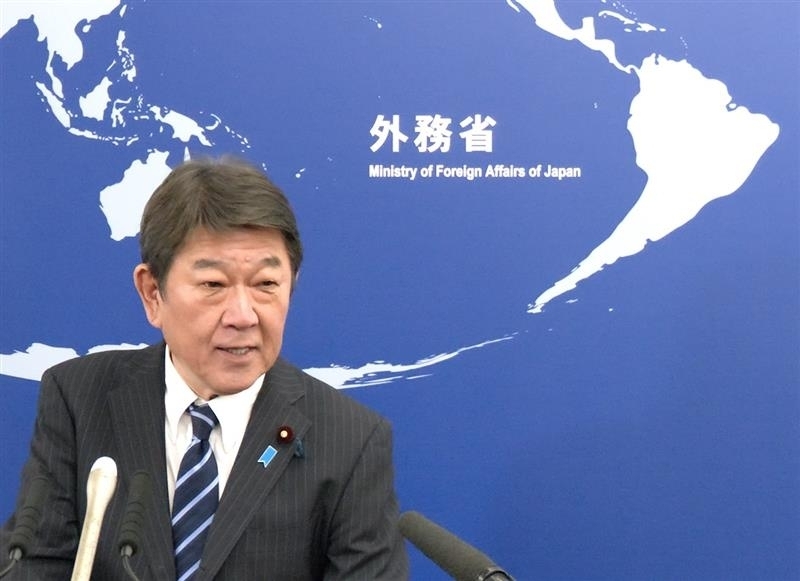
Press Conference by Foreign Minister MOTEGI Toshimitsu
Tuesday, June 30, 2026, 2:36 p.m. Ministry of Foreign Affairs
Japanese
Opening Remarks
Emergency Assistance in Response to the Earthquake Damage in Venezuela
Foreign Minister MOTEGI Toshimitsu: First, I have an announcement regarding emergency assistance for Venezuela.
The recent earthquake in Venezuela has caused a large number of casualties and extensive damage.
In response to the earthquake damage, the Government of Japan has decided to provide plastic sheets, portable jerry cans, and water purifiers as emergency relief goods to the Government of Venezuela through the Japan International Cooperation Agency (JICA).
In addition, a JICA survey team has been dispatched to the affected area since last Friday, June 26, to assess local medical, recovery, and reconstruction needs. While awaiting the survey team’s report, the Government of Japan will continue to consider necessary assistance, including dispatching a Japan Disaster Relief team and providing an Emergency Grant, based on the needs on the ground.
That concludes my opening remarks.
Support for Ukraine
Asahi Shimbun, MIYAWAKI: You will hold a meeting with Ukrainian Foreign Minister Sybiha tomorrow. As you have stated at your press conferences, I understand that you will convey Japan’s unwavering support for Ukraine. On the other hand, given that no in-person meeting between Prime Minister TAKAICHI and President Zelenskyy has taken place, including at the recent G7 Evian Summit, there are some concerns that Japan’s engagement in Ukraine may be waning. Could you please tell us once again the Government of Japan’s position on support for Ukraine?
Foreign Minister MOTEGI: First and foremost, I would like to make it clear that Japan’s support for Ukraine is unwavering.
In my meeting with Foreign Minister Sybiha tomorrow, I will reiterate that Japan stands with Ukraine and that this position remains unwavering. I will also have a thorough exchange of views with Minister Sybiha on deepening bilateral relations and on the international situation.
Japan has committed to and is steadily providing assistance totaling approximately USD 20 billion in the areas of humanitarian assistance, financial support, and recovery and reconstruction, in coordination with the G7 and other countries.
We will continue to work closely with the international community and provide assistance, including recovery and reconstruction support through public-private partnerships to ensure Ukraine’s social and economic resilience.
The Entry into Force of the Ethnic Unity and Progress Promotion Law in China
Kyodo News, ONDA: The Ethnic Unity and Progress Promotion Law will enter into force in China tomorrow, July 1. There are concerns that it will accelerate China’s assimilation policies for ethnic minorities. The law further stipulates that entities and individuals outside China will be held legally liable for acts that undermine ethnic unity. Some are worried about the impact this may have on Japan. Could you please share the Government of Japan’s assessment on this?
Foreign Minister MOTEGI: The Government of Japan is aware that the law you referred to will enter into force tomorrow, July 1. However, it is a law of another country, and I believe the Government of Japan is not in a position to comment on the interpretation or implementation of the provisions of the law. In any case, with those concerns in mind, the Government will respond appropriately to ensure that the safety of Japanese nationals is not compromised.
Significance of the Launch of Negotiations on the Japan-MERCOSUR Economic Partnership Agreement (EPA)
Sankei Shimbun, NAGAHARA: MERCOSUR, a customs union of five South American countries, including Brazil, will hold a summit meeting on June 30, local time, and is expected to formally approve the launch of EPA negotiations with Japan. Could you please tell us once again the significance of entering into EPA negotiations with MERCOSUR? In addition, Liberal Democratic Party members who represent agricultural interests, among others, have expressed concerns due to the considerable impact the EPA may have on the domestic agricultural industry. I would also like to ask how the Government intends to address those concerns.
Foreign Minister MOTEGI: First of all, speaking of Brazil, I believe that the Japanese national team delivered an exceptional performance in this morning’s match against Brazil, but the result was truly unfortunate and heartbreaking. With regard to the EPA with MERCOSUR, of which Brazil is a key member, while the EPA holds enormous potential, the Government of Japan as a whole takes seriously the strong concerns being voiced by domestic producers, particularly in the agriculture and livestock sectors.
Prime Minister TAKAICHI clearly conveyed this point to President Lula at the recent Japan-Brazil Summit meeting.
I, too, have directly met with relevant organizations and received their requests. The so-called five “sensitive” products have consistently been treated as a priority since the TPP negotiations. The Government fully recognizes these concerns, including the sensitivities surrounding agriculture and livestock sectors.
That being said, strengthening Japan-MERCOSUR economic relations not only contributes to enhancing economic security but also holds enormous potential for developing new markets, including the promotion of exports of Japanese agricultural, forestry, and fishery products and foodstuffs. At the same time, it has significance for strengthening the resilience of supply chains of critical materials, such as fertilizer.
Moreover, given that the MERCOSUR countries are key members of the Global South, Japan believes that the EPA has strategic significance in strengthening cooperation between Japan and the Global South. Japan has repeatedly confirmed with MERCOSUR that both sides will reach a mutually beneficial agreement while addressing each side’s sensitivities. Japan intends to engage in the negotiations with a firm resolve to protect Japan’s national interests.
Over the years, I have been involved in numerous negotiations, including those for the Comprehensive and Progressive Agreement for Trans-Pacific Partnership (CPTPP), the Japan-U.S. Trade Agreement, and the Japan-UK EPA. The fundamental principle is to pursue negotiations and reach an agreement that is mutually beneficial and is in line with national interests, and I intend to ensure that this is firmly upheld.
Japan’s Nuclear Non-Proliferation Policy
Pan Orient News, Azhari: Japan has consistently maintained a firm diplomatic stance advocating for the complete denuclearization of both Iran and North Korea, citing the severe risks these programs pose to regional stability and global non-proliferation efforts. However, this position is frequently contrasted with Japan’s muted approach toward Israel’s nuclear arsenal that is reportedly used to threaten Egypt, Iraq, Palestine, Syria and Lebanon. Critics are wondering how your selective approach is going to work effectively in persuading other nations to abandon their nuclear ambitions.
Foreign Minister MOTEGI: At the outset, I would like to make it clear that Japan is not taking a selective approach by any means.
Leading the international community’s efforts toward a world without nuclear weapons is the mission of Japan, the only country to have ever suffered atomic bombings during war. Israel maintains a policy of neither confirming nor denying its possession of nuclear weapons. Japan has repeatedly conveyed to various countries, including Israel, that maintaining and strengthening the international nuclear non-proliferation regime is important and that they should join the Treaty on the Non-Proliferation of Nuclear Weapons (NPT).
Japan will continue to persistently and steadily advance realistic and practical efforts toward achieving a world without nuclear weapons, including maintaining and strengthening the NPT regime.