
Press Conferences
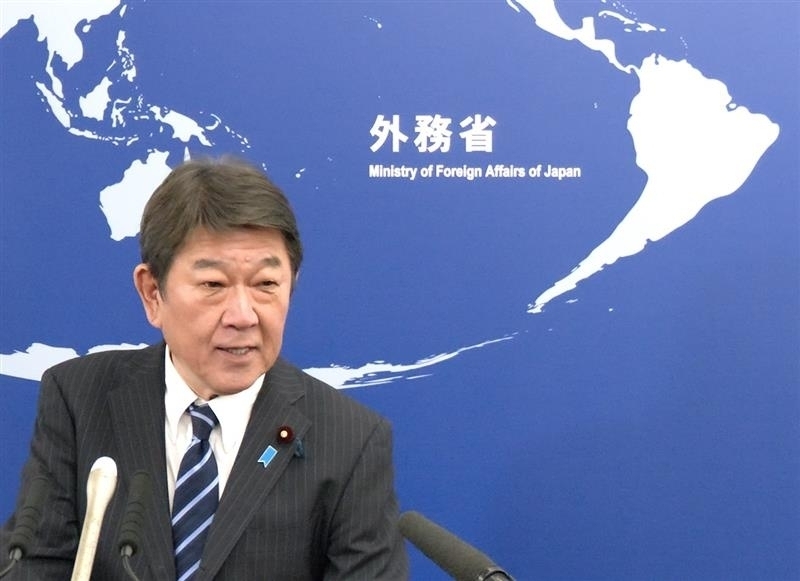
Press Conference by Foreign Minister MOTEGI Toshimitsu
Tuesday, April 21, 2026, 11:57 a.m. Ministry of Foreign Affairs
Japanese
Amendment of the Three Principles on Transfer of Defense Equipment and Technology
Kyodo News, ONDA: I would like to ask about the revision of the Three Principles on Transfer of Defense Equipment and Technology. The revised Three Principles were approved by the Cabinet a short while ago. The Government has explained that the revision of the Three Principles, along with the review of their Implementation Guidelines will contribute to enhancing persistent warfare capabilities. I presume that they are also expected to serve as a diplomatic tool. Could you please elaborate on the significance of the revision and the expectations from a diplomatic perspective? I would also like to ask how the Ministry of Foreign Affairs (MOFA) will be involved in post-transfer monitoring of defense equipment and technology.
Foreign Minister MOTEGI Toshimitsu: We are now in an era in which no country can ensure its own peace and security alone. In this context, it is important to build relationships that allow Japan and its ally and like-minded countries to support one another in times of contingency through security cooperation from peacetime.
Today’s amendment of the Three Principles and -their Implementation Guidelines, in principle, permits overseas transfer of all defense equipment and technology, including finished products. This will contribute to enhancing the defense capabilities of Japan’s ally and like-minded countries, and by extension, to preventing conflicts from occurring, thereby helping to create a desirable security environment for Japan. In this sense, we believe that the amendment holds major diplomatic significance.
Pursuant to the amendment, Japan will ensure appropriate control of arms under the Self-Defense Forces Law by reinforcing the system for monitoring the status of control after transfer occurs. MOFA intends to make every effort to ensure appropriate control, in coordination with relevant ministries and agencies, with the Ministry of Defense playing a leading role.
The Possibility of Lowering the Level of Travel Advice and Warnings for Gulf Cooperation Council (GCC) Member Countries
Pan Orient News, Azhari: MOFA has raised the warning level for GCC countries, Gulf Cooperation Council, to level 3, which means don’t travel there no matter what and consider leaving. This was due to the missile war over Iran. Given that there is the ceasefire agreement now and there is the fact that no Japanese citizens have been or were injured in that area for decades, is MOFA planning to reduce the warning level from level 3 to level 2, or even level1?
Foreign Minister MOTEGI: In light of developments since February 28, including damage to civilian and other facilities in GCC member countries, the Government of Japan raised its Travel Advice and Warnings to Level 3 (Avoid All Travel), and has issued alerts for the whole of Kuwait, Bahrain, Qatar, United Arab Emirates, Oman, as well as Riyadh and Eastern regions of Saudi Arabia.
While there have been no reports of harm to Japanese nationals, the situation surrounding Iran remains fluid. With regard to revising the level of Travel Advice and Warnings, we will continue closely monitoring the situation in each country and make appropriate judgments accordingly.
A Look Back at the First Six Months as Foreign Minister
Shimotsuke Shimbun, OTA: I understand that today marks exactly six months since you assumed office again as Foreign Minister last October, after four years. Amid an extremely severe and complex international environment, you have undertaken numerous important diplomatic engagements since immediately after taking office. Could you please reflect on the past six months and share with us any particularly memorable duties or achievements?
Foreign Minister MOTEGI: To be honest, when I look back on the past six months, I was very busy, and time went by quickly.
The world today is undergoing the most significant structural changes in the international community since the end of World War II—driven by shifts in the balance of power and the intensification of conflicts and confrontations—and the security environment is becoming even more severe. The world I see now is completely different from the one I observed during my first tenure as Foreign Minister four years ago. That is my impression.
Against this backdrop, I have prioritized strengthening cooperation with our ally and like-minded countries. I held a series of Japan-U.S. Foreign Ministers’ meetings, attended the Japan-U.S. Summit Meeting last October and last month, and engaged in discussions at G7 Foreign Ministers’ meetings in Canada and France. Furthermore, I have worked to strengthen the Japan-U.S. Alliance and to enhance cooperation with like-minded countries through close communication, including Australia and European countries.
I have also focused on advancing efforts toward the realization of a “Free and Open Indo-Pacific (FOIP)”, which marks the tenth anniversary of its launch this year. I held extensive discussions and confirmed cooperation with wide-ranging partners, including through participation in ASEAN-related Summit meetings shortly after assuming office, as well as visits to India and the Philippines early this year. I will continue promoting FOIP as a pillar of Japan’s diplomacy and strategically evolve it in line with the changes in the times.
In addition, regarding the recent situation in Iran, immediately after it arose, I have held a series of meetings with relevant countries, including Iran and other parties, and, in close coordination with the international community, have worked to ensure the safety of Japanese nationals, make necessary diplomatic efforts, and call for the cessation of hostilities as soon as possible.
To protect Japanese nationals, evacuate them to safe areas, and arrange their return to Japan, everyone at the Ministry and at relevant diplomatic missions worked day and night. Looking back now, they truly did an outstanding job, and I would like to commend their efforts.
Personally, I made seven overseas visits over the past six months. In retrospect, I held a considerable number of substantive meetings during this period, including Foreign Ministers’ meetings during my overseas visits and more than 30 telephone calls. While the thought of holding another 30 telephone calls may seem daunting, in hindsight, the overall number of telephone meetings I conducted was substantial and the number of in-person meetings was even greater.
Last but not least, I believe that the public’s understanding is essential for pursuing these diplomatic activities. Since assuming office as Foreign Minister, I have made a conscious effort to communicate various diplomatic initiatives and achievements in my own words, and I intend to continue doing so in a timely manner whenever opportunities arise.
Yesterday, I held a Foreign Ministers’ Strategic Dialogue with Foreign Secretary Cooper of the UK. Many of you may have already read the press release, but I believe it was an excellent meeting. We also posted a video of the dialogue on social media, which I think is quite well produced.