
Press Conferences
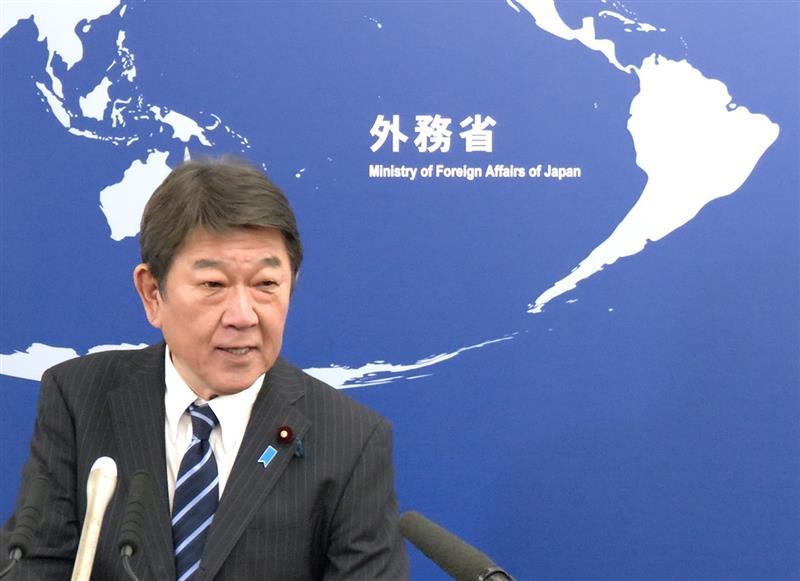
Press Conference by Foreign Minister MOTEGI Toshimitsu
Tuesday, March 17, 2026, 5:33 p.m. Ministry of Foreign Affairs
Japanese
Opening Remarks
Establishment of the International Peace Mediation Unit
Foreign Minister MOTEGI Toshimitsu: I have one announcement today. Today, the Ministry of Foreign Affairs (MOFA) established the International Peace Mediation Unit under the Foreign Policy Bureau of the Ministry. As the international environment becomes increasingly severe and conflicts continue to emerge across the globe, the imperative of preventing disputes before they arise, supporting an early resolution by engaging from the outset of conflicts, and providing seamless support from the realization of a ceasefire through humanitarian assistance, and recovery and reconstruction has become ever more pronounced.
Through the establishment of the International Peace Mediation Unit, MOFA will further strengthen its active and flexible engagement in peace mediation efforts.
That concludes my opening remarks.
Establishment of the International Peace Mediation Unit
Nikkei Shimbun, HORIKOSHI: I would like to ask about the International Peace Mediation Unit you just introduced. First, what do you consider to be Japan’s strengths with respect to inter-state and inter-regional mediation? Second, while there are many regions where conflicts and wars continue, including Gaza and Ukraine, what kind of role does the Government envision for the unit in these regions? Additionally, if there are other situations or incidents in which Japan intends to engage actively, please share them with us.
Foreign Minister MOTEGI: First of all, in principle, it is important to create situations in which conflicts do not arise, rather than actively engaging in conflict mediation.
Regarding Japan’s strengths, for example, in the case of Gaza, Japan maintains strong relationships with both Israel and Palestine. Japan is highly trusted, not only in the Middle East but around the world. In addition, I believe we can leverage the experience and know-how accumulated by each of our regional bureaus and other relevant bodies.
With regard to Gaza, with the ceasefire agreement in effect, Ambassador OKUBO has already begun his assignment at the Civil-Military Coordination Center (CMCC). Ambassador OKUBO will engage seamlessly across challenges, from humanitarian assistance through recovery and reconstruction.
As for Ukraine, we will need to closely monitor how the situation unfolds. In any case, we expect that humanitarian assistance, along with recovery and reconstruction, will also become major challenges in Ukraine, and Japan intends to engage fully in these efforts.
Going forward, we will continuously review the unit while assessing where conflicts may arise and what forms they may take.
President Trump’s Statements on the Dispatch of Vessels to the Strait of Hormuz and Other Related Matters
Jiji Press, CHIBA: I have a question related to the situation in Iran. First, in connection with President Trump’s request to Japan and other countries to dispatch vessels to the Strait of Hormuz, did you gain a clearer understanding of what kind of cooperation the U.S. is seeking during your telephone meeting with Secretary Rubio yesterday? What did you convey to Secretary Rubio about the support Japan can provide? Second, with a summit meeting scheduled this week, if President Trump makes a request, does Japan intend to convey its position on some form of cooperation? Third, during your telephone meetings with the foreign ministers of Iran and Israel, I believe you urged both ministers for an early de-escalation of the situation. Do you intend to urge the U.S. for an early de-escalation?
Foreign Minister MOTEGI: During the Japan-U.S. Foreign Ministers’ Meeting last evening, as already announced in a press release, I exchanged views with Secretary Rubio focusing on the current situation in the Middle East, including the situation surrounding Iran. Secretary Rubio explained the position and efforts of the U.S., and we affirmed that we would continue to maintain close communication. I did not receive any request from the U.S. side regarding the dispatch of vessels.
I would like to refrain from disclosing further details about our exchanges of views as they are diplomatic communications. In any case, amid the continued exchange of retaliatory attacks and the deterioration of the situation across the region, we believe that what is of utmost importance, above all else, is working toward the early de-escalation of the situation. This is a shared recognition among the G7 countries, and a G7 Foreign Ministers’ Meeting was held the day after the situation arose. I believe it goes without saying that we would also say the same to the U.S., just as we have done with other countries.
At the same time, the safety of navigation is also a critically important issue, and there are growing concerns over its potential impact on the Japanese, Asian, and global economy. On this front as well, Japan has taken various measures and initiatives toward achieving regional stability and stable energy supply. At the Japan-U.S. Summit Meeting, and through close communication with relevant countries including the U.S., I expect that in-depth discussions will be held on the necessary measures to be taken, including what Japan can do in light of the current situation.
Japan-U.S. Summit Meeting
Sankei Shimbun, NAGAHARA: You and the Prime Minister will be visiting the U.S. from tomorrow for the Japan-U.S. Summit Meeting. With President Trump mentioning the postponement of his visit to China, it appears that his focus may be shifting from China to the Middle East. Could you share your thoughts on how you intend to approach the meeting in order to maintain U.S. engagement in the Asia-Pacific region?
Foreign Minister MOTEGI: While I am not aware of whether President Trump will postpone his visit to China, I believe such a postponement would not in the least suggest a diminished U.S. interest in Asia. The U.S. has consistently expressed its commitment to cooperating with allies and others toward deterring conflicts in the Indo-Pacific and to the “Free and Open Indo-Pacific” (FOIP), which is a common goal affirmed by Japan and the U.S.
At the Japan-U.S. Summit Meeting, I expect that an in-depth discussion will be conducted on the increasingly severe international environment, including the situation in the Indo-Pacific.
We also intend to make the meeting an opportunity to reaffirm the two countries’ strong commitment to FOIP, a pillar of Japan’s diplomacy that has just marked its tenth anniversary.
Situation in Iran (Intentions for Mediation among Iran, the U.S., and Israel)
Financial Times, Dempsey: Does Japan plan to offer the U.S. the option of mediating between the U.S., Israel and Iran to secure an end to hostilities?
Foreign Minister MOTEGI: Regarding the conflict involving the U.S., Israel, and Iran, or the talks between the U.S. and Iran, various countries such as Qatar and Oman have indeed undertaken mediation efforts. As this issue now concerns not only the region but also the international community as a whole, I believe it is of utmost importance to consider possible measures within the G7, together with the Gulf States and neighboring countries.
Situation in Iran (Oil Suppliers Outside the Middle East)
Independent Web Journal, HAMAMOTO: My question is about the situation in Iran. An oil crisis is beginning to emerge in Japan. While Japan is said to hold strategic oil reserves equivalent to eight months of supply, its actual national reserves cover for only about four months’ worth. You ruled out the option of importing oil from Russia at your recent press conference, but has Japan secured alternative oil suppliers outside the Middle East under the current circumstances? The U.S. has eased sanctions against Russia, removing Russian crude oil and petroleum products from the list of sanctioned items until April 12. In light of this decision, could Russia become one of Japan’s potential options? Thank you.
Foreign Minister MOTEGI: As I have answered this question many times already, I will respond to the part I have not yet covered.
Regarding alternative routes and new sources of supply, we are considering procurement from the Middle East that does not pass through the Strait of Hormuz. We also intend to examine all options without ruling any out, including Central Asia, which has a track record of supply and potential for increased production, as well as South America.
Establishment of the International Peace Mediation Unit
Kyodo News, ONDA: My question is related to the International Peace Mediation Unit you mentioned at the outset. Who is heading the unit, and how many people does it consist of? In addition, my understanding is that the establishment of this unit was part of the coalition agreement reached between the Liberal Democratic Party and the Japan Innovation Party. Could you please explain once again the significance of establishing this unit?
Foreign Minister MOTEGI: Could you please repeat your question?
Kyodo News, ONDA: I understand that the establishment of the International Peace Mediation Unit was included in the coalition agreement with the Japan Innovation Party. Could you please explain again the significance of establishing this unit?
Foreign Minister MOTEGI: As for the significance, it is as I mentioned earlier.
Regarding the head of the unit and its size, as these are matters related to personnel, I believe it is necessary to respond flexibly, as I mentioned earlier.
The idea is to engage proactively and flexibly in peace mediation efforts. Rather than maintaining a fixed number of personnel, I believe that once peace mediation actually begins, the unit will expand in size. When such mediation is unnecessary, though it may not be exactly peacetime, the unit will focus on liaising and coordinating with various bureaus within the Ministry.