
Press Conferences
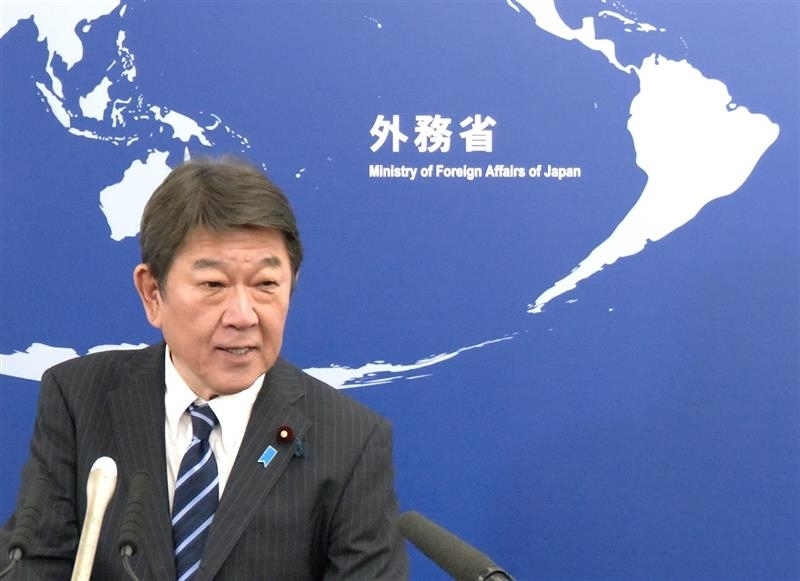
Press Conference by Foreign Minister MOTEGI Toshimitsu
Thursday, February 19, 2026, 12:08 p.m. Ministry of Foreign Affairs
Japanese
Opening Remarks
Thoughts on Reappointment as Foreign Minister
Foreign Minister MOTEGI Toshimitsu: Allow me to begin with a few remarks of my own.
I have been reappointed as Minister for Foreign Affairs in the TAKAICHI administration. I look forward to once again working closely with all of you, members of the press club.
Over the past four months, I have served as Foreign Minister for the second time. Compared to my first tenure in that role, from six to four years ago, I am keenly aware that the world today is undergoing the most significant structural changes in the international community since the end of World War II — driven by shifts in the balance of power and the intensification of conflicts and confrontations —and that the security environment is becoming even more severe.
Situations such as Russia’s aggression against Ukraine, instability in the Middle East, China’s diplomatic posture and military activities in areas surrounding Japan, North Korea’s development of nuclear weapons and missiles, and the concerning development of military cooperation between Russia and North Korea have emerged and continue even now.
In the face of such severe international circumstances, I have no doubt that expectations toward Japan, a country that maintains a consistent diplomatic stance, are rising. In order for Japan to proactively fulfill the roles and responsibilities expected of it by the international community, I intend to pursue “diplomacy that has inclusiveness and strength leading multifaceted and multilayered collaboration.”
Furthermore, in order to ensure Japan’s security, peace, and prosperity, I intend to work steadfastly in close cooperation with the relevant ministers and other officials under the National Security Council (NSC) on matters including the review of the three strategic documents.
The Japan-U.S. Alliance is the cornerstone of Japan’s diplomacy and security, and the foundation for peace and stability in the Indo-Pacific region. We intend to further strengthen the deterrence and response capabilities of the Japan-U.S. Alliance in a multifaceted manner.
Including the upcoming opportunity of Prime Minister TAKAICHI’s visit to the U.S., which we are currently coordinating for the spring, we will strive to maintain close high-level coordination with the U.S., including between the leaders and foreign ministers.
Japan has been advancing the “Free and Open Indo-Pacific” (FOIP) as a pillar of its diplomacy, and it has been ten years since the launch of FOIP. We intend to strategically evolve FOIP in response to the changes over the period and new challenges.
In addition, we will further strengthen cooperation with the G7, ASEAN, Australia, India, the EU, NATO, and other partners, and expand practical and multifaceted cooperation, including through Japan-U.S.-ROK, Japan-U.S.-Australia, Japan-U.S.-Philippines, and Japan-Australia-India-U.S. (Quad) frameworks.
Japan intends to build stable relationships with its neighboring countries, while directly addressing difficult issues and challenges. With the Republic of Korea (ROK), we will work to develop Japan-ROK relations in a future-oriented and stable manner. With North Korea, we will continue to exert all efforts to resolve various issues, starting with the abductions issue.
With China, there are a number of challenges and concerns, including unilateral attempts to change the status quo by force or coercion in the East China Sea and South China Sea, as well as a series of military activities around our country. Peace and stability across the Taiwan Strait are also of utmost importance.
Japan’s policy of comprehensively promoting a “Mutually Beneficial Relationship Based on Common Strategic Interests” and building a “constructive and stable Japan-China relationship” remains unchanged. Precisely because there are issues and concerns, it is all the more important for Japan and China to communicate with each other.
Japan remains open to dialogue with China. At the same time, the Government of Japan will continue to squarely counter any inappropriate remarks by China that are inconsistent with the facts. Indeed, I did so in response to remarks made at the Munich Security Conference. In its relations with China, Japan will continue responding calmly and appropriately based on this stance going forward.
In addition, cooperation with the countries of the Global South, which are gaining a greater voice in the international community, is becoming increasingly important. Through quintessentially Japanese visible development cooperation based on Official Development Assistance (ODA) and through Official Security Assistance (OSA), we intend to advance finely tuned cooperation that takes into account the needs of partner countries, while also providing various forms of capacity building support to partner countries.
Regarding economic diplomacy, in order to strengthen the Japanese economy, the government intends to provide diplomatic backing to firmly support Japan’s technological and problem-solving capabilities, areas in which Japan holds a competitive advantage, as well as the overseas expansion of Japanese companies.
Maintaining and reinforcing the rules-based free and fair international economic order is also essential. We will work toward the strategic expansion of the Comprehensive and Progressive Agreement for Trans-Pacific Partnership (CPTPP), the promotion of the World Trade Organization (WTO) reform, and the development of a “safe, secure, and trustworthy AI” ecosystem.
Furthermore, in order to address the increasingly important challenges of economic security, we will make every effort to secure stable supplies of energy and food, strengthen the resilience of supply chains including for critical minerals, counter economic coercion, and promote the protection and development of critical and emerging technologies.
There are, of course, many more specific matters to address in each of these areas, but in broad terms, these are the policies under which we intend to conduct Japan’s diplomacy going forward.
That concludes my opening remarks.
Review of Japan’s Support for Ukraine and Future Initiatives
Kyodo News, ONDA: Since assuming office, you have expressed your intention to pursue diplomacy unique to Japan, in order to enhance Japan’s presence in the international community. Next week, on the 24th, it will mark four years since Russia’s invasion of Ukraine shocked the international community, which you referred to in your opening remarks. Could you please share the amount of assistance Japan has provided, as well as your reflection on the contributions Japan has made? Secondly, following your reappointment, I would like to reconfirm Japan’s stance on the ceasefire and support for reconstruction, including, in particular, whether Japan intends to participate in the NATO’s, the Prioritized Ukraine Requirements List (PURL) framework. Thank you.
Foreign Minister MOTEGI: Russia’s aggression against Ukraine is, first of all, an outrageous act that shakes the very foundation of the international order, and Japan cannot condone such attempts to unilaterally change the status quo by force. Realize a just and lasting peace in Ukraine as soon as possible is essential, and this was the very issue discussed at the recent G7 Foreign Ministers’ Meeting in Munich. There is no change in Japan’s stance.
As to your question regarding Japan’s support for Ukraine, to date we have committed and are steadily providing assistance totaling approximately USD 20 billion across humanitarian, financial, and recovery and reconstruction fields, in coordination with the G7 and other countries. We have also provided equipment such as bulletproof vests and Japan Self-Defense Force vehicles, among other forms of support.
We will continue to work closely with the international community and provide assistance, including recovery and reconstruction support through public-private efforts to ensure Ukraine’s social and economic resilience.
With regard to PURL, which you mentioned, we will continue coordinating with the NATO, as affirmed during my meeting with NATO Secretary General Rutte on February 14.
Japan, a country in Asia, has provided support at this level to Ukraine, and I believe that such efforts by Japan have been highly valued by many countries. For my part, I have addressed this issue with a sense of crisis, recognizing that “Ukraine today may be East Asia tomorrow.” At the same time, the security of the Euro-Atlantic and of the Indo-Pacific are inseparable. Furthermore, attempts to unilaterally change the status quo by force or coercion, anywhere in the world, must be firmly opposed by allies and like-minded countries working together. It is with this conviction that I have approached, and will continue to approach, this issue going forward.
The Ideal Form of an Evolved FOIP
Asahi Shimbun, MIYAWAKI: Regarding FOIP, which you mentioned in your opening remarks, please share your thoughts on the ideal form of a “New FOIP,” that is, an FOIP that will be strategically evolved going forward. Furthermore, in addition to the use of military force by Russia and Israel, the United States has conducted military operations against Venezuela, and the existing international order is wavering. In this context, what significance and influence do you believe the “rule of law” holds in the current international situation?
Foreign Minister MOTEGI: As I mentioned, it has been ten years since FOIP was launched. Since then, the international situation and security environment surrounding Japan have become increasingly severe. New challenges in the areas of economic security and international competition over emerging technologies have also emerged and intensified. In addition, significant structural changes, such as the rise of the Global South, are under way. At this 10th anniversary, with such major changes taking place, we believe it is necessary to strategically evolve FOIP in the manner that best responds to these changes.
When Prime Minister ABE first proposed FOIP in Kenya ten years ago, the broad underlying vision was that the Indo-Pacific region would become a central driver of global development, and that making this region free and open, from trade to connectivity, would contribute to the development of the world as a whole. Given the circumstances of that time, this was a sweeping vision that attracted considerable attention and gained support. Since then, however, issues like economic security, such as critical minerals, have become matters of utmost importance for many countries in the Indo-Pacific region. Building resilient supply chains did not attract much attention at that time, but it has since become one of the most critical issues. Moreover, while matters such as the safety of sea lanes were already considered at that time, the importance of so-called maritime security have since grown significantly. Supporting the nations’ capacity building to strengthen their own maritime security capabilities, including port development, has become increasingly important. Through means such as OSA, we believe it is becoming even more critical to advance multilateral support for strengthening the security capabilities of each country, and we intend to advance the strategic evolution of FOIP with these elements in mind.
At the same time, the fundamental principles of FOIP, such as upholding freedom, the rule of law, respecting diversity, inclusiveness, and openness, remain entirely unchanged. These are basic principles that will endure regardless of how the environment changes. We are firmly committed to maintaining these principles going forward.
In advancing the strategic evolution of FOIP, it is important for Japan to seek to proactively fulfill the roles and responsibilities expected of it by the international community through a broad range of initiatives that address the changes of the times, while holding firm to the principles I have just described. How to evolve FOIP and give it concrete form is, we believe, the very pillar of Japanese diplomacy.