
Press Conferences
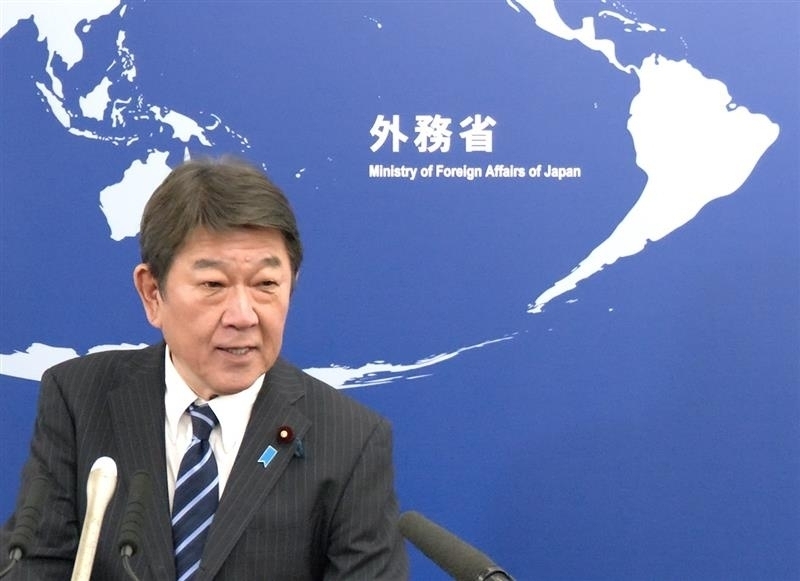
Press Conference by Foreign Minister MOTEGI Toshimitsu
Friday, December 5, 2025, 4:30 p.m. Ministry of Foreign Affairs
Japanese
Japan-China Relations (Response to China’s Measures)
Yomiuri Shimbun, SATO: I would like to ask about Japan-China relations. December 7 will mark one month since Prime Minister TAKAICHI’s responses in the Diet regarding a Taiwan contingency. During this period, China has intensified its opposition and has taken measures to restrict people-to-people exchanges and economic activities. What responses do you consider necessary to reduce Japan’s dependence on China in economic and other sectors?
Foreign Minister MOTEGI Toshimitsu: Japan and China have reaffirmed a broad direction to comprehensively promote a “Mutually Beneficial Relationship Based on Common Strategic Interests” and build “constructive and stable Japan-China relations.” Japan will continue to closely monitor the situation and take necessary responses.
That being said, we believe it is critical to strengthen the resilience of supply chains, irrespective of the China issue. To diversify and strengthen the resilience of supply chains, Japan should work closely with the countries concerned and accelerate the necessary initiatives.
By this, I am referring not merely to rare earths, but also to various supplies, including energy and food. We consider diversifying these supply chains necessary as a global trend.
Release of the U.S. National Security Strategy
Kyodo News, SAKAGUCHI: The U.S. Government released the first National Security Strategy under the second Trump administration, in which it describes the Indo-Pacific as “key economic and geopolitical battlegrounds.” It states that the U.S. Government maintains its policy of not supporting any unilateral change to the status quo in the Taiwan Strait. On the other hand, it calls on allies, including Japan, to significantly increase defense spending as a share of GDP, and explicitly states that the U.S. urges Japan and the Republic of Korea (ROK) to increase their defense burden-sharing to protect the First Island Chain. What is your view on this security strategy, and how does Japan intend to respond to these U.S. requests?
Foreign Minister MOTEGI: The U.S. released a new National Security Strategy. We are currently reviewing its content, and I would like to refrain from commenting on the details at this point. Your question reffered to the reinforcement of defense capabilities. Japan is already taking proactive steps in this direction. We will bring forward the defense budget to the level of 2% of GDP and revise the three security-related documents by the end of next year. These measures are being taken not at the request of others but Japan in response to the most complex and severe security environment surrounding the country since the end of World War II.
That being said, there is no question that the Japan-U.S. Alliance is the cornerstone of Japan’s diplomacy and security. Japan and the U.S. will continue to work together closely and strengthen the deterrence and response capabilities of the Japan-U.S. Alliance.
Japan-Australia-India-U.S. (Quad)
Sankei Shimbun, NAGEHARA: I would like to ask about the Japan-Australia-India-U.S. cooperation framework, the Quad. While I believe the Quad is an essential framework for realizing a “Free and Open Indo-Pacific” (FOIP), as advocated by the TAKAICHI administration, the Quad Leaders’ Meeting has yet to be held this year due to the U.S.-India confrontation over tariff issues. Please share your views on how the Government of Japan will reach out to the other Quad members to ensure the meeting is held by the end of the year.
Foreign Minister MOTEGI: The Quad held its first Foreign Ministers’ Meeting on the occasion of the United Nations General Assembly session in September 2019, during my previous tenure as Foreign Minister. Later, the Leaders’ Meeting was launched, bringing us to where we are today. Japan attaches importance to the Quad as an initiative among four countries that share fundamental values to advance various practical cooperation in a wide range of areas toward the realization of FOIP.
During President Trump’s visit to Japan in October, Prime Minister TAKAICHI and President Trump reaffirmed the importance of strengthening networks among like-minded partners, including the Quad.
While the date of the next Quad Leaders’ Meeting is not decided at this point, Japan will continue working to further deepen the quadrilateral cooperation and strongly promote initiatives that truly benefit the countries in the region, and will make efforts toward this end.
Inviting China to the G7
Jiji Press, CHIBA: I would like to ask about China-France relations. There have been reports that President Macron is considering inviting President Xi Jinping to next year’s G7 Summit, and that the Government of Japan has asked France to handle this issue carefully. First, please tell us the facts. Additionally, at the China-France Summit Meeting yesterday, President Macron reportedly conveyed his view that the G7 should cooperate with China in addressing economic imbalances and other issues. What are your thoughts on inviting or engaging China in the G7?
Foreign Minister MOTEGI: I am aware of the reports. However, regarding the so-called “outreach” or invited countries for next year’s G7 Summit under the French Presidency, it is my understanding that nothing has been decided at this point.
This year’s G7 Summit included quite a number of outreach countries. I believe invited countries are determined based on the themes of each summit among other factors.
That being said, Japan attaches importance to the unity of the G7, which shares fundamental values such as freedom, democracy, and the rule of law, as well as strategic interests. We also place importance on close coordination and cooperation within the G7 and believe that dialogue for this purpose is necessary.
Looking ahead to next year’s G7, we intend to continue having thorough discussions with France, which will hold the G7 Presidency, as well as other G7 member states, including on what the key themes should be and which countries should be invited as outreach countries.
The Government of Japan’s Position on Taiwan
Bloomberg, MURAKAMI: I would like to ask about Japan-China relations. Regarding Taiwan, the Government of Japan has explained to China that Japan’s position is as articulated in the 1972 Japan-China Joint Communique, and that there is no change in this position. Meanwhile, the Chinese authorities have commented that this explanation is certainly unacceptable, and they are questioning why Japan has not clearly stated its legal obligations under its basic position. What are the Government of Japan’s thoughts on the Chinese side’s interpretation that Japan is not clarifying its legal obligations? Please also share whether the Government intends to provide a more explicit and detailed clarification of its legal obligations when explaining Japan’s position to China.
Foreign Minister MOTEGI: I am not quite sure about the intent of your question. Would you mind repeating it?
Bloomberg, MURAKAMI: Regarding Prime Minister TAKAICHI’s recent explanation that Japan’s position on Taiwan is as articulated in the 1972 Japan-China Joint Communique and there is no change in this position, the Chinese side has questioned why Japan is unwilling to clearly state its legal obligations under its basic position, expressing this at a press conference. Could you please share the Government of Japan’s thoughts on this and whether it intends to clarify its legal obligations when communicating with China or explaining its position to China?
Foreign Minister MOTEGI: I am still not quite sure what the intent of your question is. The Japan-China Joint Communique of 1972 is not something Japan created on its own. As a matter of course, negotiations took place between Japan and China, and I understand that the content was agreed upon by then-Prime Minister TANAKA and then-Premier Zhou Enlai of China after spending considerable time negotiating the wording and other details. So, I am not quite certain what you mean by your question.
Survival-Threatening Situation and Japan-China Relations
Independent Web Journal, HAMAMOTO: I would also like to ask about Japan-China relations. In your press conference on November 28, you stated that “Japan’s basic position on Taiwan is as articulated in the 1972 Japan-China Joint Communique.” This appears to affirm that the Government of Japan continues to maintain the stance articulated in the Japan-China Joint Communique: severing diplomatic relations with Taiwan, recognizing the Republic of China as the legitimate government, respecting the “one China”, ending the state of war, and restoring diplomatic relations with China. You also stated that you expect that the issue surrounding Taiwan will be resolved peacefully by dialogue. The word “expect” would not be interpreted as suggesting military intervention and does not contradict the Joint Communique. Your view is extremely prudent. I believe the Government should act swiftly to normalize relations with China by aligning the Cabinet around the view you expressed, correcting Prime Minister TAKAICHI’s remarks regarding a survival-threatening situation, and bringing the situation under control. I would like to hear your opinion on this.
Foreign Minister MOTEGI: I appreciate your positive comments about my remarks.
That being said, as your question was based on a recognition that differs from the Government’s on several points, I would like to restate the Government’s position. First, regarding the Government’s view on the determination of a survival-threatening situation, whether any given situation constitutes a survival-threatening situation will be determined by the Government comprehensively, based on all available information and the specific circumstances of each individual case that occurred. This explanation has been reiterated by the Government since Prime Minister ABE’s administration when the Legislation for Peace and Security was enacted. I believe the Government’s position has remained consistent.
Second, as I stated recently, the Government of Japan’s basic position on Taiwan is as articulated in the 1972 Japan-China Joint Communique. We expect that the issue surrounding Taiwan will be resolved peacefully by dialogue. This is not my personal opinion but the consistent position Japan has held.
The Japanese side is always open to dialogue between Japan and China. Precisely because there are issues and concerns between us as neighboring countries, not only with China but also with the ROK, we believe it is important to reduce such issues and concerns as much as possible through discussions and dialogues, while also advancing mutual understanding and cooperation since there are also areas where cooperation is possible.
Cooperation on Disaster Risk Reduction for India and Southeast Asia
Asian News International, ITAGAKI: Recently, the Chief Minister of Punjab State and members of a business delegation visited Japan. Attracting investment was their primary objective. At the same time, as Punjab State was hit by large-scale flooding in July that caused significant damage, its attention is focused on Japan. In particular, they even pointed out that, in Tomioka Town in Fukushima, where not only did the nuclear accident have ramifications but also the tsunami swept away the soil, new soil was brought in from elsewhere to open a winery, and wine is now being produced. As this example indicates, Punjab State is paying keen attention to Japan. Japan has gained deep expertise in disaster responses and reconstruction, not only related to Fukushima but across the country, and I think India, as well as Southeast Asia, has strong interest in this field. In this context, could you please share your thoughts on this situation and your outlook for the future?
Foreign Minister MOTEGI: First of all, I would like to once again extend my heartfelt sympathies to the affected people in Punjab State, India.
As you noted, Japan is a disaster-prone country and has also rebuilt itself from the Great East Japan Earthquake. Building on these experiences, Japan aims to become the leading nation for disaster risk reduction in the world. Japan has led and will continue to lead international cooperation in this field.
Recently, major disasters struck Southwest Asia, including India, as well as Thailand, Sri Lanka, and Indonesia. in Southeast Asia. Japan has provided emergency assistance and support forrecovery and reconstruction following disasters, as well as assistance for disaster readiness, including the installation of quality infrastructure for disaster risk reduction and human resource development. For example, in Sri Lanka, which was recently hit by a cyclone, medical waste incinerators equipped with proper disaster countermeasures — provided through Japan’s official development assistance (ODA) —were unaffected by the floods and remained usable after the disaster. I have been informed of such cases. By leveraging Japan’s technologies and know-how, we intend to contribute even more to making the world resilient against disasters, including through fine-tuned cooperation and assistance for India and Southeast Asian countries.
Views on G7 Expansion
Kyodo News, SAKAGUCHI: I would like to follow up on the earlier question regarding the G7. U.S. President Trump previously stated that the removal of Russia from the G8 was a mistake, and now there are reports that France is considering inviting China to the G7. What are your thoughts on the idea of expanding the G7? Furthermore, as you mentioned earlier, I understand that countries that share fundamental values and principles are G7 member states. What kind of political system do you think the future G7 member countries should have?
Foreign Minister MOTEGI: While this partly reiterate my answer to the earlier question, Japan attaches importance to the unity of the G7, which shares fundamental values such as freedom, democracy, and the rule of law, as well as strategic interests, and places importance on close coordination and cooperation within the G7. Together with other G7 member states, we will consider what form would be appropriate in line with these principles.