
Press Conferences
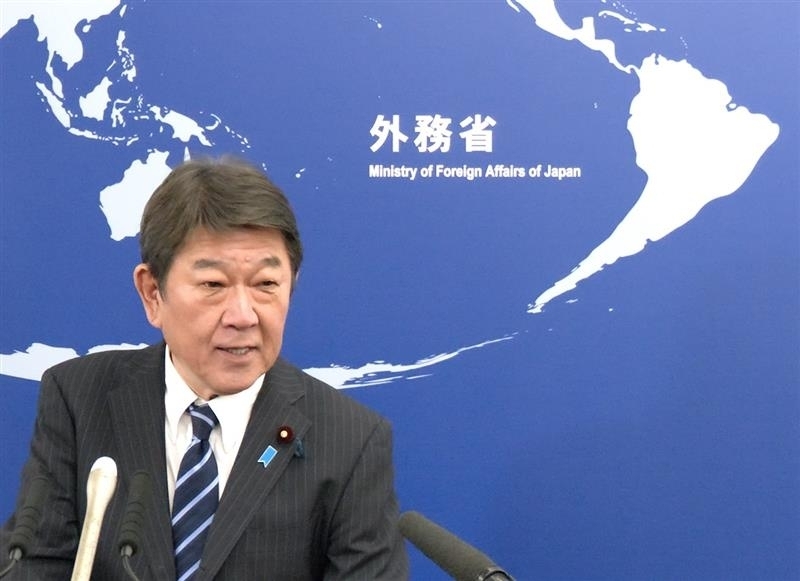
Press Conference by Foreign Minister MOTEGI Toshimitsu
Tuesday, December 2, 2025, 4:34 p.m. Ministry of Foreign Affairs
Japanese
Japan-Soviet Joint Declaration
Hokkaido Shimbun, MURAKAMI: I have a question about the Japan-Soviet Joint Declaration of 1956. Next year will mark 70 years since the declaration was signed. First, I would like to ask again about what significance the declaration holds for postwar Japan-Soviet and Japan-Russia relations. Second, although the Joint Declaration enabled the repatriation of Japanese citizens who were detained in the former Soviet Union, collection of the remains of Japanese citizens has made little progress. How do you view this situation? Third, the Joint Declaration states that two of the islands that make up the Northern Territories, Habomai and Shikotan, would be transferred to Japan after the conclusion of a peace treaty. An agreement was then reached with the Russian side in 2018 to accelerate negotiations on a peace treaty based on the Joint Declaration. I would like to ask again whether this agreement remains valid. Thank you.
Foreign Minister MOTEGI Toshimitsu: Next year will mark the 70th anniversary of the Japan-Soviet Joint Declaration. It is a basic document that ceased the state of war between the two countries, restored their diplomatic relations, and set the starting point for the negotiation process toward the conclusion of a peace treaty.
Since the declaration, negotiations have been conducted in various forms, and several agreements have been reached, including agreements other than the document you just mentioned, leading us to where we are today.
Regarding the collection of remains of Japanese citizens who died during their detainment in Siberia, the Ministry of Foreign Affairs (MOFA) will work together with the Ministry of Health, Labour and Welfare and coordinate with the Russian side to ensure that collection of remains resumes promptly, and that as many remains as possible are collected and returned to their families.
You asked about the Singapore agreement. As I stated earlier, once negotiations on a peace treaty resume, we will negotiate m on the basis of the agreements and documents concluded between Japan and Russia, including the one you mentioned. During my previous tenure as Foreign Minister, I visited Moscow in December 2019 and held negotiations with Foreign Minister Lavrov for a full eight hours. And at that times, we moved forward with the negotiations, discussing various past agreements that had been reached. That was my experience, and I think this is how it works.
Issue of Taiwan
Asahi Shimbun, MIYAWAKI: I have a question related to China. At the end of last week, Foreign Minister Wang Yi of China held a series of consultations with senior government officials, including Diplomatic Adviser to the President Bonne of France and the Prime Minister’s National Security Adviser Powell of the UK, and urged them to support China on the issue of Taiwan. China is not only posting information on social media and making appeals to the United Nations. China is also seeking to shape public opinion that is favorable to itself through bilateral meetings. How does the Government of Japan intend to respond?
Foreign Minister MOTEGI: I also meet with the foreign ministers and ambassadors of various countries. When I meet with my counterparts from individual countries, I make an effort to provide a clear explanation of Japan’s position in an appropriate manner, and seek to obtain their understanding.
We are aware of the various actions China has taken, including those that you referred to. If the Chinese side made any assertions about Japan’s policies or position that are inconsistent with the facts, the Government of Japan has accurately countered them and communicated the facts by clarifying that such assertions are incorrect.
At the same time, it is essential to obtain understanding of other countries on the Government of Japan’s position. As I stated at the outset, the Government as a whole, including myself, has been explaining Japan’s position to other countries on various occasions and will continue to do so.
Japan-China Relations (Parliamentary and Business Community Exchanges)
Kyodo News, HIGA: I would also like to ask about Japan-China relations. Yesterday, House of Representatives member OBUCHI Yuko of the Liberal Democratic Party and other members of the bipartisan Japan-China Parliamentary Friendship Association met with Mr. Wu Jianghao, Ambassador of China to Japan, and conveyed their intention to visit China by the end of this year. Furthermore, Chairman TSUTSUI of KEIDANREN (Japan Business Federation) met with the ambassador last month and requested the acceptance for visit to China in January next year. Amid the deteriorating bilateral relationship, what significance do you attach to these continued exchanges with China by Diet members and the business community? Additionally, please tell us how MOFA will be supporting these exchanges.
Foreign Minister MOTEGI: As I have repeatedly stated in my press conferences, Japan and China have concurred on a broad direction to comprehensively promote a “Mutually Beneficial Relationship Based on Common Strategic Interests” and build “constructive and stable Japan-China relations.”
The Government believes that it is extremely important to reduce issues and concerns, and deepen and expand mutual understanding and cooperation through a series of dialogues and exchanges in various fields and at multiple levels, including not only through diplomatic channels but also by parliamentary members and the business community. This way, we would like to promote parliamentary diplomacy and exchanges within the business community. Japan remains open to various forms of dialogue. This remains unchanged.
Assistance in Response to the Damage Caused by Natural Disasters in Sri Lanka, Thailand, and Indonesia
Nikkei Shimbun, HORIKOSHI: Changing topics, I would like to ask about the cyclone damage in Southeast Asia. The Government has decided to dispatch a Medical Team to Sri Lanka. Indonesia and Thailand were also hit by the cyclone and suffered damage. I believe Japan has know-how about preventing and recovering from water-related disasters. How does Japan intend to utilize this know-how to provide its assistance? Please also share with us if you are considering any assistance other than the dispatch of the Medical Team. Lastly, there have been some criticisms recently about allocating money for these overseas assistances. What benefits do you think be brought to Japan by providing disaster response and development assistance to developing countries?
Foreign Minister MOTEGI: The three countries you just noted suffered serious damage. Many lives have been lost and many people have been affected. These are also important friendly countries for Japan, and I think it is only natural that Japan provides necessary assistance to them. I do not believe such assistance has resulted in major criticisms. Japan will continue to demonstrate that it is a country that stands ready to address humanitarian issues.
In response to the request from the Government of Sri Lanka, the Government of Japan has decided to provide emergency relief goods and dispatch an International Emergency Assistance Team and Medical Team. The Medical Team is scheduled to depart Japan tomorrow, on December 3.
Furthermore, upon the request of Thailand, Japan has decided to provide emergency relief goods and transferred them to Thailand today.
As for Indonesia, it has suffered damage from heavy rains. A Japan International Cooperation Agency (JICA) expert team has been dispatched to the affected areas and is currently assessing their assistance needs.
Appointment of the Ambassador of Japan to Indonesia
Indonesia Tribune, Susilo: Regarding the Ambassador of Japan to Indonesia, could you share approximately when the new Ambassador is expected to be appointed? If they have not yet left for Indonesia, I would like to interview them beforehand. Thank you.
Foreign Minister MOTEGI: I understand your wish to conduct an interview, and we hope to make a decision as early as possible.
Indonesia and Japan are comprehensive and strategic partners with close friendly relations. In addition to strengthening bilateral relations, Japan attaches importance to working with Indonesia on regional and international issues. At last month’s Japan-Indonesia Foreign and Defense Ministerial Meeting, “2+2,” I confirmed with the Indonesian side about strengthening our relations. Following the meeting, I held a working dinner with Minister Sugiono, where we agreed to further deepen diplomatic and security cooperation between the two countries, as well as cooperation in wide range of areas, such as agriculture, response to climate change, and energy policy.
The new Ambassador to Indonesia has not yet been decided at this point. However, given Indonesia’s importance, we would like to select and dispatch a suitable person as early as possible so that the bilateral partnership can be further developed in various fields.
The decision may be made suddenly. Let me inform you: please make sure to closely follow the developments so that you don’t miss the opportunity to interview the Ambassador in time.