
Diplomatic Bluebook 2026
Chapter 2
Japan's Foreign Policy by Region
3 Central Asian and Caucasus countries
(1) Overview
Central Asian and Caucasus countries are situated in a location of geopolitical importance that connects East Asia, South Asia, the Middle East, Europe, and Russia, and have abundant energy and mineral resources such as oil, natural gas, uranium, and rare metals. The stability of the entire region, including Central Asia and the Caucasus countries, has also been of great importance in addressing key issues the international community is facing, such as the fight against terrorism and drug problems.
In the wake of Russia's aggression against Ukraine, Central Asian and Caucasus countries that have close historical and economic ties with Russia have each been forced to take a cautious approach. Central Asian and Caucasus countries have been absent from or abstained from voting on UN General Assembly resolutions related to the aggression against Ukraine, with the exception of Georgia, which has expressed support for Ukraine, and many of these countries have avoided making their positions clear externally. Meanwhile, Japan and the five Central Asian countries have concurred, seizing various opportunities including the framework of the “Central Asia plus Japan” Dialogue, on the importance of upholding the Charter of the UN and other international laws, which includes respecting the independence, sovereignty, and territorial integrity of all countries and peacefully settling disputes.
Japan and the Central Asian and Caucasus countries have traditionally maintained friendly relations. Following the independence of these countries upon the dissolution of the Soviet Union, Japan was among the first to establish diplomatic relations, and continues its efforts to strengthen bilateral relations with Central Asian and Caucasus countries through high-level dialogues, economic cooperation, and other means.
In addition, in light of the current international situation, the importance of the “Trans-Caspian International Transport Route,” a transportation route linking Central Asia and Europe, is attracting increasing attention from Central Asian and Caucasus countries as well as Western countries. Japan is also focusing on enhancing connectivity within the region, and from Central Asia to the world and promoting economic cooperation, including facilitating logistics by speeding up customs clearance.
In recent years, there has also been a growing movement among Central Asian countries and neighboring countries to promote regional cooperation. In 2025, there were a number of meetings attended by the leaders of Central Asian countries, including a Shanghai Cooperation Organization (SCO) summit meeting (August), a Commonwealth of Independent States (CIS) summit meeting (October), and a Collective Security Treaty Organization (CSTO) summit meeting (November). In addition, between the Kyrgyz Republic and Tajikistan, a treaty on the border was signed in March, representing the fruition of years of negotiations through constructive dialogue between the two governments on their border, which had remained undelimited since the collapse of the Soviet Union.
Between Armenia and Azerbaijan, in August, the leaders of the two countries signed a joint declaration toward a peace agreement to end a conflict spanning more than 30 years, witnessed by President Trump of the U.S. In response, Japan issued a Foreign Minister's Statement welcoming the signing of the declaration, and expressed high appreciation for the mediation efforts by the U.S., including by President Trump, as well as expectation that the signing of the document would lead to the achievement of peace and ultimately a final resolution of the conflict between the two countries, bringing lasting peace and prosperity to the Caucasus region. Georgia regards EU and NATO membership as foreign policy priorities. While the European Council granted Georgia the status of an EU candidate country in December 2023, Prime Minister Irakli Kobakhidze announced in November 2024 that Georgia would not begin the EU accession process until the end of 2028. This prompted citizens supporting EU accession to launch large-scale protest activities, which led to clashes with security forces and many arrests and injuries. Japan issued a Press Secretary's Statement expressing concerns over the situation and urging the Georgian government to exercise restraint to avoid a further deterioration of the situation and expressing Japan's hope that the Georgian government would take a constructive approach that would gain the understanding of its people and that the situation would calm down as soon as possible. It should be noted that problems exist regarding South Ossetia and Abkhazia, and Georgia has severed diplomatic relations with Russia.
(2) Central Asian Countries
The countries of Central Asia are partners of Japan in maintaining and strengthening a free and open international order, and Japan is promoting diplomacy aimed at contributing to peace and stability in Central Asia.
Japan launched the framework of the “Central Asia plus Japan” Dialogue (CA+JAD) in 2004, based on the recognition that interregional cooperation is indispensable for the development of Central Asia. With Japan playing a catalytic role, the framework promotes intraregional cooperation with the Central Asian countries as the main actors. Japan and the Central Asian countries have promoted cooperation in various fields including politics, economy, and people-to-people exchanges, through up to ten Foreign Ministers' Meetings including online meetings, Senior Officials Meetings (SOM), and business dialogues by government officials, expert meetings on topics such as drug control and border management, and tourism, as well as the Tokyo Dialogue (an open symposium by experts) on topics such as connectivity with Central Asia and the Caucasus. In addition, in February 2025, the Ministry of Foreign Affairs of Japan invited law enforcement officials from the five Central Asian countries to Japan and held the “Central Asian Counter Terrorism Workshop: Building Cooperation and Coordination to Promote the Rule of Law,” confirming cooperation in international counter-terrorism measures.
In recent years, the international community has shown increasing interest in strengthening relations with the Central Asian countries, and with the U.S., the EU, the Gulf Cooperation Council (GCC),(6) China, Russia, India, Germany, and Italy holding summit meetings with the Central Asian countries, Japan held the Summit of the “Central Asia plus Japan” Dialogue (CA+JAD) for the first time in December 2025. (See the Column on page 165) At the summit the leaders of the six countries adopted a Joint Declaration (Tokyo Declaration) where the “CA+JAD Tokyo Initiative” for a mutually beneficial relationship to support the industrial upgrading and diversification of Central Asia have been launched and “Green and Resilience,” “Connectivity,” and “Human Resource Development” are announced as the three priority areas of cooperation. Prior to the summit, from January through February, Special Advisor to the Prime Minister NAGASHIMA Akihisa visited the five Central Asian countries as Special Envoy of the Prime Minister, and exchanged views on cooperation toward the Summit of the “Central Asia plus Japan” Dialogue and bilateral relations through meetings with the foreign ministers and other officials of each country, and courtesy calls to the Presidents of Kazakhstan and Uzbekistan. In addition, in August, Foreign Minister Iwaya visited Kazakhstan and Uzbekistan, and concurred to hold the Summit of the “Central Asia plus Japan” Dialogue at an early date. Japan will continue to strengthen its relations with Central Asia through high-level dialogues and other means. Regarding relations with Uzbekistan, in August, Head of the Department of Creative Economy and Tourism of the Presidential Administration Gayane Umelova visited Japan on the occasion of Uzbekistan's National Day at the Expo 2025 Osaka, Kansai, Japan. Furthermore, in the same month, Foreign Minister Iwaya of Japan visited Uzbekistan, held the first-ever Japan-Uzbekistan Foreign Ministers' Strategic Dialogue with Foreign Minister Bakhtiyor Saidov, and paid a courtesy call on President Shavkat Mirziyoyev and others. At the Foreign Ministers' Strategic Dialogue, the two sides discussed cooperation toward the early holding of the Summit of the “Central Asia plus Japan” Dialogue and bilateral relations, and after the meeting, the Joint Communiqué of the First Foreign Ministers' Strategic Dialogue was signed by the two foreign ministers, and letters were signed and exchanged regarding the Grant Aid project “Project for Human Resource Development Scholarship” and the “Project for Promoting Economic Activities in Surkhandarya Region through Supporting Self-reliance of Vulnerable People including Afghan People.” In December, a summit meeting was held between President Mirziyoyev, who visited Japan to attend the Summit of the “Central Asia plus Japan” Dialogue, and Prime Minister Takaichi, resulting in the announcement of a “Joint Statement on Expanded Strategic Partnership for future generations.” Prior to the Dialogue Summit, the Exchange of Notes regarding the Yen Loan “Livestock Promotion and Animal Health Enhancement Project” was signed and exchanged.
 Courtesy call by Foreign Minister Iwaya on President Mirziyoyev of Uzbekistan (August 27, Tashkent, Uzbekistan)
Regarding relations with Kazakhstan, in March, Deputy Prime Minister and Foreign Minister Murat Nurtleu visited Japan as a guest of the Ministry of Foreign Affairs, held a meeting with Foreign Minister Iwaya, and paid courtesy calls on Prime Minister Ishiba and Chief Cabinet Secretary HAYASHI Yoshimasa. In addition, Minister of Trade and Integration Arman Shakkaliyev visited Japan on the occasion of Kazakhstan's National Day at the Expo 2025 Osaka, Kansai, Japan in August. Furthermore, in the same month, Foreign Minister Iwaya of Japan visited Kazakhstan, paid a courtesy call on President Kassym-Jomart Tokayev and others, and held a Foreign Ministers' Meeting with Deputy Prime Minister and Foreign Minister Murat Nurtleu, at which the two foreign ministers signed and exchanged the notes on grant aid for “the Economic and Social Development Programme” (support for nuclear test victims: provision of medical equipment). In December, a summit meeting was held between President Tokayev, who visited Japan to attend the Summit of the “Central Asia plus Japan” Dialogue, and Prime Minister Takaichi, and as an outcome, the “Joint Statement between the Republic of Kazakhstan and Japan on Further Synergy of the Future-Oriented Expanded Strategic Partnership” was announced, and the two sides agreed to begin consultations toward the conclusion of an aviation agreement.
 Courtesy call by Foreign Minister Iwaya on President Tokayev of Kazakhstan (August 25, Astana, Kazakhstan)
Regarding relations with the Kyrgyz Republic, Deputy Chairman of the Cabinet Edil Baisalov visited Japan on the occasion of the Kyrgyz Republic's National Day at the Expo 2025 Osaka, Kansai, Japan in June. In December, a summit meeting was held between President Sadyr Zhaparov, who visited Japan to attend the Summit of the “Central Asia plus Japan” Dialogue, and Prime Minister Takaichi, and as an outcome, the “Joint Statement on Further Development of Relations between Japan and the Kyrgyz Republic to Co-create Mutually Beneficial Cooperation” was announced. In addition, a meeting was held between Minister of Foreign Affairs Jeenbek Kulubayev, who accompanied the President, and Foreign Minister Motegi, and on this occasion, the “Cooperation Program between the Ministry of Foreign Affairs of Japan and the Ministry of Foreign Affairs of the Kyrgyz Republic for 2026–2027” and the Japan-Kyrgyz Republic Tax Agreement were signed.
 Japan-Kyrgyz Foreign Ministers' Meeting (December 19, Tokyo)
Regarding relations with Tajikistan, in May, State Minister for Foreign Affairs FUJII Hisayuki attended the “High-Level International Conference on Glaciers' Preservation” held in Dushanbe as a representative of the Government of Japan, and held meetings with Foreign Minister Sirojiddin Muhriddin and other government officials, exchanging views on bilateral relations and other matters. First Deputy Prime Minister Hokim Kholiqzoda visited Japan on the occasion of Tajikistan's National Day at the Expo 2025 Osaka, Kansai, Japan in June. In addition, in the same month, the 3rd Meeting of the Japan-Tajikistan Intergovernmental Commission for Economic, Technological and Scientific Cooperation was held in Tokyo. In December, a summit meeting was held between President Emomali Rahmon, who visited Japan to attend the Summit of the “Central Asia plus Japan” Dialogue, and Prime Minister Takaichi, and as an outcome, the “Joint Statement between Japan and the Republic of Tajikistan on Further Development of Relations to Co-create Mutually Beneficial Cooperation” was announced. In addition, a Foreign Ministers' Meeting was held between Minister Sirojiddin Muhriddin, who accompanied the President, and Foreign Minister Motegi, and on this occasion, the “Cooperation Program between the Ministry of Foreign Affairs of Japan and the Ministry of Foreign Affairs of the Republic of Tajikistan for 2026–2028” and the Japan-Tajikistan Investment Agreement were signed.
 Japan-Tajikistan Foreign Ministers' Meeting (December 19, Tokyo)
Regarding relations with Turkmenistan, in April, on the occasion of the Turkmenistan National Day ─ the first National Day Event of Expo 2025 Osaka, Kansai, Japan ─ President of Turkmenistan Serdar Berdimuhamedov visited Japan and held a summit meeting with Prime Minister Ishiba, confirming that the two countries would work closely together toward deepening their bilateral relationship as a mutually beneficial partner based on friendship and mutual trust, with a joint press release issued as an outcome of the meeting. In November, the Japan-Turkmenistan Tax Convention entered into force. In December, President Berdimuhamedov, who visited Japan again to attend the Summit of the “Central Asia plus Japan” Dialogue, held a summit meeting with Prime Minister Takaichi, and a joint press release was issued as an outcome of the meeting.
 Japan-Turkmenistan Summit Meeting (December 20, Tokyo; Photo: Official Website of the Prime Minister's Office of Japan)
- (6) GCC (Gulf Cooperation Council): Established in 1981 by Saudi Arabia, the United Arab Emirates (UAE), Bahrain, Oman, Qatar, and Kuwait. Its purpose is to promote coordination, integration, and cooperation among participating countries in all fields, including defense and the economy.
(3) Caucasus Countries
The Caucasus region has potential to be a gateway connecting Asia, Europe, and the Middle East, and geopolitical importance that directly affects the peace and stability of the international community. Japan announced the Caucasus Initiative in 2018, which is comprised of two pillars: (a) assistance for human resources development for state building (human resources development) and (b) assistance for paving the way to “Appealing Caucasus” (infrastructure development and business environment improvement), and develops its diplomacy in line with this initiative.
Regarding relations with Azerbaijan, Assistant to the President Anar Alakbarov visited Japan on the occasion of Azerbaijan's National Day at the Expo 2025 Osaka, Kansai, Japan in June. Assistant to the President Alakbarov met with Minister for the World Expo 2025 ITO Yoshitaka and Special Advisor to the Prime Minister Nagashima, and they had discussions aimed at further strengthening bilateral relations.
Regarding relations with Armenia, Prime Minister Ishiba held a summit meeting with Prime Minister Nikol Pashinyan, who visited Japan on the occasion of Armenia's National Day at the Expo 2025 Osaka, Kansai, Japan in September, welcoming the signing of the joint declaration toward a peace agreement between Armenia and Azerbaijan, and expressing expectations for the achievement of peace. In addition, in December, the Japan-Armenia Tax Convention entered into force.
Regarding relations with Georgia, in December, Commissioner of the Japan Sports Agency KAWAI Junichi received a courtesy call from Minister of Sports Shalva Gogoladze, and exchanged views on bilateral cooperation on sports.

 CA+JAD logo ©MORI Kaoru
On December 20, the first-ever Summit of the “Central Asia plus Japan” Dialogue (CA+JAD) was held in Tokyo. The meeting was chaired by Prime Minister Takaichi, and attended by President of Kazakhstan, Kassym-Jomart Tokayev, President of the Kyrgyz Republic, Sadyr Zhaparov, President of Tajikistan, Emomali Rahmon, President of Turkmenistan, Serdar Berdimuhamedov and President of Uzbekistan, Shavkat Mirziyoyev.
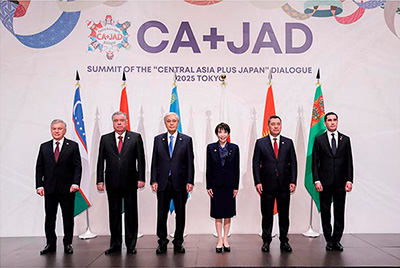 Group photo at the Summit of the “Central Asia plus Japan” Dialogue (December 20, Tokyo; Photo: Official Website of the Prime Minister's Office of Japan)
 CA+JAD image character life-size panel ©MORI Kaoru
Twenty-one years have passed since Japan pioneered the establishment of CA+JAD in 2004 as a dialogue mechanism with the Central Asian countries, ahead of other nations. At this Summit Meeting, discussions were held on the importance and potential of the Central Asian region and on cooperation with Japan, against the backdrop of changes in the international situation within and surrounding the region during this period. Prime Minister Takaichi highlighted the importance and potential of the Central Asian region, including (a) its geopolitical significance as a junction between Europe and Asia, (b) its importance in economic security due to its energy and mineral resources, and (c) its potential with high economic growth and population increase. Building on these points, Prime Minister Takaichi declared, on the occasion of this Summit Meeting, the launch of the “CA+JAD Tokyo Initiative” to support the industrial advancement and diversification of the five Central Asian countries and strengthen the mutually beneficial relationship between Japan and Central Asia. Specifically, Prime Minister Takaichi announced that Japan would promote mutually beneficial projects centered on the three priority areas of cooperation newly identified on this occasion: (a) Green and Resilience (examples: cooperation on energy transition, disaster risk reduction, and climate change measures; strengthening of critical minerals supply chains); (b) Connectivity (examples: Enhancing Connectivity through Support for the Further Development of the “Trans-Caspian International Transport Route”; Launch of the “Japan-Central Asia AI Cooperation Partnership”); and (c) Human resource development (examples: continuation of the Project for Human Resource Development Scholarship (JDS) and others; cooperation in the health and medical fields).
The leaders of the Central Asian countries expressed gratitude for Japan's cooperation and support in the three priority cooperation areas, and showed their willingness to form mutually beneficial projects between Japan and Central Asia.
At the conclusion of the meeting, the Tokyo Declaration of the Summit of the “Central Asia plus Japan” Dialogue (Tokyo Declaration) was adopted. In addition, more than 150 documents were signed and presented by both the public and private sectors.
It is expected that Japan's relations with Central Asia will be further strengthened through the Summit Meeting as well as the bilateral summit meetings held separately with each of the five Central Asian countries.