Diplomatic Bluebook 2026
Chapter 2
Japan's Foreign Policy by Region
2 Russia and Belarus
(1) Situation in Russia
A Internal Situation in Russia
As Russia's aggression against Ukraine (which Russia calls the “special military operation,” hereinafter referred to as the “operation”) has surpassed three years, President Putin's approval rating has continued to remain at a high level, and various measures related to the “operation” have been observed.
As part of efforts to secure personnel for the aggression against Ukraine, the recruitment of contract soldiers has continued, and a decision has been made to shift regular conscription ─ previously conducted twice a year in spring and autumn ─ to a year-round basis in order to streamline conscription-related procedures. In addition, a law was enacted allowing for the special call-up of certain citizens for the defense of domestic facilities during peacetime.
In the nationwide local elections held in September, a large number of “operation” participants were fielded as candidates, particularly at the municipal level. In particular, more than 800 “operation” participants fielded by the ruling party “United Russia” were elected, which was more than double the number from the previous year.
Furthermore, the Russian government's restrictions on freedom of speech and the press have continued. In September, a federal law entered into force that, among other measures, imposes fines for searching for “extremist content.” In addition, since August, certain functions of foreign-made messaging applications that have been widely used within Russia have been restricted, while the use of the Russian-made messenger app “MAX” has been promoted.
B Russian Foreign Policy
Following the inauguration of U.S. President Trump, who had expressed his eagerness to mediate a cease-fire in Ukraine, direct discussions between Russia and Ukraine ─ the first since 2022 ─ took place in Istanbul, Türkiye in May. (Bilateral talks were subsequently held in Istanbul again in June and July.) Although exchanges of prisoners of war and human remains took place, the gap in positions on peace could not be bridged.
In terms of relations with the U.S., with which high-level dialogue had been almost cut off since the start of Russia's aggression against Ukraine, numerous exchanges at various levels ─ including at the summit and foreign ministers' level ─ were held after the inauguration of the Trump administration. In August, the U.S.-Russia Summit Meeting was held in Alaska, U.S., but Russia has since repeatedly reiterated its longstanding position that the “root causes” must be eliminated to resolve the situation in Ukraine, and no concrete breakthrough toward a resolution of the situation was achieved. In October, the U.S. introduced additional sanctions against two major Russian oil companies as the first direct sanctions against Russia by the second Trump administration.
In September, President Putin stated that Russia was prepared to comply with the quantitative limits of the Treaty between the U.S. and the Russian Federation on Measures for the Further Reduction and Limitation of Strategic Offensive Arms (New START Treaty) for one additional year beyond the deadline of February 2026, but no official response from the U.S. side toward the extension of the Treaty was observed. The New START Treaty reached its expiration date and expired. Furthermore, in October, Russia announced the successful testing of the nuclear-powered cruise missile “Burevestnik” and the nuclear-powered unmanned underwater drone weapon “Poseidon,” and in November, announced plans to deploy the new intercontinental ballistic missile (ICBM) “Sarmat” in 2026.
In terms of relations with European countries, the EU has been strengthening its sanctions against Russia, including by lowering the price cap under the oil price cap system,(1) stepping up its response to the “Shadow Fleet,”(2) and banning the import of Russian liquefied natural gas (LNG) from January 2027 onwards. In 2025, relevant countries have announced that airspace violations by Russian military aircraft and by drones suspected of Russian involvement occurred in multiple North Atlantic Treaty Organization (NATO) member countries.
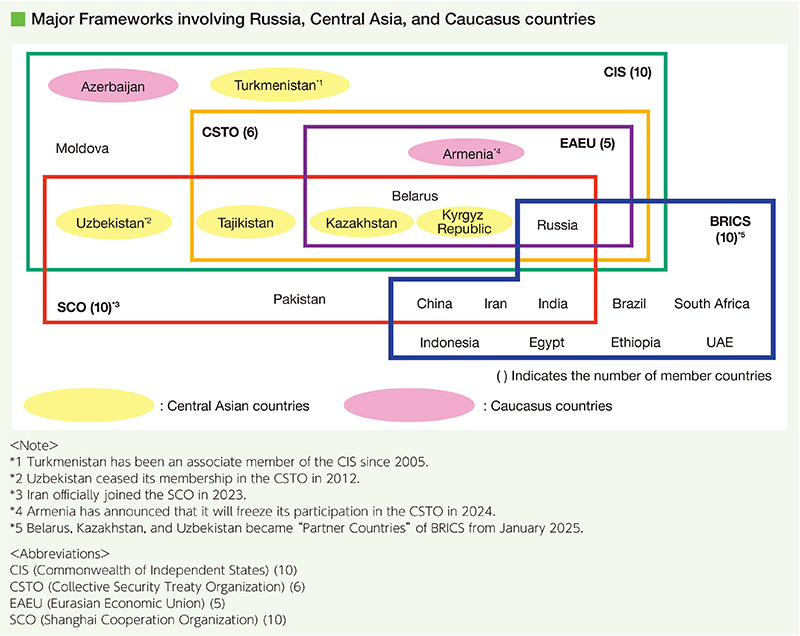
Russia continues seeking to further strengthen its ties with China, North Korea, and Global South countries including India. Furthermore, President Putin has repeatedly emphasized the importance of multilateral frameworks such as BRICS(3) and the Shanghai Cooperation Organisation (SCO) in the international community.
In May, Russia held a military parade commemorating the 80th anniversary of the Victory over Nazi Germany, with the participation of many foreign leaders including those from Africa and Latin America. President Xi Jinping attended as the guest of honor. The joint leaders' statement issued following the China-Russia summit contained many passages asserting the historical contributions of both countries on the occasion of the 80th anniversary of the end of World War II. From late August through September, President Putin visited China, held a China-Russia summit meeting, and attended the “Ceremony Commemorating the 80th Anniversary of the Victory of the Chinese People's War of Resistance against Japanese Aggression and the World Anti-Fascist War,” where President Putin, President Xi, and President Kim Jong Un of North Korea were seen standing side by side.
On the military front, the Chinese and Russian navies conducted the joint exercise “Maritime Cooperation ─ 2025” in the Sea of Japan from August 1 to 5, after which Chinese and Russian naval vessels conducted joint navigation in the Sea of Japan and the Pacific Ocean. On December 9, Chinese and Russian bombers conducted joint flights over the East China Sea and the Pacific Ocean. The strengthening of China-Russia military cooperation must continue to be closely monitored with serious concern from the perspective of Japan's security.
Regarding relations with North Korea, in late April, both Russia and North Korea publicly announced that North Korean soldiers had participated in combat in Russia's Kursk Oblast, into which Ukraine had been advancing since August 2024. In addition, North Korea has been providing Russia with ballistic missiles and ammunition, and there are also deep concerns that there may be nuclear-and missile-related technology transferred from Russia to North Korea in return. High-level meetings have continued as well. At the summit level, following the Russia-North Korea summit telephone call in August, a summit meeting was held in Beijing, China in September, at which President Putin stated that relations between the two “countries” had come to take on a dimension of alliance.
Regarding relations with India, President Putin of Russia visited India in December for the first time in four years.
- (1) A measure that prohibits services related to the maritime transportation, etc., of Russian crude oil and oil products that exceed a certain price, while the provision of such services is not subject to prohibition if the price is at or below a certain level.
- (2) The “Shadow Fleet” refers to vessels engaged in illicit operations for the purpose of evading sanctions, safety and environmental regulations, and insurance costs, or for other illegal activities (IMO Resolution A.1192(33), para. 1, December 2023).
- (3) BRICS: A term referring to a group consisting of countries such as Brazil, Russia, India, China, and South Africa, and other countries. At the inaugural foreign ministers' meeting in 2006 and the inaugural summit meeting in 2009, the original four countries ─ Brazil, Russia, India, and China ─ participated. South Africa joined in 2011, giving the grouping its current name, BRICS. In 2024, Egypt, Ethiopia, the United Arab Emirates, and Iran joined as Member Countries, followed by Indonesia in 2025. At the summit meeting in October 2024, a new category of “BRICS Partner Countries” was introduced, and it was announced that Belarus, Bolivia, Kazakhstan, Cuba, Malaysia, Thailand, Uganda, Uzbekistan, and Nigeria joined as Partner Countries from January 2025, with Viet Nam's accession as a Partner Country announced in June of the same year.
C Russian Economy
Since the start of the aggression against Ukraine, Russia's defense spending has accounted for a large share of the federal budget. In the federal budget for 2026, there was none of the significant expansion of defense spending that had been seen for the previous three consecutive years. For the first time since the aggression against Ukraine, the nominal amount of defense spending fell below the previous year's level. However, it still accounts for approximately 30% of the overall budget, placing strain on the federal budget. The fiscal deficit has also been expanding, and the government plans tax increases such as raising the value-added tax (VAT) rate from 20% to 22% in 2026, citing defense and security needs.
Some slowdown is also observed in domestic economic growth. With regard to the real GDP growth rate, which had exceeded 4% in 2024, Russia's Ministry of Economic Development revised its forecast for 2025 downward in September from 2.5% to 1% year-on-year. In addition, amid frequent Ukrainian drone attacks on oil refineries and seasonal increases in demand, concerns arose about shortages of gasoline and diesel, and the government implemented countermeasures such as a full ban on gasoline exports and the extension of trading restrictions.
Sanctions have significantly reduced energy exports to Europe, but Russia's friendly countries including China continue to import Russian energy. In August, U.S. President Trump imposed additional 25% tariffs (so-called “secondary tariffs”) on India, citing its imports of oil from Russia, and in October, the U.S. introduced sanctions against two major Russian oil companies ─ the first direct sanctions against Russia by the Trump administration. As Western countries strengthen export controls, Russia continues to pursue sanctions evasion measures, including advancing import substitution and continuing circumvention imports through friendly countries.
Domestic labor shortages and restrictions on access to Western advanced components could affect the growth of the Russian economy in the medium- to -long term.
(2) Japan-Russia Relations
A Overview
Russia's aggression against Ukraine, which began in February 2022, continues to have a serious impact on Japan-Russia relations. In order to achieve a just and lasting peace in Ukraine as soon as possible, Japan, in cooperation with the international community including the G7, has been taking measures such as imposing severe sanctions against Russia. At the same time, there remain a host of pending issues that Japan and Russia must resolve as neighboring countries, and Japan has been appropriately responding to these from the perspective of what is in Japan's national interest. It will continue to be necessary to appropriately communicate with the Russian side.
With regard to fisheries, even after Russia's aggression against Ukraine, the Government of Japan has been holding discussions with Russia to maintain and secure Japan's interests related to fishing activities. In 2025, fishing operations were conducted under the “Agreement between the Government of Japan and the Government of the Union of Soviet Socialist Republics on Mutual Relations in the Field of Fisheries off the coast of Both Countries” and the “Agreement between the Government of Japan and the Government of the Union of Soviet Socialist Republics concerning cooperation in the fields of fisheries,” as well as fishing operations based on the Kaigara Island Kelp Agreement, a private agreement. On the other hand, regarding the Framework Agreement Concerning Operations in the Waters Around the Four Northern Islands, despite repeated urging from the Japanese side, Russia has not concurred to the holding of inter-governmental consultations based on the agreement, and operations under the agreement have not been resumed.
Regarding security issues, following the intrusions into Japan's territorial airspace three times by a Russian military aircraft over Japanese territorial waters north of Rebun Island in Hokkaido in September 2024, the Government of Japan lodged a very severe protest with the Russian government and urged that it investigate the cause and prevent a recurrence of such intrusions. Japan has also conveyed serious concerns to the Russian government about the continued joint operations between the Chinese and Russian militaries around Japan.
On the subject of cultural and people-to-people exchanges, Japan is conducting projects within an appropriate scope that includes accepting Russian students by the Japanese Government (Monbukagakusho: MEXT Ministry of Education, Culture, Sports) Scholarship and providing Japanese language education in Russia based on the belief that it is important to maintain contact with Russian civil society, especially the younger generation, and to provide Russian citizens with opportunities to gain international perspectives.
The Japan Centers have been in operation for more than 30 years, and amid major changes in the situation within Russia and surrounding Japan-Russia relations, the Government of Japan decided in August 2025 to terminate their operations and close them, based on a comprehensive judgment that they had sufficiently fulfilled their historic role. It should be noted that, in making the decision to close the Centers, the unilateral decision by the Russian government in January of the same year to terminate the application of the memoranda between the Japanese and Russian governments concerning the Japan Centers was also an important factor in the consideration.
B The Northern Territories Issue and Negotiations on a Peace Treaty
The greatest concern between Japan and Russia is the Northern Territories issue. The Northern Territories are islands over which Japan has sovereignty. The islands are an inherent territory of Japan but are currently illegally occupied by Russia. The Northern Territories issue is yet to be resolved even after 80 years have passed since the end of World War II, and the Government of Japan has firmly worked on the negotiations under the policy of concluding a peace treaty through the resolution of the issue of the attribution of the Four Northern Islands.(4)
However, in March 2022, the Government of Russia, considering the measures taken by Japan in relation to Russia's aggression against Ukraine, announced measures such as discontinuing negotiations on a peace treaty, suspending Free Visits and the Four-Island exchange program, and withdrawing from the dialogue on joint economic activities on the Four Northern Islands. In September, the Government of Russia also announced a government decree suspending the validity of the agreement on Free Visits and the Four-Island exchange program.
The current situation is entirely the result of Russia's aggression against Ukraine, and Russia's attempt to shift responsibility to Japan is extremely unjust and absolutely unacceptable, and the government has lodged a strong protest against the Russian side.
Although Japan-Russia relations are in a difficult situation due to Russia's aggression against Ukraine, it remains the policy of the Government of Japan to conclude a peace treaty through the resolution of the issue of the attribution of the Four Northern Islands.
In addition, the Four-Island exchange program,(5) Free Visits, and Visits to Graves in the Northern Territories have not been conducted since 2020 due to the impact of COVID-19 and the deterioration of Japan-Russia relations following Russia's aggression against Ukraine. Resuming the Four-Island exchange program, Free Visits, and Visits to Graves in the Northern Territories is one of the highest priorities in Japan-Russia relations. In light of the earnest wishes of the elderly former residents of the islands, the resumption of Visits to Graves in the Northern Territories is an eminently humanitarian matter, and the Government of Japan will continue to strongly urge the Russian side to resume these programs, with particular emphasis on Visits to Graves in the Northern Territories.
Japan has also lodged protests against Russia over Russia's moves to build up its military forces in the Four Northern Islands and surrounding waters, including military exercises, stating that these moves are contrary to Japan's position concerning these islands and unacceptable.
- (4) Refer to the Ministry of Foreign Affairs website for the position of the Government of Japan on the Northern Territories issue:
https://www.mofa.go.jp/region/europe/russia/territory/index.html
- (5) Refers to Visits to Graves in the Northern Territories, Free Visits, and exchange visits/receptions to the Four Northern Islands (including receiving patients and expert exchanges).
C Japan-Russia Economic Relations
Since Russia's aggression against Ukraine, Japan has continued its policy of suspending, for the time being, government projects related to economic cooperation with Russia while imposing severe sanctions against the country.
Against this backdrop, trade between Japan and Russia contracted significantly compared to before the start of the aggression. Japan-Russia trade from January through December 2025 amounted to approximately 1,195.1 billion Japanese yen, a decrease of 50.5% from the same period in 2021, before the start of the aggression (Japan-Russia trade during the same period was approximately 2,413.9 billion Japanese yen). Of this, exports from Russia to Japan fell 46.6% (especially in coal), and exports from Japan to Russia fell by 57.5% during the same period in 2021 (all sources: Trade Statistics, Ministry of Finance).
With regard to sanctions against Russia, Japan, in cooperation with the international community including the G7, has maintained and strengthened severe sanctions against Russia in order to demonstrate that outrageous acts that shake the very foundations of the international order come with a high price. These include sanctions against individuals and organizations in Russia and occupied territories, including Russian government and military officials. They also include sanctions in the financial sector, including the freezing of bank assets and measures prohibiting imports and exports, among others. Japan and like-minded countries, such as those in the G7, introduced a price cap system for Russian crude oil in December 2022 and for Russian oil products in February 2023, with the aim of stabilizing international oil prices while reducing Russia's energy revenues. Furthermore, based on a recognition of the importance of ensuring the effectiveness of sanctions, since December 2023, the Government of Japan has also been introducing sanctions measures against entities in third countries suspected of involvement in the circumvention or evasion of sanctions.
In 2025 as well, Japan maintained its basic policy of continuing sanctions against Russia, and introduced additional sanctions in January and September. These measures include additional sanctions against entities in third countries suspected of involvement in the circumvention or evasion of sanctions, as well as against individuals and entities involved in Russia-North Korea cooperation in support of Russia's aggression against Ukraine. In September, Japan, in step with like-minded countries, lowered the price cap under the price cap system for Russian crude oil.
Regarding the energy sector, the Government of Japan intends to phase out its dependence on Russian energy, including coal and oil, and will take this step in a manner that minimizes adverse effects on Japanese people's lives and business activities. However, the government policy remains focused on maintaining Japan's interests in the “Sakhalin 1” and “Sakhalin 2” oil and natural gas development projects in Russia, as these projects are important to Japan's energy security from the perspective of ensuring a stable supply over the medium- to long -term.
(3) Situation in Belarus
Although Belarus did not take part in Russia's aggression against Ukraine, it supported Russian military operations through the use of its territory at the beginning of the aggression. In response to this, Western countries strengthened sanctions against Belarus, while Japan also implemented sanctions against Belarus.
In internal politics, President Lukashenko won his seventh term in the presidential election held in January. In the election, candidates with anti-government positions were not allowed to run, and the Organization for Security and Cooperation in Europe (OSCE) election observer mission could not be dispatched; European countries pointed out problems such as the lack of democratic procedures.
In foreign policy, President Lukashenko keeps close relationship with Russia, frequently meeting with Russian President Putin. Moves to restrain Western countries have also been observed, such as the joint military exercise “Zapad 2025” with Russia in September, during which Belarus announced that operational training with Russian tactical nuclear weapons and the new intermediate-range ballistic missile “Oreshnik” had been conducted.
Moves to strengthen relations with countries and regions close to Russia were also observed, including two visits to China by President Lukashenko in 2025 and a visit to Belarus by Foreign Minister Choe Son-hui of North Korea. Meanwhile, there were some changes in the Belarus-U.S. relationship. President Lukashenko held his first telephone call with U.S. President Trump in August. As a result of negotiations with the U.S., the Belarusian government released many foreign detainees, including Japanese nationals, on multiple occasions, and the U.S. also partially lifted its sanctions against Belarus.
Attempts of illegal border crossings from Belarus into neighboring countries by irregular migrants from Middle Eastern and African countries, which began in 2021, have continued, although the scale has decreased. In addition, in October, Lithuania temporarily sealed its border with Belarus, following several incidents of airport closures caused by balloons flying in from the Belarusian side.