
Japan's Official Development Assistance White Paper 2008

 Next Page
Main Text > Part III Official Development Assistance in FY2007 > Chapter 2 Details about Japan's Official Development Assistance > Section 2. Measures for Each of the Priority Issues > 4. Peacebuilding > (1) Iraq
<Overview>
The international community, including Japan, has been extending assistance for Iraqi nation building to restore and well establish a peaceful and stable Iraq. It is extremely important not only for the people of Iraq, but also for the peace and stability of the Middle East and the international community that Iraq rebuild itself as a peaceful democratic country while ensuring its sovereignty, unity, and territorial integrity. This is also a matter of direct concern to the national interest of Japan.
In Iraq, an official government was inaugurated in 2006 as a result of the Iraqi National Assembly election held in 2005. In May 2007, a ministerial-level meeting on the establishment of the International Compact with Iraq—a compact that stipulates the cooperative roles of the Iraqi government and international society in a wide range of sectors, including politics, safety, economics, and society—was held in Egypt with the attendance of 74 national delegates and organizations. It is expected that the international community lend assistance so as to allow the Iraqi government to have more independent and autonomous efforts under such broad endorsement.
<Japan's Assistance>
To date, Japan has conducted the reconstruction assistance of Iraq by combining the human contribution of Self-Defense Forces (SDF) and development assistance as an "inseparable pair." Regarding assistance by the SDF, the Japan Ground Self-Defense Force engaged in humanitarian reconstruction assistance including the reconstruction and development of public medical, water provision, and school facilities centered in Samawah from the beginning of 2004 until July 2006. Transport assistance for personnel and goods from the UN and allied forces by the Japan Air Self-Defense Force continues to be provided as of September 2008.
As for official development assistance, Japan's direct assistance through grant aid has reached approximately US$1.69 billion in total as of the end of March 2008. Among the aid projects to date, nine projects for the provision of equipment including police vehicles, fire trucks and equipment for solid waste management in Samawah as well as another seven projects including those for the provision of a mobile transformer substation and for the rehabilitation of general hospitals in northern and central regions in Iraq were completed. Results of these assistance projects are beginning to be felt on the ground. In FY2007, Japan decided to implement a project to improve health services for 500,000 mothers and children around Fallujah by providing medical devices for the establishment of the Maternity and Children's Hospital in Fallujah and other means such as the Grant Aid for Conflict Prevention and Peacebuilding through the United Nations Development Programme (UNDP).65
Human resource development is important in advancing steady reconstruction efforts in Iraq. Japan has been assisting capacity building of Iraqi administrative officials and engineers through training programs in various areas. As of the end of FY2007, approximately 2,400 Iraqis received training in Japan and in Iraq's neighboring countries such as Egypt and Jordan. Moreover, Japan has been holding the National Reconciliation Seminar with the participation of representatives from Iraq's various religious and ethnic groups in order to promote national reconciliation, which is currently an outstanding issue in Iraq. In addition, Japan accepted seven Iraqi students at the expense of the Iraqi government in FY2007.
Regarding loan aid, after discussion with the Iraqi side and conducting various studies, Japan decide the provision of approximately US$2.1 billion of funds necessary to implement 10 projects in the sectors of power, transportation, petroleum, irrigation, and others, by the end of FY2007. Furthermore, in order to address Iraq's debt problems, an agreement was reached in 2004 at the Paris Club that 80% of Iraq's total Paris Club debt of US$36.2 billion be reduced over three stages. Based on this agreement, an Exchange of Notes took place in November 2005 between Japan and Iraq, which would reduce Iraq's total debt owed to Japan of approximately US$7.6 billion (Japan is the number one creditor nation to Iraq) by 80% in total over the three stages. The debt reduction schedule works in tandem with International Monetary Fund (IMF) assistance programs, and as of March 2008, has progressed to the second phase.
• Assistance to the Province of Al-Muthanna
In the Province of Al-Muthanna, the central city of which is Samawah, the Government of Japan has provided assistance of more than US$200 million in total through development assistance in the forms of Grant Assistance for Grass-Roots Human Security Projects and Emergency Grant Aid in coordination with the activities of the SDF. In particular, the Government has placed priority on the following issues: provision of safe drinking water, stabilization of the electricity supply, provision of basic medical services, improvement of sanitary conditions, improvement of the educational environment, maintenance of community roads, creation of employment opportunities, restoration of public safety for people's lives, and development of human resources. Furthermore, loan aid was provided to help build a new bridge and reconstruct two bridges and to help rebuild irrigation facilities in Al-Muthanna Province.
Some specific examples of cooperation with the SDF through development assistance are that SDF medical officers provided instruction on the use of the medical equipment provided, and that the roads graveled by the SDF were paved with asphalt.
• Assistance through Various Collaborations
The promotion of international cooperation is important in the reconstruction assistance to Iraq. Based on this perspective, Japan extended US$490 million to the International Reconstruction Fund Facility for Iraq (IRFFI), whose establishment was agreed upon at the Madrid Conference for Reconstruction of Iraq. Through this contribution, Japan supports various reconstruction projects implemented by UN organizations and the World Bank.
Japan also provides assistance through NGOs in fields like medical care, education, and water supply, the total of which is approximately US$26 million as of the end of FY2007. Through this contribution, a total of 22 projects have been implemented via NGOs comprising the Japan Platform (JPF). The projects include three emergency reconstruction projects for internally displaced persons and returnees in the northern part of Iraq, a project for the restoration of primary and secondary schools in Baghdad, and assistance for medical care in the northern region.
Aside from this, Japan provides assistance to Japanese NGOs which are not under the JPF as well as to international NGOs.66 Initiatives implemented through Japanese NGOs to date include the provision of medical equipment like incubators for newborns to Samawah Maternal Hospital and the provision of educational materials for the Samawah Nursing High-School. Examples of Japan's assistance through international NGOs include the provision of pharmaceuticals and medical supplies to Baghdad's Al-Yarmouk Teaching Hospital and supplying water by renting water tank trucks in the Province of Al-Muthanna.
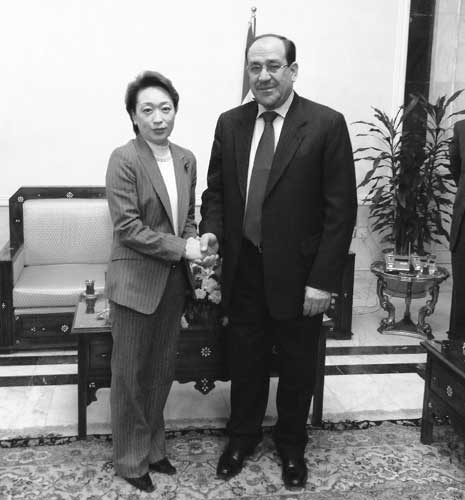
State Secretary for Foreign Affairs Seiko Hashimoto talking with Iraqi Prime Minister Nouri al-Maliki