
Peacekeeping and Peacebuilding
Column by Shumpei TSUJIMOTO, Community Stabilization/Peacebuilding Officer at IOM, a Primary Course Associate of the FY2024 Program for Global Human Resource Development for Peacebuilding and Development
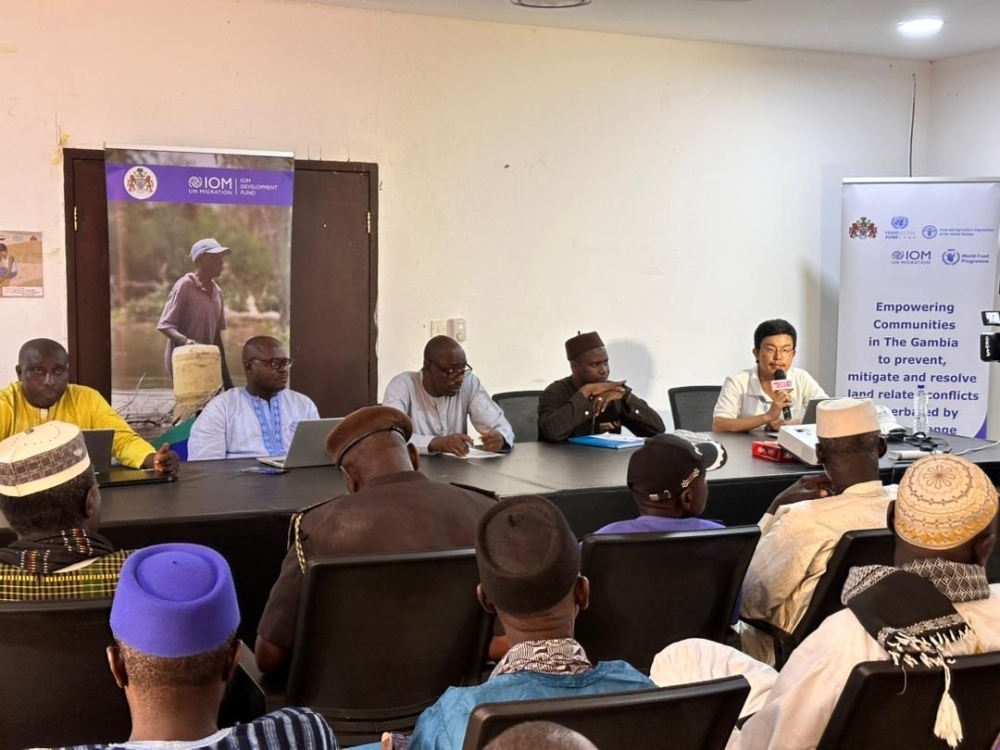 In PBF project, at the opening of the regional consultation with the relevant partners to conduct the mapping of data collection localities for TTT (The author on the right)
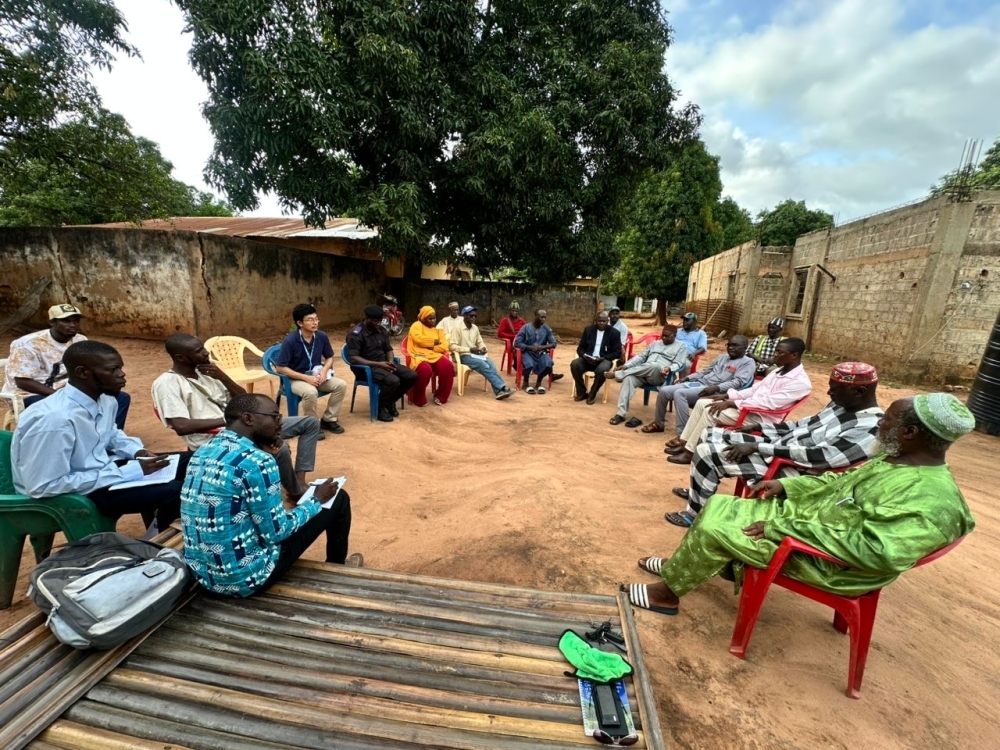 A meeting with community in the field (Author in the back left)
I am Shumpei Tsujimoto, a Program Associate of “Primary Course” of “The Program for Global Human Resource Development for Peacebuilding and Development” of the year of Reina 6. I have been assigned to International Organization for Migration (IOM) through the mentioned course and working as a Community Stabilization/Peacebuilding Officer at the Gambian Office.
My primary responsibility is managing a climate security project, funded by the UN Peacebuilding Fund (PBF) to which Japan is also one of the donors. Although there is no serious armed conflict in The Gambia, the country faces challenges such as decreasing rainfall, soil erosion and windstorm caused by climate change. Additionally, rising sea levels caused by the global warming have increased the salt levels of rivers flowing through The Gambia, which is a low-lying country. This also has exacerbated the salinization of the lands. Due to the issues mentioned, the land productivity is decreasing, and the land-related conflicts are increasing among people who depend on livestock and agriculture for their livelihoods. This project aims to prevent, mitigate and solve the land-related conflicts with a comprehensive approach. This project is being implemented jointly with Food and Agriculture Organization (FAO) and World Food Programme (WFP), leveraging their respective areas of expertise.
I work on this project especially in terms of planning, coordination and implementation with national staff members with different expertise to conduct activities such as community-based disaster risk reduction; Transhumance Tracking Tool, a data tool developed by IOM, identifying data collection localities, training for enumerators, data collection and data analysis; green livelihood assessment and grant support on green livelihood; organizing community dialogues; environmental conservation awareness raising; peacebuilding capacity development training utilizing mental health and psychosocial support (MHPSS) and so on.
Through some of the above activities, I visited areas where farmlands are encroaching livestock routes as well as some lands that became no longer productive due to salinization. Hearing actual conflict cases and having a series of discussions with communities and partners, I realized this project came at a critical time. While the project is still ongoing, agreements were sometimes reached for solving the land issues when I visited local communities with partners from the government and a civil society organization. In such moments, I strongly feel the tangible impact of the project and find great fulfillment in working in the field of peacebuilding.
Moreover, with the support from the Government of Japan, IOM is implementing a project to strengthen border management capacity of The Gambia. In the current project, 3 border posts and a fraud document detection laboratory were established to support safe, orderly and regular cross-border movements of people. I personally have been assisting this project by utilizing the previous experience of Japan-funded projects and communicating with the Embassy of Japan in Senegal which overseas The Gambia.
As mentioned above, the funding assistance from the Government of Japan is playing a vital role in solving issues The Gambia faces across many areas. I hope to continue working hard to support sustainable peace of The Gambia through the funding assistance from the Government of Japan.