
G20 (Summit on Financial Markets and the World Economy)
G20 Foreign Ministers’ Meeting
Session 1: "Geopolitical Issues"
October 30, 2026
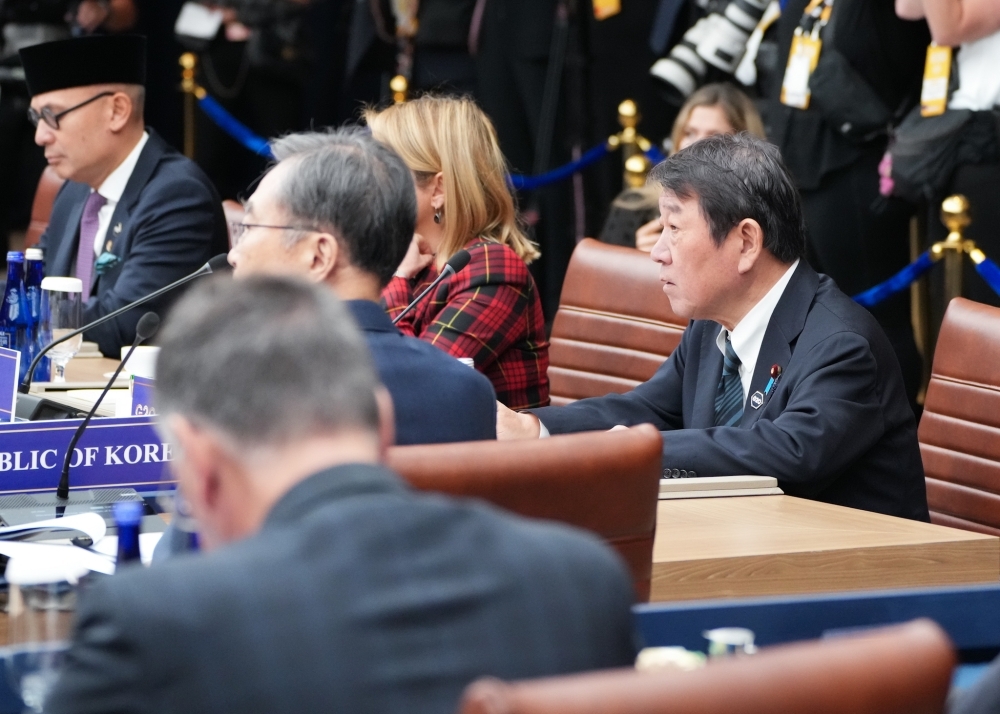
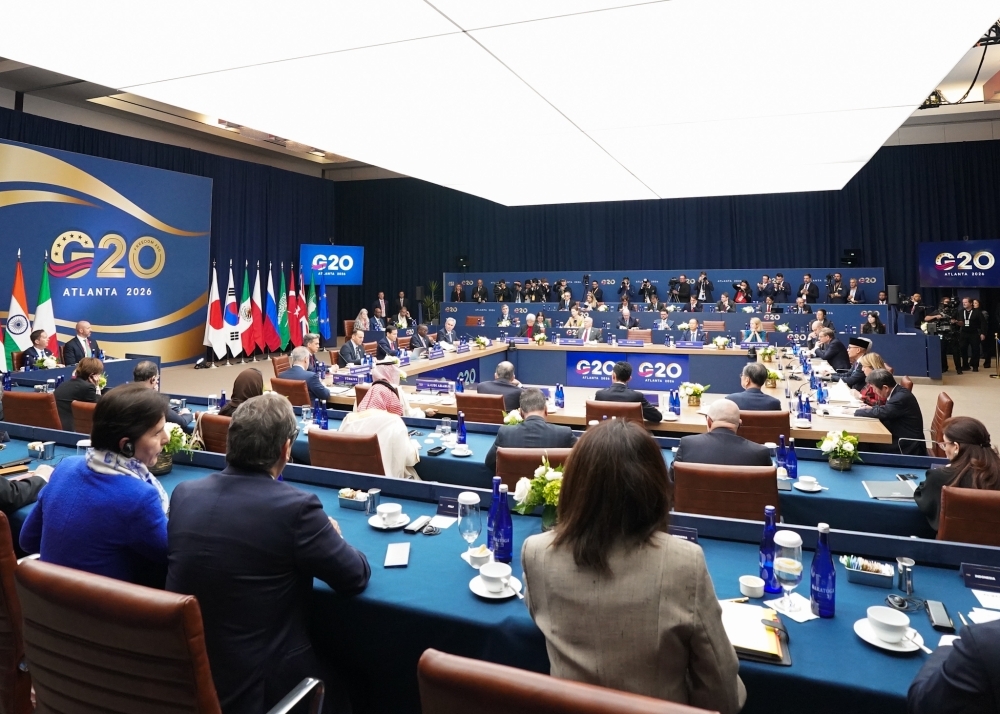
On October 30, commencing at 10:40 a.m. local time (11:40 p.m., JST) for approximately 2 hours, Mr. MOTEGI Toshimitsu, Minister for Foreign Affairs of Japan, attended session 1 "Geopolitical Issues" of the G20 Foreign Ministers’ Meeting, held in Atlanta, the United States of America.
- In this session, discussions were held on the situations including in the Middle East, Ukraine, and the Indo-Pacific.
- Foreign Minister MOTEGI made the following remarks.
- The Middle East
- (i) The instability in the region is disrupting navigation through the Strait of Hormuz and the Bab el-Mandeb Strait, which are key logistical chokepoints. This is also having a negative impact on global energy supply. The priority now is to ease military tensions and restore free and safe navigation through both straits.
- (ii) From this perspective, Japan has been making persistent diplomatic efforts toward an early de-escalation and stabilization of the situation, including by strongly calling on Iran to exercise maximum flexibility. Japan will continue to coordinate closely with G20 countries and the international community.
- Ukraine
In order to achieve a just and lasting peace, Japan will continue its support for Ukraine. With a harsh winter ahead, Japan will continue supporting Ukraine including in the energy sector, such as through the provision of large-scale generators. Ensuring grain exports from Ukraine’s Black Sea ports is also critical for global food security. - Indo Pacific
- (i) It is essential to uphold the principle of the complete denuclearization of North Korea. Addressing malicious cyber activities is also urgent. I ask for your continued understandingand cooperation for the immediate resolution of the abductions issue.
- (ii) The situations in the Middle East, Europe, and the Indo-Pacific are deeply interconnected. Securing the capability to determine our future and resilience of each country is directly linked to world over. From this perspective, Japan has been advancing concrete cooperation under the updated “Free and Open Indo-Pacific.” For example, we are promoting initiatives to develop a free and open maritime order and to ensure logistics such as enhancing regional connectivity through development of ports, developing aids of navigationin the Straits of Malacca and Singapore, and developing rules governing passage through these straits.
- (iii) Furthermore, unilateral attempts to change the status quo by force or coercion should never be tolerated anywhere in the world, including in the East China Sea and the South China Sea.
- Conclusion
At a time when the international community faces complex geopolitical tensions, I strongly believe that we, the G20 members, can lead the international community through cooperation and collaboration, rather than division and confrontation.
- The Middle East
(Reference)Participating countries and international organizations for G20 Foreign Ministers’ Meeting
- G20 members
Japan, the United States (Presidency), Argentina, Australia, Brazil, Canada, China, France, Germany, India, Indonesia, Italy, Mexico, Republic of Korea, Russia, Saudi Arabia, Türkiye, United Kingdom, African Union (AU), European Union (EU), Türkiye, United Kingdom, African Union (AU), European Union (EU) - Invited countries
Poland