
Foreign Visits
Japan-U.S.-ROK Foreign Ministers’ Meeting
July 22, 2026
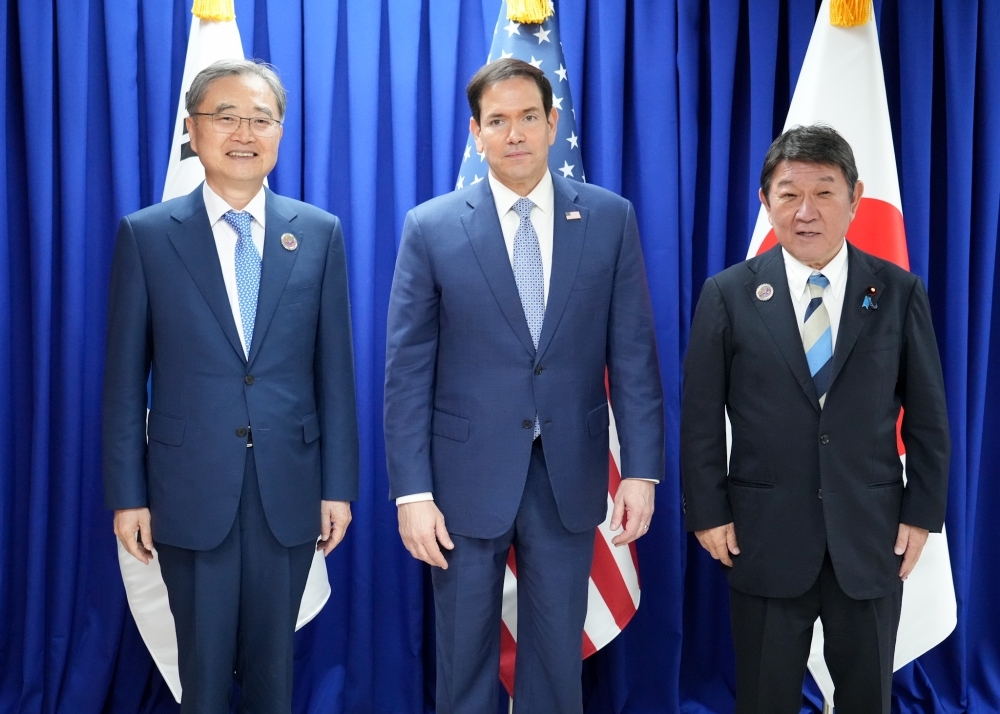
On July 22, commencing at 0:55 p.m. local time (1:55 p.m. on July 22, Japan time), for approximately 35 minutes, Mr. MOTEGI Toshimitsu, Minister for Foreign Affairs of Japan, visiting Manila, the Philippines, on the occasion of the ASEAN-related Foreign Ministers’ Meetings, held a Japan-U.S.-Republic of Korea (ROK) Foreign Ministers’ Meeting with the Honorable Marco Rubio, Secretary of State of the United States, and H.E. Cho Hyun, Minister of Foreign Affairs of the ROK.
- The three Ministers welcomed to hold the second Japan-U.S.-ROK Foreign Ministers’ meeting this month, following the one held in Ankara, Türkiye, and reaffirmed that, in light of the increasingly severe strategic environment that the three countries face, it remains important to strengthen the solidarity among the three countries to show the strategic coordination of these alliances.
- The three ministers affirmed that they would further advance their security cooperation, including joint exercises, economic security cooperation, including the supply chain early warning system and the field of cutting-edge technology, and cooperation regarding response to transnational crime, and welcomed the launch of the trilateral consultation on international disaster relief. They also affirmed that they would expand the scope of the trilateral cooperation through continuous action-oriented discussions, following up on such outcomes.
- The three ministers also discussed North Korea, and reaffirmed that they would further strengthen coordination among the three countries, including the consistent support from the governments of the U.S. and the ROK regarding the immediate resolution of the abductions issue. They also reaffirmed their commitment to the complete denuclearization of North Korea in accordance with the United Nations Security Council resolutions. In addition, they reaffirmed the importance of addressing North Korea’s malicious cyber-related activities, which fund its nuclear and missile programs, and concurred to advance their efforts against North Korean IT workers.
- Furthermore, they exchanged their views on the ways of engagement toward Southeast Asian countries and on regional situations, including unilateral attempts to change the status quo by force or coercion, and affirmed that the three countries would work closely together.