
Press Conferences
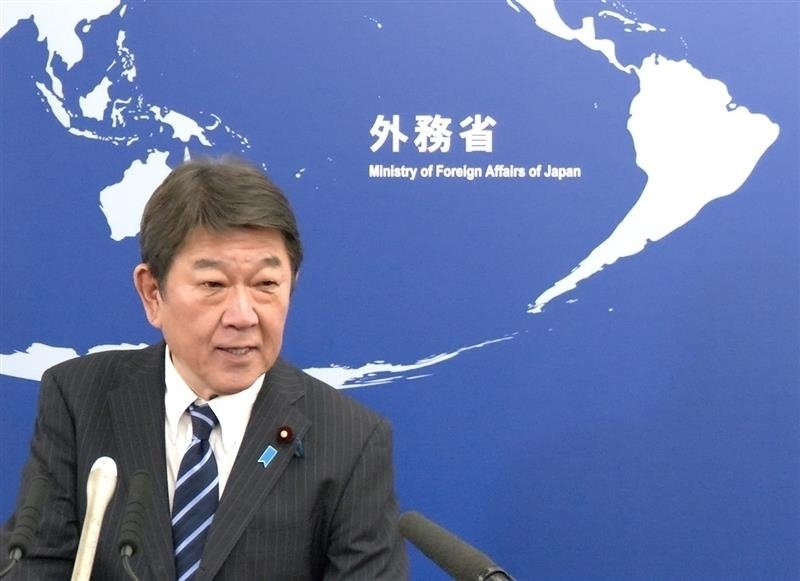
Press Conference by Foreign Minister MOTEGI Toshimitsu
Tuesday, March 3, 2026, 5:45 p.m. Ministry of Foreign Affairs
Japanese
Opening Remarks
Japan’s Response to the Situation in Iran
Foreign Minister MOTEGI Toshimitsu: Last evening, I held individual meetings with the Iranian Ambassador to Japan and the Israeli Ambassador to Japan, as well as a meeting with the ambassadors or chargés d’affaires ad interim of countries in the region. The details are as we have already announced.
Also, yesterday, the Government of Japan assisted five Japanese nationals who wished to evacuate from Israel, and they arrived safely in Amman, Jordan. This has also already been announced.
That concludes my opening remarks.
Situation in Iran (The Possibility of a Protracted War)
Kyodo News, ONDA: I would like to ask about the situation in Iran, which you mentioned in your opening remarks. President Trump of the U.S. has stated that the military operation against Iran could continue for four to five weeks if necessary, and also mentioned the possibility of a longer duration. While there have been casualties among U.S. military personnel, I would like to ask whether Japan can support the attack. Furthermore, with civilian casualties also occurring, I would like to ask what efforts Japan will make toward an early ceasefire. Thank you.
Foreign Minister MOTEGI: As I have responded in the Diet, Iran’s development of nuclear weapons must never be allowed. This has been Japan’s consistent position.
Japan has consistently respected fundamental values and principles, such as freedom, democracy, and the rule of law. We have pursued diplomatic efforts to resolve Iran’s nuclear issue in coordination with relevant countries. Talks between the U.S. and Iran are extremely important for resolving this issue, and Japan has strongly supported them.
What is of utmost importance now, above all else, is the early settlement of the situation. To this end, I myself have been making the necessary diplomatic efforts and on the morning of March 1, the day after the outbreak of the situation, a G7 Foreign Ministers’ Meeting was convened.
Regarding my meetings with ambassadors and others last evening, we have already made announcement. We intend to continue various efforts, including telephone meetings, and will announce them as they occur. We will continue to seize every opportunity to deepen communication and coordination with relevant countries.
Protection of Japanese Nationals in Response to the Situation in Iran
Sankei Shimbun, NAGAHARA: I also have a question regarding the situation in Iran. At the meeting of the Budget Committee of the House of Representatives yesterday, it was revealed that there are 7,700 Japanese nationals in the countries neighboring Iran. Can you provide a detailed breakdown of which countries these 7,700 people are staying in? Furthermore, given that Iran’s attacks have spread across a wide area, please share your thoughts on ensuring the safety of Japanese nationals.
Foreign Minister MOTEGI: I was referring to the neighboring countries not only of Iran but also of Israel, and the total number is roughly 7,700 personnel. Would you like a detailed breakdown?
The breakdown is as follows: approximately 160 Japanese nationals in Kuwait, approximately 720 in Saudi Arabia, approximately 190 in Bahrain, approximately 710 in Qatar, approximately 5,500 in the United Arab Emirates (UAE), approximately 60 in Oman, approximately 210 in Jordan, approximately 60 in Lebanon, and approximately 120 in Iraq.
The Ministry of Foreign Affairs is working to ensure the protection of Japanese nationals across the region, including the neighboring countries of Iran and Israel, and to monitor the situation of maritime and air traffic. Meanwhile, in order to provide information to relevant parties, our diplomatic missions in neighboring countries issue regular updates three times a day, and promptly send consular emails concerning important information.
This consular email is sent to individuals registered with the overseas travel registration service (Tabi-Regi) and is also posted on the Overseas Safety website, making it widely accessible not only to those currently traveling but also to Japanese companies and family members in Japan.
In addition, we are preparing a system to provide consultation and support by consular officers at the nearest diplomatic mission in case Japanese nationals actually encounter difficulties in the region.
Regarding the departure of Japanese nationals from Israel yesterday on March 2, it is as we have already announced.
Based on the situation on the ground and the needs of Japanese nationals, the Government will continue to take all possible measures to ensure their protection, including preparation for their evacuation in the event of an unforeseen situation.
Excuse me. I previously said there were 60 Japanese nationals in Oman, but the correct number is 90.
Situation in Iran (Iran’s Nuclear Development and Other Matters)
Pan Orient News, Azhari: My question is also about the situation in Iran. Japan seems to hold Iran accountable for the Israeli and American attacks, hinting that Iran’s nuclear ambitions may have warranted such attacks. On what grounds does Japan base its assertion that Iran is pursuing nuclear weapons? Could you please shed light on Japan’s stance toward the Israeli nuclear arsenal, which is considered a threat to the whole of the Middle East countries? And further, is Japan, which maintains good relations with all sides, considering any steps to help de-escalate tensions overall? Thank you.
Foreign Minister MOTEGI: Japan has continued its diplomatic efforts to resolve Iran’s nuclear issue through dialogue, while urging Iran to conduct talks with the U.S. and to fully cooperate with the International Atomic Energy Agency (IAEA). As you are aware, Iran has continued its nuclear enrichment activities. Under these circumstances, Iran indicated that it would not fully cooperate with the IAEA. Japan has consistently emphasized the need for Iran to further increase the transparency of its nuclear development.
Additionally, it is our understanding that Israel maintains a policy of neither confirming nor denying its possession of nuclear weapons. In any case, based on Japan’s position to attach great importance on maintaining and strengthening the international nuclear non-proliferation regime, Japan intends to continue clearly conveying its stance to relevant countries, including Israel.
Situation in Iran (the Government’s Position on the Attacks Against Iran)
Independent Web Journal, HAMAMOTO: I would like to ask about the situation surrounding Israel. Despite Iran’s lack of capability to directly attack the U.S. mainland and posing no imminent threat, launching a preemptive strike aimed at regime change on the grounds of future danger constitutes a preventive attack prohibited under international law and is clearly unjustifiable. I think we are currently at a historic turning point where international law and international order designed to deter war are on the brink of collapse. Moreover, a renewed oil crisis would likely lead to another wave of soaring inflation. From the perspective of Japan’s national interests, as well as from the perspective of legal legitimacy, how do you view the latest attacks against Iran?
Foreign Minister MOTEGI: I believe I have already addressed all aspects of your questions in my previous responses.
Nuclear Buildup by France
Chugoku Shimbun, SHIMOTAKA: President Macron of France has announced that France will increase its number of nuclear warheads. Please share your thoughts on this. Secondly, the NPT regime, to which the Government of Japan attaches great importance, stipulates an obligation to negotiate nuclear disarmament. What kind of impact do you think this will have on the NPT regime? Please also share your views on the impact this will have on the “world without nuclear weapons” that the Government of Japan aims to achieve.
Foreign Minister MOTEGI: I am aware that, on March 2, local time, President Macron delivered an address on nuclear deterrence and stated that he had ordered an increase in the number of nuclear warheads possessed by France.
While I would like to refrain from commenting on another country’s policy, Japan intends to communicate closely with France regarding the background and concerns surrounding this recently announced policy, and to monitor the situation, including verifying the facts, with interest.
In any case, as the only country to have ever suffered atomic bombings during war, Japan will continue advancing realistic and practical efforts under the NPT regime toward the realization of a “world without nuclear weapons.”
Visit to Japan by Prime Minister Carney of Canada
Asahi Shimbun, MIYAWAKI: Prime Minister Carney of Canada is scheduled to visit Japan and hold a summit meeting with Prime Minister TAKAICHI this weekend. I understand that the agenda between Japan and Canada includes strengthening cooperation on energy security, food security, and critical minerals. I would like to ask about the significance you attach to this meeting and Japan’s objectives.
Foreign Minister MOTEGI: Regarding the details of the summit meeting during Prime Minister Carney’s visit to Japan, I believe there will be various exchanges at the spot, but basically, I expect candid discussions on wide-ranging issues, including further strengthening the bilateral relationship as well as the regional and international situations.
For Japan, Canada is an important partner in working together toward the realization of a “Free and Open Indo-Pacific” (FOIP). Canada is also a key partner from the perspective of energy security, food security, and economic security, including critical minerals. I anticipate discussions covering these issues.
Through Prime Minister Carney’s visit to Japan, we expect the bilateral relationship to strengthen further.