
Press Conferences
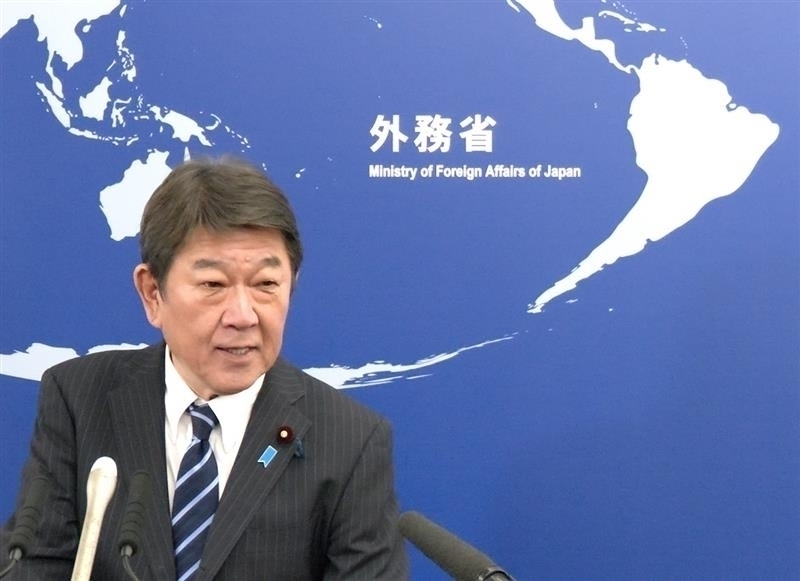
Press Conference by Foreign Minister MOTEGI Toshimitsu
Friday, May 15, 2026, 3:06 p.m. Ministry of Foreign Affairs
Japanese
Opening Remarks
Visit to Japan by United Nations Secretary-General Guterres
Foreign Minister MOTEGI Toshimitsu: From May 17 to May 20, Secretary-General Guterres of the United Nations (UN) will visit Japan with many Executive Heads of the UN system to attend the UN System Chief Executives Board for Coordination (CEB) and its related events, which are to be held in Asia for the first time.
During his stay in Japan, His Majesty the Emperor of Japan will hold an audience with Secretary-General Guterres. Prime Minister TAKAICHI and I will also hold meetings and exchange views with Secretary-General Guterres and the Executive Heads of the UN system who will visit Japan.
This year marks the 70th anniversary of Japan’s admission to the UN. Since joining the UN in 1956, Japan has prioritized multilateral cooperation through proactive contributions in a wide range of areas, including the three pillars of UN activities─international peace and security, development, and human rights.
On the occasion of the 70th anniversary of Japan’s admission to the UN and the visit to Japan by Secretary-General Guterres, we intend to further deepen our cooperation with the UN.
That concludes my opening remarks.
Assessment of the U.S.-China Summit Meeting
Kyodo News, ONDA: I would like to ask about the U.S.-China Summit meeting. A U.S.-China Summit meeting was held yesterday and today. While both leaders showed a positive attitude toward maintaining stable bilateral relations, President Xi Jinping reportedly warned the U.S. regarding Taiwan. Please share your views on the outcomes of the meeting so far.
Foreign Minister MOTEGI: Since the meeting concluded only moments ago, I would like to share my thoughts after carefully reviewing the information.
That being said, as I have stated repeatedly, we believe it is essential that U.S.-China relations contribute to the stability of the international community including Japan, and we have closely followed the U.S.-China Summit meeting with great interest. We intend to respond appropriately by gathering information and coordinating with the U.S., taking into account implications for Japan.
In any case, based on our strong relationship of trust with our ally, the U.S., the Government of Japan considers it important to continue to encourage China to fulfill responsibilities commensurate with its international standing.
Japan’s Diplomacy toward Russia
Hokkaido Shimbun, MURAKAMI: I would like to ask about diplomacy toward Russia. Special Presidential Envoy Shvydkoy of Russia, during a meeting with House of Councillors member SUZUKI Muneo of the Liberal Democratic Party on May 12, proposed holding vice foreign ministerial talks between Japan and Russia. According to Mr. SUZUKI, the possibility of a foreign ministers’ meeting or telephone call was raised during his meeting with you on May 14. Could there be some coordination underway between Japan and Russia? I would like to ask your views on the appropriateness of having high-level contacts with a country with which relations have deteriorated following its invasion of Ukraine.
Foreign Minister MOTEGI: There are no specific plans at this stage for a Japan-Russia meeting between the foreign ministers or contact at the vice minister-level. With Russia’s aggression against Ukraine continuing even now, there has been no change in Japan’s basic policy toward Russia, including the sanctions against Russia in coordination with other G7 members and the international community.
Russia takes the position that Japan revising its policy toward Russia is a prerequisite for dialogue, but we believe that the current situation does not allow for such a revision.
In any case, communication between the two countries is important, precisely when bilateral relations are challenged. From the perspective of appropriately managing our relationship with a neighboring country, Russia, Japan remains open to communication with Russia, including between diplomatic authorities.
Importing Russian Crude Oil
Independent Web Journal, HAMAMOTO: I have a follow-up question about diplomatic relations with Russia. Russian Foreign Minister Lavrov reportedly indicated that Russia would not oppose Japan importing Russian crude oil if Japan wishes to do so. Foreign Minister Lavrov also stated, “Their new foreign minister, Toshimitsu Motegi, made it clear that Japan would continue to exert pressure on Russia and remain one with its Western partners, but doing without Russian oil is a challenge for them,” and “We have never turned the economy or existing agreements into political tools.” I understand these remarks to mean that Russia is prepared to supply oil to Japan, which is in economic difficulties, even while knowing Japan’s political stance. What Japan needs most now is an emergency supply of oil and natural gas sufficient to meet Japan’s demand before its reserves run out. If the national interest comes first, I believe Japan should accept Russia’s offer. Please share your thoughts on this.
Foreign Minister MOTEGI: I am not aware that Minister Lavrov has made the remarks you just mentioned, and therefore I would like to refrain from commenting on them.
India’s Efforts to Attract Investment and Prospects for Japanese Companies’ Expansion of Business into Africa
Asian News International, ITAGAKI: Recently, India has actively made announcements regarding its 2026 tax reform, especially on the major incentives, such as tax reductions and subsidy measures that appear to be largely aimed at attracting investment. In particular, tax reductions in sectors such as data centers and semiconductors have been widely promoted, and there has been talk that Japan’s NTT Data could enjoy a tax holiday until the 2040s. In light of India’s proactive efforts to attract investment, and also considering the outcomes of your visits to African countries this month, I would like to ask for your thoughts regarding the future direction of a Free and Open Indo-Pacific (FOIP) amid a volatile international situation.
Foreign Minister MOTEGI: First, regarding India. India is a rapidly growing emerging market and a manufacturing hub. During Prime Minister Modi’s visit to Japan last August, we agreed to set a target of 10 trillion yen in private investment to India. In this way, the Government of Japan also promotes Japanese companies’ expansion of business and investment in India.
Against this backdrop, we welcome India’s initiatives to attract investment from Japanese companies. That being said, the Government, led by the Japan-India Economic Affairs Division established within the Ministry of Foreign Affairs this April, will continue to consult and coordinate closely with India to encourage India’s further efforts toward improving the business environment.
As for Africa, due to its young population driven by a very high population growth rate and abundant natural resources, it is attracting attention from companies across various countries, including Japan, as a continent expected to achieve continued dynamic growth.
During my recent visit to Kenya, I delivered a policy speech on Japan’s diplomacy toward Africa. In that speech, I expressed the view that establishing a “Virtuous Cycle of Growth between Africa and Japan”, one of the pillars of Japan’s Africa diplomacy, is important.
We believe that both India and the African continent are areas of critical importance from the perspective of making FOIP more resilient. Japan intends to firmly advance cooperation that allows regions and countries to acquire resilience and the capability to have the freedom to decide for themselves.