
Japan-United States of America Relations
Japan-U.S. Summit Meeting and Dinner Reception
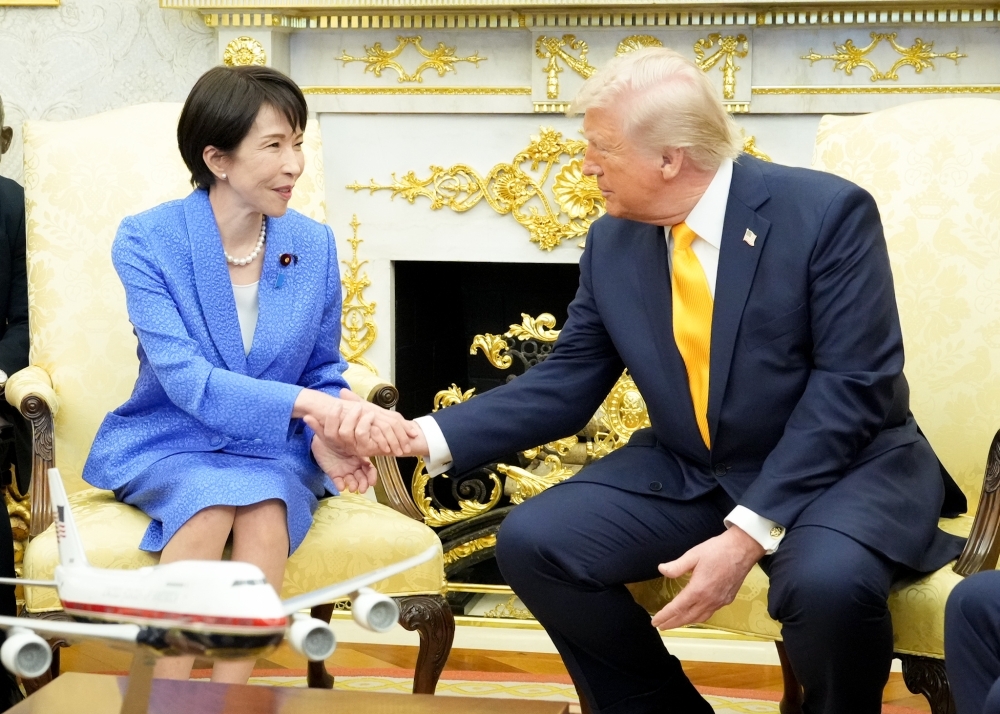 (Photo: Cabinet Public Affairs Office)
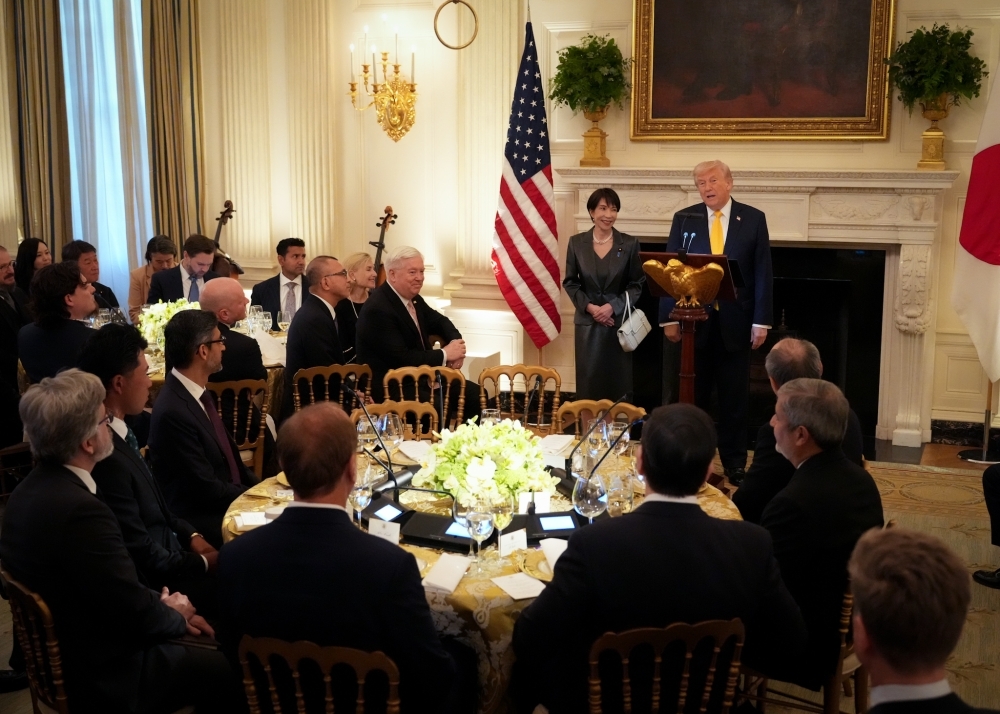 (Photo: Cabinet Public Affairs Office)
On March 19, commencing at 11:37 a.m. local time (0:37 a.m. on March 20, Japan time) for approximately 90 minutes, Ms. TAKAICHI Sanae, Prime Minister of Japan, during her visit to Washington D.C., held a Japan-U.S. Summit Meeting with the Honorable Donald J. Trump, President of the United States of America, and afterwards, participated in a dinner reception hosted by President Trump. The overview is as follows.
1. Opening remarks
President Trump reiterated his support for Prime Minister Takaichi, praising her as a “very popular, powerful woman, and [a] great woman,” and stated that Prime Minister TAKAICHI is doing a fantastic job in a large nation with a great reputation.
In response, Prime Minister TAKAICHI conveyed her appreciation of President Trump’s unwavering commitment to the Japan-U.S. alliance, as the security environment in the Indo-Pacific becomes increasingly severe. Prime Minister TAKAICHI also stated that she would like to deepen discussions towards cooperation to make both Japan and the U.S. strong and prosperous.
2. International Situation
(1) The situation in Iran
A. Regarding the current situation surrounding Iran, Prime Minister Takaichi stated the following:
(a) Japan has consistently made clear Japan’s position that “Iran must never be allowed to develop nuclear weapons.”
(b) Japan is seriously concerned about and condemns Iran’s actions such as the closure of the Strait of Hormuz, activities that threaten the safety of navigation, and attacks on surrounding areas.
(c) It is important to make efforts, together with the international community, including the U.S., towards an early de-escalation of the situation and towards the realization of peace and stability in the Middle East, including the stability of the international supply of energy.
(d) In particular, with regard to ensuring a stable supply of energy, we would like Japan and the United States to work together to expand the production of U.S.-sourced energy, taking into account crude oil procurement needs in Japan and across Asia. Furthermore, we aim to realize a joint initiative in Japan for the stockpiling of crude oil procured from the United States.
B. Furthermore, the two leaders concurred that, including from the perspective of energy security, they would continue to maintain close communication between Japan and the U.S. toward peace and stability in the Middle East, including the Strait of Hormuz.
(2) Challenges regarding the Indo-Pacific
Prime Minister Takaichi reaffirmed her determination to continue strongly promoting the “Free and Open Indo-Pacific (FOIP)” as a pillar of Japan’s diplomacy and to strategically evolve it, and the two leaders affirmed that they would continue to strongly advance cooperation under FOIP.
The two leaders also affirmed the importance of strengthening the region’s network of like-minded countries, such as Japan-U.S.-Republic of Korea (ROK), Japan-U.S.-Philippines, and Japan-Australia-India-U.S..
The two leaders exchanged views on issues concerning China and reaffirmed that Japan and the U.S. would continue to coordinate closely.
The two leaders exchanged the views on the situation surrounding North Korea, and affirmed the need to address its nuclear and missile issues together, as well as their resolute commitment to the complete denuclearization of North Korea. Prime Minister Takaichi asked for continued understanding and cooperation of the U.S. for the immediate resolution of the abductions issue and gained full support from President Trump.
3. Bilateral relations
Prime Minister Takaichi and President Trump, building on the strong mutual trust between them, affirmed that they would advance high-quality Japan-U.S. cooperation in concrete terms across a wide range of areas, including the economy, economic security, and security, and elevate the Japan-U.S. Alliance to further heights.
The two leaders concurred to advance a broad range of security cooperation including co-development and co-production of missiles in order to further enhance the deterrence and response capabilities of the Japan-U.S. Alliance.
In the area of economy, the two leaders concurred on further strengthening bilateral cooperation in the field of economic security, in such areas as ensuring a stable supply of energy, which has increasingly been of importance under the current circumstances, as well as critical minerals and cooperation on advanced technologies including AI. In this regard, they welcomed the consolidation of three documents addressing cooperation on concrete critical mineral projects and cooperation on deep-sea mineral resource development including rare-earth mud near Minami-Tori Shima Island, among other matters.
The two leaders reaffirmed the steady implementation of the agreement on tariffs between Japan and the U.S. They also concurred on a second batch of projects under the Japan-U.S. Strategic Investment Initiative including the construction of small modular reactors (SMR).
The two leaders confirmed their opposition to any measures, including export restrictions, that could threaten the stable supply of critical minerals and other critical products and concurred to work together to strengthen supply chain resilience, thereby contributing to the robust development of both Japan and the United States.
4. Dinner Reception
At the outset, President Trump expressed his gratitude for the donation of 250 cherry blossom trees from Japan. He then stated that Japan and the United States are robust allies as well as very close friends, and through their partnership, both nations have become stronger, freer, and more successful than any other country in the world. President Trump further expressed his confidence that, under the leadership of the two leaders of Japan and the U.S., this partnership can be made stronger and more magnificent than ever before.
In response, Prime Minister Takaichi extended her congratulations on the 250th anniversary of the founding of the United States, while calling for the forging of a new chapter in the history of the Japan-U.S. Alliance together (full text attached separately).
Through the dinner reception, Prime Minister Takaichi and President Trump further deepened their friendship and reaffirmed their commitment to working together for the further development of the friendly relations between Japan and the United States.
(Reference)
- Joint Announcement on the Japan-U.S. Strategic Investment (PDF)

- United States-Japan Action Plan For Critical Minerals Supply Chain Resilience (PDF)
- Joint Fact Sheet for Japan-U.S. Critical Minerals Project Cooperation (PDF)
- Memorandum of Cooperation Regarding Deep-Sea Mineral Resource Development Between the Ministry of Economy, Trade, and Industry of Japan and the Department of Commerce of the United States of America (PDF)