
Japan-Italy Relations
Japan-Italy Summit Meeting and Working Lunch
June 15, 2026
 (Photo: Cabinet Public Affairs Office)
 (Photo: Cabinet Public Affairs Office)
 (Photo: Cabinet Public Affairs Office)
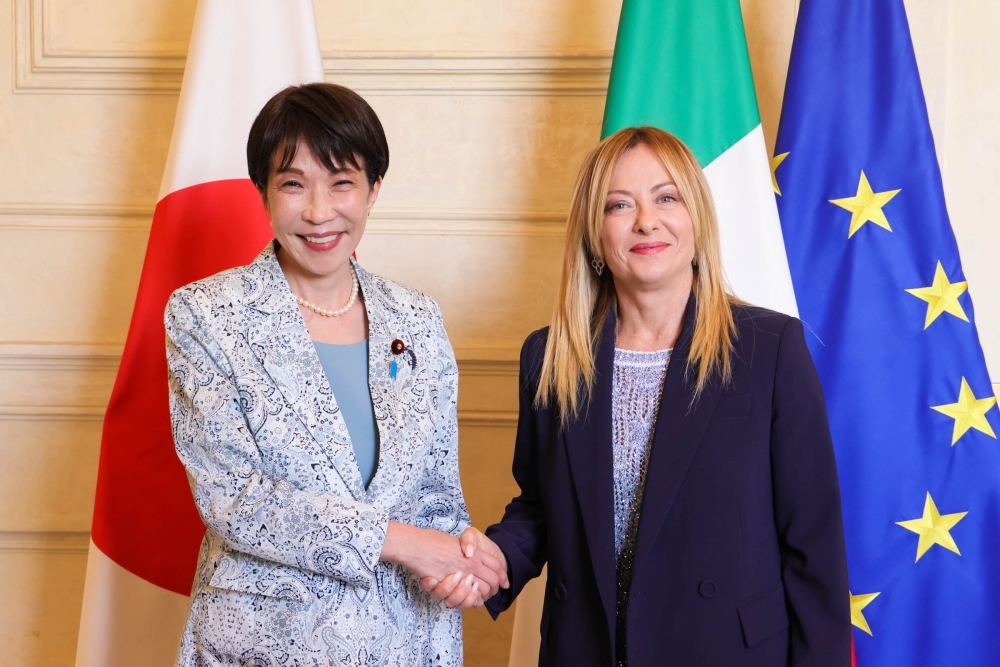
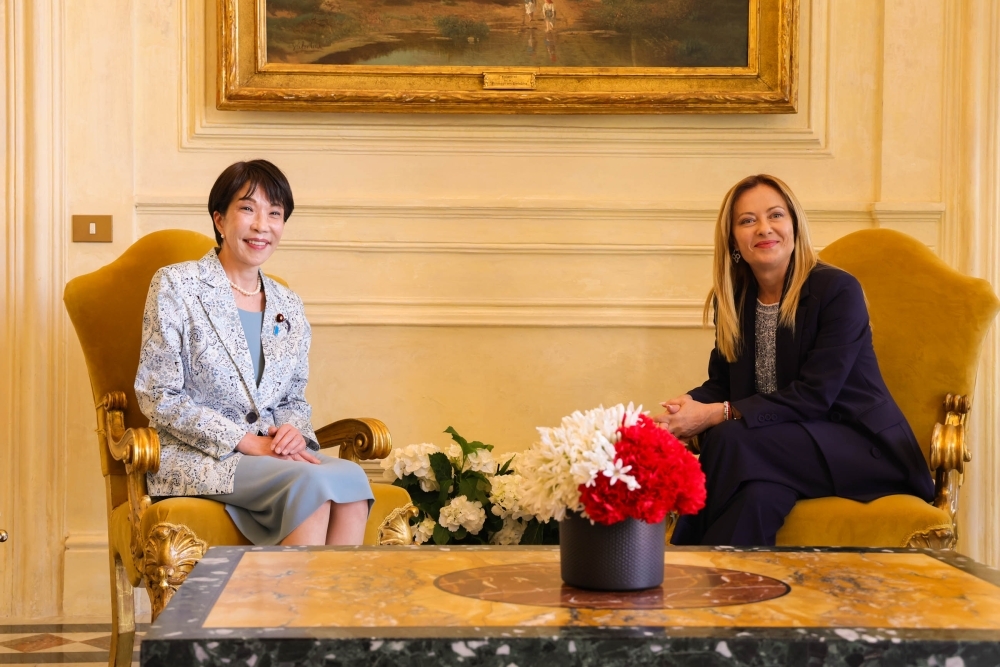
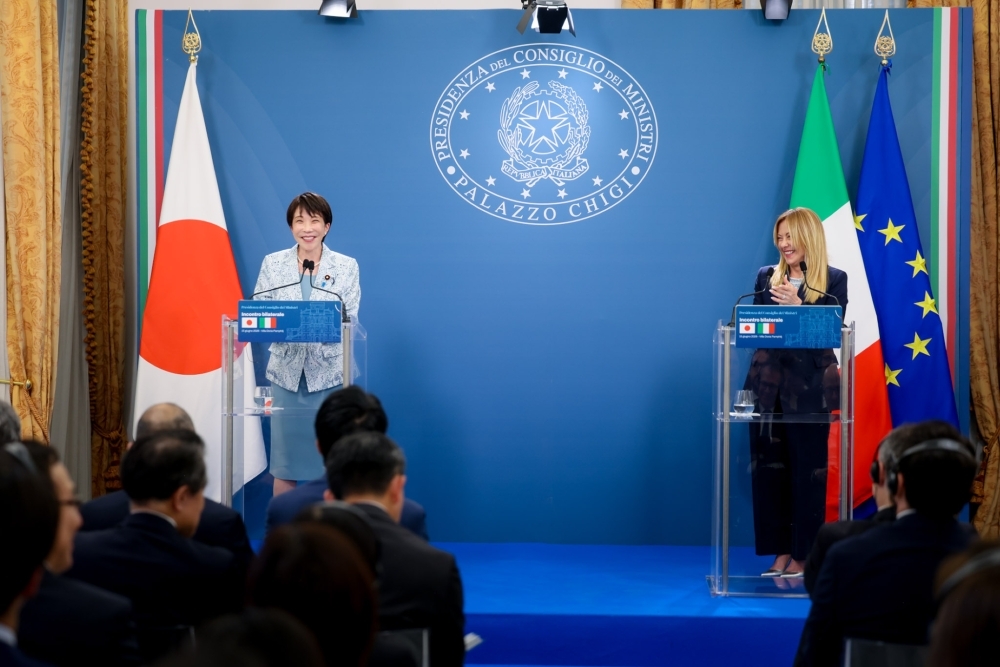
On June 15, commencing at 11:26 a.m. local time (18:26 p.m. Japan time) for approximately 2 hours and 35 minutes, Ms. TAKAICHI Sanae, Prime Minister of Japan, who is visiting Rome, Italy, held a summit meeting with H.E. Ms. Giorgia MELONI, President of the Council of Ministers of Italy, followed by a working lunch. The beginning part of the summit meeting was held as a small group meeting for approximately 35 minutes.
Following the meeting, the two leaders issued the “Japan-Italy Joint Statement on Space Cooperation.” In addition, various cooperation documents were signed and exchanged between relevant ministries, institutions and companies of the two countries.
1. Opening Remarks
- Prime Minister Meloni welcomed Prime Minister TAKAICHI 's visit to Italy and stated that, in order to further deepen bilateral relations, which had been elevated to a “Special Strategic Partnership” in January this year, she wished to work even more closely with Prime Minister TAKAICHI to strengthen cooperation across a wide range of fields.
- In response, Prime Minister TAKAICHI expressed her gratitude for Prime Minister Meloni's invitation to visit Italy and stated that, amid an increasingly severe international environment, it was important to work closely with like-minded countries such as Italy. She further noted her intention to elevate Japan-Italy relations to even greater heights under the “Special Strategic Partnership” by further expanding cooperation in such areas as security and defense, as well as economic security, including supply chain resilience.
2. Bilateral Relations
- With respect to economic security, the two leaders exchanged views on economic coercion, export restrictions on critical minerals and other materials that have a negative impact on global supply chains, and how Japan, Italy, and like-minded countries could coordinate their responses. The two leaders welcomed the first Japan-Italy Economic Security Dialogue held in Tokyo in May this year, following the summit meeting in January and also welcomed the signing of a Memorandum of Cooperation between the two governments on strengthening supply chain resilience, including in the fields of semiconductors, critical minerals, and high technologies, as well as a Memorandum of Understanding between relevant institutions on enhancing cooperation in the semiconductor sector. The two leaders confirmed that they would further promote concrete bilateral cooperation in the field of economic security based on those efforts.
- The two leaders shared the recognition that energy security is an urgent global challenge facing the world. Prime Minister TAKAICHI highlighted Japan’s efforts to advance cooperation through "POWERR Asia", a framework for strengthening energy resilience in Asia launched in April this year. The two leaders discussed actions that the G7 should take to enhance energy resilience. In addition, Prime Minister TAKAICHI also stated that she would like to further promote cooperation with Italy in the energy sector, including cooperation on LNG supply arrangements.
- The two leaders confirmed the importance of cooperating with like-minded countries, including the G7, with regard to critical minerals, to diversify supply sources in areas such as mining, refining, recycling, and stockpiling.
- The two leaders concurred on accelerating the joint development of the next-generation fighter aircraft, under the Global Combat Air Programme (GCAP). Prime Minister TAKAICHI welcomed Italy’s continued engagement in the Indo-Pacific and the planned port call of an Italian naval vessel to Japan in September this year.
- The two leaders welcomed the expansion of trade and investment between Japan and Italy and expressed their expectation that the Strait of Messina Bridge Construction Project, in which a Japanese company is participating, would become a major project symbolizing economic cooperation between the two countries.
- The two leaders welcomed the first round of the Japan-Italy Space Consultations —which they concurred on holding this January— which was convened in Tokyo in May, as well as the issuance of the “Japan-Italy Joint Statement on Space Collaboration”. They also welcomed the announcement of cooperation documents exchanged between space start-up companies based in the two countries.
- The two leaders exchanged views on science and technology, covering what a 'trustworthy AI' ecosystem should be like and AI’s impact on society. Recognizing that responses to disasters such as volcanic eruptions and earthquakes are common challenges for both countries, they exchanged ideas on expanding cooperation in this field.
3. Regional and International Affairs
- With regard to the situation in Iran, the two leaders welcomed the agreement on a memorandum of understanding between the United States and Iran, confirmed the importance of ensuring the free and safe navigation through the Strait of Hormuz, and concurred to closely cooperate to ensure the speedy and steady implementation of this agreement, aiming for peace and stability across the Middle East.
- The two leaders exchanged views on the situation in the Indo-Pacific, including issues related to China and their policies toward North Korea, including on the nuclear and missile issues as well as the abductions issue. They concurred on the importance of the two countries working closely together for peace and stability in the region under the updated Free and Open Indo-Pacific (FOIP).
- With regard to the situation in Ukraine, the two leaders confirmed that they would continue to work closely together towards the realization of a just and lasting peace in Ukraine.
