|
 |

-
 Annual
Celebrations: Fire Festivals and Lucky
Ceremonies
Annual
Celebrations: Fire Festivals and Lucky
CeremoniesNenchu gyoji, or annual celebrations, are held throughout the year. Setsubun is a ceremony held on February 3 or 4, the eve of spring, when beans are scattered at homes or shrines to drive away evil as people yell, "Out with demons! In with happiness!" Shichigosan is held every November 15: Five-year-old boys and three- and seven-year-old girls dress up in their best suits or kimonos to visit a Shinto shrine, where prayers are offered for their safe growth. Tsukimi, or "moon viewing," takes place on those autumn evenings when the full moon floats in the clear sky for people to appreciate. Traditionally this was a time of thanksgiving , parties, and prayers for bountiful harvests.
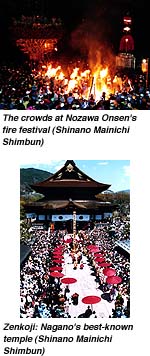
In many nenchu gyoji, fires are lit and shrines worshipped. Nozawa Onsen Village, where the biathlon events will be held, has an exciting fire festival, which is counted among Japan's biggest three. Every year on the evening of January 15, a struggle unfolds around a 15-meter (50-foot) shrine made from beech logs and leaves and cedar needles. The shrine is built by men aged 25 or 42, considered unlucky ages for men in Japan. The struggle develops as one of these men tries to set fire to the shrine and another tries to stop him. Toward the end of the festival, the two end their struggle and set fire to the shrine together. As the shrine goes up in smoke, prayers are said to purify the people and prepare them for the new year.
The Gokaicho festival, held at the temple of Zenkoji in Nagano City, is one of the most famous Buddhist celebrations in Japan. This temple is visited by many who believe that worship here promises a next life in paradise. To this day, millions of people go to Zenkoji every year. The temple's inner hall is the third largest wooden structure in the world. Once every seven years, a reproduction of the temple's main Buddha statue is installed in the main hall for two months. It is said that touching this image of Buddha will yield good fortune, so people from all over Japan come to take part in this event. Every day during the two months of this festival, the road leading up to the temple is lined with worshippers waiting for the head of the temple to bless them with Buddhist rosary beads.